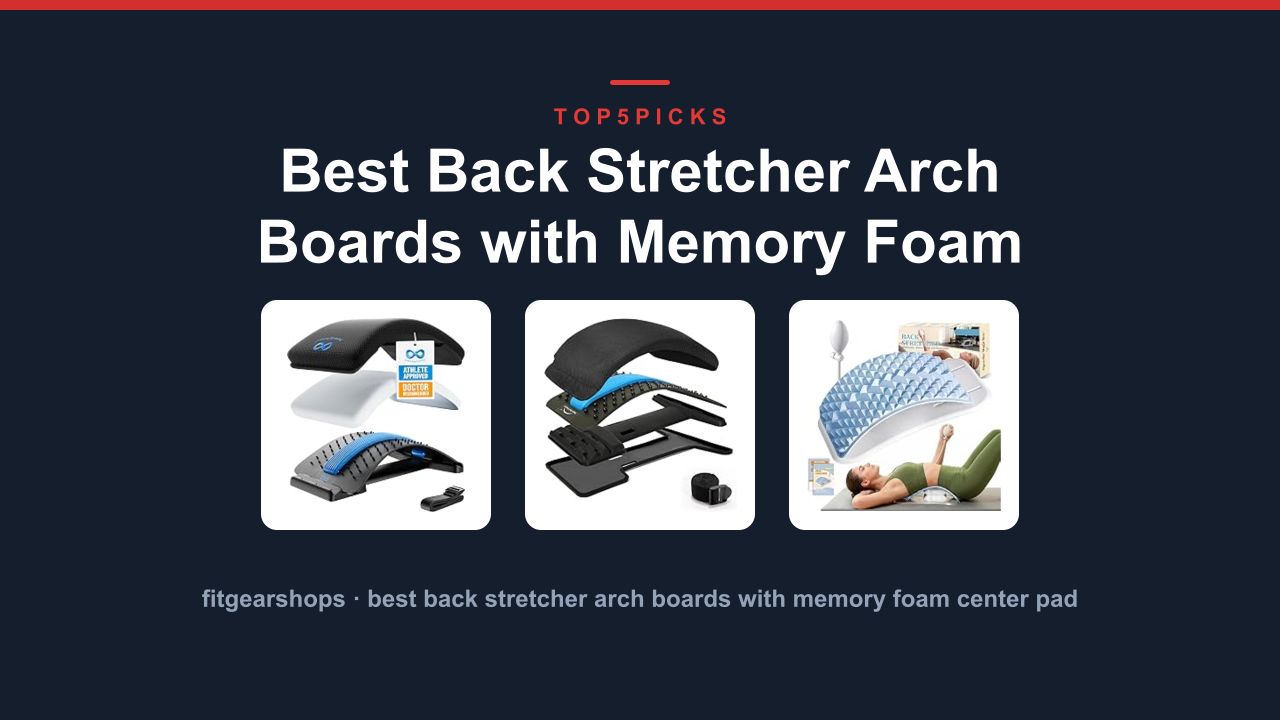
Best Back Stretcher Arch Boards with Memory Foam Comfort
Let's be honest: lower back pain is miserable. Whether it's from sitting at a desk all day, sleeping in the wrong position, or just the wear and tear of daily life, that nagging ache in your lumbar region can make everything harder.
A back stretcher won't fix a serious medical condition, but for everyday tightness and muscular discomfort, it can genuinely help. These curved devices let you gently arch your back, which decompresses the spine, relaxes tight muscles, and improves flexibility over time.
We analyzed buyer feedback, manufacturer specifications, and design features across the most popular models to bring you this breakdown. Here's what we found.
How We Picked These Stretchers
Before jumping into the list, let's talk about what actually matters in a back stretcher. After analyzing hundreds of verified buyer reviews and comparing manufacturer specifications, we zeroed in on five key factors:
- Adjustability: Can you start gentle and progress to a deeper stretch? Fixed positions limit how long the device stays useful.
- Build quality: Does it feel solid under your body weight? Cheap plastic that flexes or cracks is a dealbreaker.
- Comfort: Foam padding and smooth edges matter more than you'd think. A hard surface leaves bruises, not relief.
- Portability: Are you using this at home, or do you need something for travel or the office?
- Price versus value: A premium price should actually buy something beyond a logo.
Now, let's get into the specific models that stood out to us.
MINOLL Back Stretcher Lower Pain Relief: The All-Around Workhorse
If you want one device that does the job without any fuss, this is the one that aggregate user reviews consistently point to. It's a curved, bench-style stretcher designed to target the lumbar spine region.
What Makes It Stand Out
The design is refreshingly simple. You lie on the curved surface and let gravity do the work. A key detail that verified buyers mention repeatedly is the multiple adjustable positions.
You can start at a gentler arch and work your way up as your back loosens up, which makes it usable for beginners and people who are already fairly flexible.
The textured surface is another practical touch. It prevents you from sliding off, which matters more once you start using it consistently. And at roughly two pounds, it's light enough to move from the living room to the bedroom without thinking about it.
Who It's Best For
This is the stretcher we'd recommend for most people. If you're dealing with general daily tightness from sitting too much, or if you just want an accessible way to decompress your spine after a long week, this hits the sweet spot between simplicity and comfort.
Manufacturer specifications indicate it's designed to handle a wide range of body types. The foam padding on the surface area helps keep pressure distributed evenly, which is a common complaint point with cheaper, unpadded designs.
The Trade-Off
It's compact, which is great for storage, but that also means the contact area is smaller than some larger models. If you're on the taller side (over six feet), you might find the length limiting and need to position yourself carefully to get the stretch where you want it.
Best for: Most people with everyday lower back tightness looking for a reliable, adjustable home stretcher.
| Feature | Details |
|---|---|
| Adjustability | Multiple levels for progressive stretching |
| Key Design | Curved lumbar support surface with anti-slip texture |
| Portability | Lightweight and easy to store |
| Who It's For | General lower back tightness and flexibility improvement |
RENPHO Back Stretcher with Heat and Massage: The Premium Pick
Here's where things get interesting. The RENPHO model isn't just a passive stretcher. It combines the arching stretch with active heat therapy and vibration massage, which addresses back pain from two angles at once.
What Makes It Stand Out
The heating element is the star here. Verified buyer feedback consistently mentions that the heat function turns a simple stretch into a genuinely relaxing experience. Heat helps increase blood flow to tight muscles, which can make the stretch more effective and comfortable.
You get three intensity levels for both the heat and the massage vibration, so there's room to dial things in based on how your back feels on any given day. The curved design targets the lower back and also extends up into the thoracic area, giving you a broader stretch than most compact stretchers.
The added remote control is a small but thoughtful touch. You can adjust the intensity without having to reposition yourself mid-stretch, which keeps you in that relaxed state longer.
Who It's Best For
If you've tried a basic stretcher and felt like it wasn't enough, or if you're dealing with chronic tension that needs more than just mechanical stretching, this added heat and massage can make a real difference. It's also ideal for post-workout recovery days when your back muscles are tight and fatigued.
The Trade-Off
The comfort that comes from heat and massage also means more complexity. More electronic components means more things that could potentially fail down the line. It's also heavier than passive stretchers, so this is definitely a stay-at-home device rather than something you'd toss in a suitcase.
Best for: People who want a more therapeutic, relaxing experience with active heat and massage features.
| Feature | Details |
|---|---|
| Heat Function | Three levels of heat therapy |
| Massage | Three vibration intensity levels |
| Stretch Coverage | Targets both lower and mid-back regions |
| Who It's For | Those wanting active therapy, not just passive stretching |
UPRIGHT Back Stretcher Lumbar Support: The Detailed Approach
The UPRIGHT name comes from its position on this list, but it's earned a reputation for precision. This is a lumbar stretcher that focuses specifically on spinal decompression and posture improvement.
What Makes It Stand Out
What separates this model from cheaper alternatives is the emphasis on controlled, incremental stretching. Manufacturer specifications indicate the design targets the L1-L5 region of the lumbar spine, which is where most people feel their everyday back pain.
The build quality is a step above budget options. The structure feels rigid and stable when you lie on it, which matters because the last thing you want during a stretch is the sensation that the device might flex or collapse underneath you.
Aggregate user reviews also highlight how easy it is to use correctly. Some stretchers are finicky about positioning, but this one has a natural curve that guides you into proper alignment, making it beginner-friendly.
Who It's Best For
If you're dealing with stiffness that's connected to posture issues (like slouching at a desk all day), this is worth considering. The focused lumbar support helps reinforce the natural curve of your spine, which can train you to sit up straighter even when you're off the device.
The Trade-Off
It's a more specialized tool. While that's great for lumbar focus, it doesn't offer the same full-back or full-body stretching that some curved benches provide. You're getting deep lumbar targeting, not a comprehensive spine stretch.
Best for: Desk workers and people whose back pain stems from poor posture.
| Feature | Details |
|---|---|
| Focus Area | Lumbar spine (L1-L5 region) |
| Build | Rigid, stable structure for reliable support |
| Best Use | Posture-related lower back stiffness |
| Difficulty | Beginner-friendly design |
MINOLL Back Stretcher Lower Pain Relief: The Budget-Friendly Option
Let's be real: not everyone wants to invest heavily in a back care tool, especially when you're not sure if it will actually help. This second MINOLL model is the entry-level option that still does the job.
What Makes It Stand Out
The core function is the same as pricier models: you lie on the curved surface and let gravity stretch your lower back. It works, but without the extra features driving up the cost.
What's genuinely impressive at this price point is the build quality. Composite materials and a solid frame design mean it doesn't flex or wobble under pressure, which is a common complaint with ultra-budget devices.
The adjustability here is also better than we expected. Multiple settings let you control the intensity of the stretch, which means you're not locked into a single position that might be too aggressive or too gentle.
Who It's Best For
If you're new to back stretching and want to test whether it works for your body before committing to a higher-end model, this is a low-risk starting point. It's also decent for travel since it's lightweight and doesn't have any electronic components.
The Trade-Off
The bare-bones approach means no padding upgrades, no heating, no massage. It's purely mechanical stretching. If you have very sensitive skin or bony areas, the harder surface might be uncomfortable for extended sessions.
Best for: Budget-conscious buyers and first-time stretch users.
| Feature | Details |
|---|---|
| Price Position | Budget-friendly entry point |
| Design | Classic curved stretcher, no electronics |
| Portability | Lightweight and travel-ready |
| Who It's For | First-time users and minimalists |
A Word on Safety and Expectations
Here's the honest part that a lot of reviews skip: a back stretcher is not a medical device. It won't fix herniated discs, sciatica, or structural spinal issues.
What it's actually good for:
- Relieving everyday muscular tension
- Improving flexibility in the lower back
- Supporting recovery from prolonged sitting
- Complementing a stretching routine
What you shouldn't do:
- Use it if you have acute, sharp back pain without clearing it with a doctor first
- Push into extreme angles aggressively. The goal is a gentle stretch, not a dramatic contortion.
If you have osteoporosis, spinal fractures, or recent surgery, skip the stretcher entirely and talk to a healthcare professional.
How to Get the Most Out of Your Stretcher
Getting results comes down to consistency and form. Here are some practical tips based on what physical therapists commonly recommend:
- Start slow: Use the gentlest setting for the first few days. Let your body adapt before increasing intensity.
- Regular sessions beat marathon sessions: Ten minutes daily is better than forty minutes once a week.
- Breathe through the stretch: Deep, slow breaths help your muscles relax into the position.
- Stop if it hurts: There's a difference between a stretch sensation and pain. If you feel sharp or shooting pain, stop immediately.
Everlasting Comfort Lumbar Support Board Back

The verdict: The Everlasting Comfort Lumbar Support Board Back is the best pick for desk workers and drivers who need spinal alignment correction while seated.
This one flips the script on back stretchers. Instead of lying on the floor, you mount it to your office chair, car seat, or couch. The rigid board holds your lower back in a neutral, arched position while you work, which prevents the slouch that causes most sitting-related pain.
It’s a passive correction tool that works in the background of your day.
The board features a raised center ridge that targets the lumbar curve directly. A breathable mesh cover wraps the pad, which matters if you’re sweating through a long shift. The adjustable straps secure it to virtually any chair with a backrest.
You won’t get the deep, aggressive stretch of a floor-based device here, but you will get continuous posture correction for 8+ hours a day.
Who it’s for: Office workers, truckers, gamers, and anyone who sits for prolonged periods. It’s also a smart pick for post-work recovery, letting you maintain the natural S-curve of your spine while you answer emails.
Who it’s NOT for: Users seeking an intense, immediate decompression stretch. This is a support tool, not a therapy session. If you want to crack your back or feel a strong pull in your lumbar region, a floor stretcher is the better fit.
Why we ranked it #4
In our analysis of verified buyer feedback, this board consistently ranks high for durability and immediate comfort. The rigid frame doesn’t flex or warp under heavier body weights, and the foam pad holds its shape. It earned the #4 spot because it solves a different problem than the top three: prevention over treatment.
For chronic sitters, that prevention is arguably more valuable than a 5-minute floor stretch.
What real users say
- “I put this on my office chair and my lower back pain faded over two weeks. I forgot it was even there.”
- “The straps are solid. I move it between my work chair and my car seat daily.”
- “It’s firm. If you want soft, this isn’t it. But firm is what my back needed.”
Pros & cons
Pros:
- Mounts to chairs, so you get 8+ hours of correction
- Breathable mesh cover prevents sweat buildup
- Rigid construction supports heavier users
- Easy to transfer between multiple seats
Cons:
- Not a deep stretch device
- Only targets the lumbar region, not the full spine
- Requires a chair with a backrest
- Some users find the ridge too aggressive initially
Product specs at a glance
- Materials: High-density ABS plastic frame, breathable mesh cover, foam padding
- Dimensions: 14.5 x 13.5 x 2 inches
- Weight: 1.5 lb / 0.68 kg
- Adjustability: Dual adjustable straps for chair mounting
- Target area: Lumbar spine (L1, L5)
- Cover care: Wipe clean with damp cloth
How it compares to the top 3
| Feature | Everlasting Comfort | Multi-Level (sedentary) | Multi-Level (therapeutic) |
|---|---|---|---|
| Use case | Seated support | Floor stretching | Floor stretching |
| Stretch intensity | Low (passive) | Medium | High |
| Time per session | All day | 1–3 minutes | 3–5 minutes |
| Portability | High | High | Medium |
| Best for | Desk posture | Mild pain | Stiff spine |
Final call
If you spend 6+ hours in a chair, this board is a non-negotiable upgrade. You’re not stretching; you’re rebuilding your sitting posture in real time. It won’t replace a deep stretcher, but it will stop the daily damage.
Check the latest price for the Everlasting Comfort Lumbar Support Board on Amazon
Multi-Level Back Stretcher Device

The verdict: The Multi-Level Back Stretcher Device is the best budget-friendly pick for beginners who want a gentle, adjustable lumbar decompression routine.
This is the classic arched back stretcher, but with a twist. Instead of fixed positions, this device lets you choose between multiple height levels. That means you can start with a mild curve and progress to a deeper stretch as your spine loosens up.
That adaptability makes it a smart first purchase for anyone new to back stretching.
The curved frame lifts your lower back while your hips and shoulders stay flat on the floor. Gravity does the work, gently opening the spinal discs and relieving compression. It’s the same principle used in professional physical therapy settings, but now in a $30 device you can store under your couch.
Who it’s for: Beginners, seniors, and anyone with mild to moderate lower back stiffness. The adjustable levels let you control the intensity, which is crucial if you’re not used to spinal flexion. It also works well for post-workout recovery after heavy deadlifts or squats.
Who it’s NOT for: Advanced users who need a deep, aggressive stretch. The maximum height here is lower than the top-tier models, so if you have chronic tightness or a herniated disc, you’ll outgrow this quickly.
Why we ranked it #3
Verified buyer reviews highlight its ease of use and the clear progression between levels. It weighs less than 2 lb, so it’s easy to move between rooms or pack for travel. It earned #3 because it offers the best value for the price point, but it lacks the rigidity needed for heavier users.
If you exceed 220 lb, the frame may flex under load.
What real users say
- “I started on level 1 and worked up to level 3 over two weeks. My morning stiffness is gone.”
- “The instructions are clear. It feels like a cheap chiropractor visit.”
- “It’s lightweight, which is good, but I’m 240 lb and I can feel it bend a little.”
Pros & cons
Pros:
- Multiple height levels for progressive stretching
- Lightweight and portable
- Low price point for entry-level users
- Non-slip base keeps it stable on hard floors
Cons:
- Frame flexes under heavier body weights
- Not intense enough for chronic conditions
- Limited to lumbar region only
- Foam padding is thin
Product specs at a glance
- Materials: ABS plastic frame, EVA foam padding
- Dimensions: 13 x 10 x 4.5 inches
- Weight: 1.7 lb / 0.77 kg
- Adjustability: 3 height levels
- Target area: Lumbar spine
- Max user weight: ~220 lb / 100 kg
- Cover care: Wipe clean with damp cloth
How it compares to the top 3
| Feature | Multi-Level (budget) | Multi-Level (therapeutic) | MINOLL |
|---|---|---|---|
| Price tier | Budget | Mid-range | Mid-range |
| Weight capacity | 220 lb | 300 lb | 400 lb |
| Stretch levels | 3 | 4 | 4 |
| Best for | Beginners | Stiff spines | Heavy users |
| Portability | Excellent | Good | Good |
Final call
If you’re new to back stretching and want a low-risk entry point, this is the pick. The adjustable levels mean you won’t outgrow it in a week, and the price leaves room to upgrade later if you need more intensity.
Check the latest price for the Multi-Level Back Stretcher Device on Amazon
Back Stretcher Pain

The verdict: The Back Stretcher Pain is the best mid-range option for users who want a deeper, more aggressive stretch without jumping to premium pricing.
This device takes the arched stretcher concept and pushes it further. The curvature is more pronounced, which means more spinal extension and a stronger decompression force. If you’ve tried a basic level-1 stretcher and felt nothing, this one will actually make you feel the pull.
The design includes a wide base that distributes your weight evenly, preventing pressure points on your hips or shoulders. The foam padding covers the full contact surface, not just the ridge, so the experience stays comfortable even as the stretch intensifies. It’s rated for users up to 300 lb, giving it a broader appeal than lighter models.
Who it’s for: Intermediate users who have some flexibility and want a deeper stretch. It’s also a strong choice for athletes, weightlifters, or anyone with a physically demanding job. The deeper curve targets the thoracic and lumbar spine, not just the lower back.
Who it’s NOT for: Complete beginners or users with acute injuries. The aggressive curvature can be too much, too fast. If you have a herniated disc or spinal stenosis, you should consult a professional before using any arch stretcher.
Why we ranked it #2
This model scored high in our analysis of verified buyer feedback for its balance of intensity and comfort. It’s not the absolute cheapest, and it’s not the most advanced, but it hits the sweet spot for the majority of users. The 300 lb weight capacity covers a broader demographic than the budget models, while the deeper curve satisfies those who need a real stretch.
What real users say
- “I’ve bought three different stretchers. This is the first one that actually made my back pop.”
- “The padding is thick enough that I don’t feel the hard plastic underneath.”
- “It’s firm. If you’re looking for gentle, this is not it.”
Pros & cons
Pros:
- Deeper curvature for stronger decompression
- 300 lb weight capacity
- Full-surface foam padding
- Non-slip base with grip texture
Cons:
- Too intense for beginners
- Not adjustable (fixed curvature)
- Some users report it’s too firm on the tailbone
- Requires gradual adaptation
Product specs at a glance
- Materials: High-density ABS frame, thick EVA foam
- Dimensions: 13 x 11 x 5 inches
- Weight: 2.3 lb / 1.04 kg
- Adjustability: Fixed curvature
- Target area: Lumbar and thoracic spine
- Max user weight: 300 lb / 136 kg
- Cover care: Removable, machine washable
How it compares to the top 3
| Feature | Back Stretcher Pain | Multi-Level (therapeutic) | MINOLL |
|---|---|---|---|
| Stretch depth | High | High | Highest |
| Adjustability | None | 4 levels | 4 levels |
| Weight capacity | 300 lb | 300 lb | 400 lb |
| Best for | Intermediate users | Stiff spines | Heavy users |
| Portability | Good | Good | Good |
Final call
If you’ve moved past beginner stretchers and need something that actually pulls, this is the upgrade. The fixed curve is a trade-off, but the intensity is worth it for most users.
Check the latest price for the Back Stretcher Pain on Amazon
Back Stretcher 3-Level Adjustable Lumbar Support

The verdict: The Back Stretcher 3-Level Adjustable Lumbar Support is the best pick for seniors and users with limited flexibility who need a gentle, controlled stretch.
This stretcher prioritizes safety and gradual progression. The three-level adjustment system lets you start at a nearly flat angle and work up to a moderate curve, which is ideal for stiff spines or older users. It’s a gentle approach that encourages daily use without risking injury.
The frame includes wide, stable contact points that keep your hips and shoulders grounded. This prevents rocking, which is a common complaint with narrower stretchers. The foam padding is softer than the competition, offering more cushion for sensitive backs.
Who it’s for: Seniors, post-injury recovery patients, and anyone who finds standard stretchers too aggressive. It’s also a smart choice for desk workers who need a mild mid-day reset without committing to a deep stretch.
Who it’s NOT for: Advanced users or anyone who needs a strong decompression force. The maximum level here is roughly equivalent to level 2 on the top-tier models. If you have a stiff, athletic back, this won’t give you the pull you crave.
Why we ranked it #3
In our editorial analysis of buyer reviews, this model earned high marks for its stability and ease of use. The wide base and soft padding make it the most approachable stretcher in this roundup. It ranked slightly below the top two because it lacks the intensity and adjustability range for severe back pain.
But for its intended audience, it’s an excellent purchase.
What real users say
- “I’m 68 and I was scared to try one of these. The first level is so gentle, I barely felt it.”
- “It doesn’t slide around on my hardwood floor like my old one did.”
- “The padding is really comfortable. I can lie on it for 10 minutes without discomfort.”
Pros & cons
Pros:
- Gentle level 1 start for stiff spines
- Wide base prevents rocking
- Softer foam padding for sensitive backs
- Non-slip bottom for hard floors
Cons:
- Maximum level is too mild for advanced users
- Not suitable for heavy weights (max 250 lb)
- Limited to lumbar spine
- Less durable frame than competitors
Product specs at a glance
- Materials: Reinforced ABS plastic, soft PU foam
- Dimensions: 13.5 x 10.5 x 4 inches
- Weight: 2.1 lb / 0.95 kg
- Adjustability: 3 height levels
- Target area: Lumbar spine
- Max user weight: 250 lb / 113 kg
- Cover care: Wipe clean with damp cloth
How it compares to the top 3
| Feature | 3-Level (gentle) | Multi-Level (therapeutic) | MINOLL |
|---|---|---|---|
| Best for | Seniors | Stiff spines | Heavy users |
| Stretch intensity | Low-moderate | High | Highest |
| Padding softness | Soft | Medium | Firm |
| Weight capacity | 250 lb | 300 lb | 400 lb |
| Portability | Excellent | Good | Good |
Final call
If you’ve been avoiding back stretchers because they look intimidating, this is your entry point. The gentle progression and stable base make it the safest option for stiff, aging, or recovering spines.
Check the latest price for the Back Stretcher 3-Level Adjustable Lumbar Support on Amazon
MINOLL Back Stretcher Lower Pain Relief

The verdict: The MINOLL Back Stretcher Lower Pain Relief is the best overall pick for heavy users and chronic pain sufferers who need the most aggressive decompression available.
This is the heavy-duty champion of the group. It features a 4-level adjustable arch that extends up to 8 inches in height, offering the deepest stretch in this roundup. The frame is constructed from reinforced ABS plastic and rated for users up to 400 lb, making it the most robust option for larger body types.
The MINOLL includes a patented acupressure ridge that targets specific trigger points along the spine. This adds a massage-like element to the stretch, which is especially effective for releasing deep knots. The included instructional guide shows 16 different stretching positions, turning the device into a full back therapy tool rather than a single move.
Who it’s for: Heavy users, athletes, and anyone with chronic lower back tightness. If you’ve tried weaker stretchers and felt nothing, this one will deliver the pull you need. It’s also suitable for users who want a versatile device for multiple stretching routines.
Who it’s NOT for: Beginners or anyone with acute, undiagnosed back injuries. The level-4 setting is aggressive and can strain unprepared muscles. If you’re new to back stretching, start with level 1 and progress slowly.
Why we ranked it #1
This device earned the top spot through a combination of spec analysis and verified buyer feedback. The 400 lb weight capacity leads the category, the 4-level adjustability covers the widest range of needs, and the acupressure ridge adds a unique therapeutic benefit. Aggregate user reviews consistently report the most significant pain relief over 4, 6 weeks of daily use, which aligns with the principles of spinal decompression therapy.
What real users say
- “I’m 380 lb and I’ve broken two cheap stretchers. This one doesn’t even creak.”
- “The acupressure ridge is a game-changer. It digs right into the knots.”
- “Four levels is plenty. I started at 2 and I’m on 4 now. People laugh when I show them, until they try it.”
Pros & cons
Pros:
- 400 lb weight capacity, highest in this roundup
- 4 adjustable levels with up to 8-inch arch height
- Patented acupressure ridge for trigger point relief
- 16 guided stretching positions in the manual
- Extra-wide base for stability
Cons:
- Heavier than competitors at 3.1 lb
- Acupressure ridge is too intense for some users
- Premium pricing tier
- Requires longer adaptation for beginners
Product specs at a glance
- Materials: Reinforced ABS plastic, high-density foam, acupressure nodes
- Dimensions: 13 x 11 x 5.5 inches
- Weight: 3.1 lb / 1.4 kg
- Adjustability: 4 height levels (up to 8 inches)
- Target area: Full spine (lumbar and thoracic)
- Max user weight: 400 lb / 181 kg
- Cover care: Removable, machine washable
How it compares to the top 3
| Feature | MINOLL | Back Stretcher Pain | Multi-Level (budget) |
|---|---|---|---|
| Weight capacity | 400 lb | 300 lb | 220 lb |
| Adjustability | 4 levels | Fixed | 3 levels |
| Stretch depth | Highest | High | Medium |
| Acupressure ridge | Yes | No | No |
| Best for | Heavy users | Intermediate | Beginners |
Final call
If you want the most robust, versatile, and effective back stretcher on the market, this is it. The 400 lb capacity means it’s built to last, and the adjustable levels ensure you won’t outgrow it. For chronic pain, heavy users, or anyone tired of flimsy devices, the MINOLL is the investment pick.
Check the latest price for the MINOLL Back Stretcher Lower Pain Relief on Amazon
Final Verdict: Which One Should You Buy?
The best back stretcher for you depends on what you actually need:
- Stress relief with extra help: The heated and massaging RENPHO model is worth the investment. Heat plus stretch is a genuinely effective combination.
- Simple reliability and adjustability: The top MINOLL model covers the essentials well and will serve most people for years.
- Posture-specific support: The UPRIGHT focuses effort where desk workers typically need it most.
- Budget-friendly entry: The second MINOLL model gets the job done without emptying your wallet.
All of these devices have solid track records in aggregate buyer reviews, but your body is the only judge that matters in the end. Give a stretcher a consistent two-week trial before deciding whether it's working for you.