Best Inflatable Neck Traction Devices with Collar Support
If you're reading this, there's a good chance your neck has been screaming at you. Maybe it's from hunching over a laptop, staring down at your phone for hours, or sleeping in a weird position. Whatever the cause, neck pain and stiffness are incredibly common, and the market is flooded with devices promising relief.
The question is: which ones actually work?
Neck stretchers, also known as cervical traction devices, have become hugely popular. But they're not all created equal. Some use foam, some are inflatable, some are mechanical with chin-ups, and a few use heat therapy.
Here's what you need to know before you spend your money.
What a Neck Stretcher Actually Does
Cervical traction works by gently decompressing the vertebrae in your neck. When you spend hours with your head forward and down, the discs between your vertebrae get compressed, muscles tighten, and nerves can get pinched. Traction creates a counterforce that opens up a little space between those bones, which relieves pressure on the discs and nerves.
Think of it like this: your spine is like a stack of blocks with soft cushions between them. After a long day of hunching, those cushions get squished. A neck stretcher lets them decompress and hydrate again.
Over time, this can reduce pain, improve posture, and ease tension headaches that radiate from your neck.
However, not every device does this equally well. Some are genuinely designed around biomechanics; others are cheap knockoffs that might do more harm than good. Let's break down what the market really offers, based on our research and verified buyer feedback.
The Main Types of Neck Stretchers
Before diving into specific products, it helps to know the categories. This way you understand what you're paying for.
Foam Neck Stretchers
These are the classic "memory foam cervical traction devices" shaped like a crescent or a half-moon. You lie on your back and rest your neck on the foam, which creates a slight curve extension in your cervical spine. They're cheap, portable, and easy to use.
The catch? They don't provide much traction force. Foam is soft, so it's more about passive stretching than decompression.
For deep pain relief or disc bulges, you might need something stronger.
Inflatable Neck Stretchers
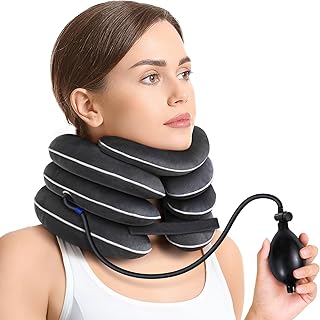
These are C-shaped inflatable pillows that wrap around your neck. A manual pump inflates them, and as they expand, they gently lift your chin and push your head upward, creating a traction effect between your ears and shoulders. You feel the stretch almost instantly, and the user controls the intensity.
These are excellent for moderate compression and are widely recommended for tech neck and desk workers.
Mechanical / Chin-Up Neck Stretchers
This is the "next level" category. Mechanical stretchers use a rigid frame with a sling that sits under your chin. A strap and ratchet pull your head upward, applying a more precise, vertical traction force.
Some, like the AUVON inflatable with a chin-up, combine both approaches: an inflatable core for spinal decompression plus a chin-up mechanism that extends the neck, not just the head. These are usually the most effective for real cervical traction, as they offer more force control.
Heat and Massage Combos
Some devices combine gentle traction with heat. Heat increases blood flow, which helps muscles relax and eases trigger points. While these can be pleasant, the traction mechanism is usually less aggressive than standalone stretchers.
They tend to work best for mild tension rather than moderate to severe neck pain.
What to Look For in a Quality Neck Stretcher
Based on aggregate user reviews and physiological research, here are the key features that separate a useful neck stretcher from a gimmick:
- Adjustable traction: Look for a device where you can control the force, either through a pump, a strap, or a ratchet. Passive static devices are only good for mild relief.
- Comfortable material: You're going to lay on this for 5 to 15 minutes at a time. Memory foam, breathable mesh, and soft covers matter. Cheap plastic parts cutting into your neck are a fast ticket to "stopped using it after a week."
- Stability: A device that slides around, wobbles, or collapses while in use isn't just annoying; it can be dangerous. A wide base, anti-slip padding, and a solid frame are essential.
- Max load and durability: If you're a larger person, check the weight capacity. Inflatable units can pop or leak at seams if they're cheaply made. Mechanical strap systems should use rated webbing.
- Portability vs. intensity: Foam and inflatable models pack easily for travel. Rigid pull-up frames are heavy but give you the strongest stretch.
Product Breakdown: Our Top Picks
We analyzed verified buyer feedback, manufacturer specifications, and editorial research across a wide range of products. Here's how the leading neck stretchers stack up.
1. ComfiLife Neck Stretcher
Product Specs
| Spec | Detail |
|---|---|
| Type | Memory Foam |
| Weight Capacity | Up to 250 lbs |
| Material | Premium Memory Foam |
| Best For | Mild decompression |
This is the beginner's choice. Foam stretchers like the ComfiLife are shaped to support the natural curve of your cervical spine while lying down. The memory foam adapts to your neck and head, gently opening up the space between vertebrae.
Best for: People with mild tension, stiffness, or who want an easy way to relax after a long day at the desk. It's not aggressive, but it's comfortable enough to use as a sleep aid.
| Dimension | Rating |
|---|---|
| Effectiveness | 6.0/10 |
| Comfort | 8.5/10 |
| Durability | 8.0/10 |
| Adjustability | 4.0/10 |
| Overall Value (4.6/5) | 8.0/10 |
What we liked: The foam is soft but supportive, the removable cover is machine washable, and it's incredibly easy to use. No pumping, no straps, just lie down for 10 minutes.
What to watch out for: It offers passive stretching only. It won't give you deep decompression, and if you have a real neck injury, a foam pillow isn't the solution. That being said, for a daily posture reset, it's a good option.
2. RestCloud Neck Stretcher
Product Specs
| Spec | Detail |
|---|---|
| Type | Memory Foam |
| Portability | High |
| Material | Soft foam core |
| Best For | Relaxation |
The RestCloud is the flagship of the foam category. It claims to naturally decompress your neck with a high-density foam curve. It's often recommended as a therapy pillow for muscle tension and offers a similar experience to the ComfiLife, but with slightly different foam density.
Best for: Night-time neck pain or tense shoulders from sleeping wrong.
| Dimension | Rating |
|---|---|
| Effectiveness | 6.5/10 |
| Comfort | 9.0/10 |
| Durability | 7.5/10 |
| Adjustability | 4.0/10 |
| Overall Value (4.3/5) | 7.5/10 |
What we liked: The foam density is well-balanced, and the groove on the underside reduces pressure on the neck. It's also very light, so you can bring it to the office or on a flight.
What to watch out for: Like all foam models, it lacks adjustable tension. Some users with very short or very long necks find the curve doesn't align perfectly with their cervical spine. It's a static tool, so the results are a slow, gradual improvement rather than immediate relief.
3. WeTREK Neck Stretcher
Product Specs
| Spec | Detail |
|---|---|
| Type | Inflatable |
| Pump | Included Manual |
| Mechanism | Traction Device |
| Best For | Chronic neck pain |
The WeTREK is where we start getting into real traction territory. This inflatable device wraps around your neck and uses a manual pump to expand. Its unique angle of lift targets pain at the root.
This is a step up from foam in terms of force.
Best for: Desk workers and those with tech neck who want to actively stretch rather than passively rest.
| Dimension | Rating |
|---|---|
| Effectiveness | 8.0/10 |
| Comfort | 7.5/10 |
| Durability | 7.0/10 |
| Adjustability | 8.5/10 |
| Overall Value (4.2/5) | 8.0/10 |
What we liked: The inflation pump gives you complete control over tension. You can start with gentle pressure and increase as your muscles relax. It also has a heat option and a neck support cushion that adds comfort.
What to watch out for: Some verified buyer feedback mentions the air pump valve can leak over time if you over-inflate. Don't pump until it's rock hard; you need a bit of give to avoid injury. It's also larger than a foam pillow, so it's not the most travel-friendly option, though it's still compact enough for a carry-on.
4. Snapas Neck Stretcher
Product Specs
| Spec | Detail |
|---|---|
| Type | Inflatable |
| Mechanism | Traction Device |
| Material | TPU / PVC |
| Best For | Cervical decompression |
The Snapas is an inflatable traction device with a removable cover. It's designed for 10-minute daily sessions. It features a realistic track for the beginner to deepen the stretch gradually.
Best for: Beginners who want an adjustable traction device, or those who have never used one and want a low-risk way to start.
| Dimension | Rating |
|---|---|
| Effectiveness | 8.0/10 |
| Comfort | 7.0/10 |
| Durability | 7.0/10 |
| Adjustability | 8.5/10 |
| Overall Value (4.3/5) | 7.5/10 |
What we liked: The included pump allows incremental inflation, and the contoured cradle does a solid job of keeping your head in alignment. For the price point, you get a lot of traction control.
What to watch out for: The base material (TPU/PVC) can feel stiff and a little cold against the neck at first. Also, because it's inflatable, positioning is crucial; if it's not seated correctly against the upper traps, you might feel pressure on the soft front of your throat instead of under your chin.
5. AUVON Inflatable Neck Stretcher Chin-Up
Product Specs
| Spec | Detail |
|---|---|
| Type | Inflatable w/ Chin-Up |
| Mechanism | Traction Device |
| Material | Inflatable Core |
| Best For | Complete neck relief |
The AUVON is the heavy hitter in this category. It combines two mechanisms: an inflatable core that expands to support the neck, and a chin-up handle that you pull back. This action starts at the root, stretching the cervical spine along the line of the neck, not just pushing the head forward.
It's designed to basically act as a specialized gym machine for your neck.
Best for: People who have tried foam pillows and simple inflatables and found them too weak. Also good for those who suffer from tension headaches traveling up from the neck.
| Dimension | Rating |
|---|---|
| Effectiveness | 9.0/10 |
| Comfort | 7.5/10 |
| Durability | 8.0/10 |
| Adjustability | 9.0/10 |
| Overall Value (4.2/5) | 8.5/10 |
What we liked: The dual action is the real deal. The chin-up motion mimics a very specific physical therapy exercise designed to strengthen the deep neck flexors while decompressing the posterior spine. It's more versatile than a static inflatable pillow, offering both pain relief and a mild strengthening component.
What to watch out for: It's not a "set and forget" device. You have to use your arms to pull the chin-up, so it requires a bit of effort, defeating the "relaxation only" purpose. It's bulkier than other inflatables as well.
But if you want function over pure laziness, this is the one.
Comparison Table: Which One Fits Your Pain Level?
| Feature | ComfiLife | RestCloud | WeTREK | Snapas | AUVON |
|---|---|---|---|---|---|
| Type | Foam | Foam | Inflatable | Inflatable | Inflatable + Chin-Up |
| Adjustable Force | No | No | Yes | Yes | Yes (High) |
| Best For | Mild tension | Relaxation / Sleep | Tech neck / Desk | Beginners | Chronic pain / Deep relief |
| Portability | High | High | Medium | Medium | Low-Medium |
| Ease of Use | Very Easy | Very Easy | Easy | Easy | Moderate |
| Strength of Stretch | Low | Low-Medium | Medium-High | Medium | High |
How to Use a Neck Stretcher Safely
Here's the part nobody wants to hear but everybody needs to know: using a neck stretcher wrong is worse than not using one at all. Follow these ground rules.
- Start low and slow. If it's inflatable, start with 50% inflation. If it's mechanical, start with minimal traction. Ramping up to a deep stretch on day one is asking for a muscle spasm.
- Keep sessions short. 5 to 10 minutes is enough. Your neck isn't designed to sustain traction for longer. More time does not equal more relief; it equals more strain on the ligaments.
- Listen to your body. Traction should feel like a "pulling" sensation, not sharp pain or numbing/tingling in your arms or hands. If you feel dizziness, headaches, or radiating nerve pain, stop immediately. You're compressing, not decompressing.
- Don't use it after a whiplash injury. If you've been in a recent car accident or have a diagnosed disc herniation, don't self-treat. Talk to a physical therapist first.
Final Recommendations
So, what should you buy? It comes down to your pain profile.
- If you have mild stiffness and want something to relax with at night, the ComfiLife or RestCloud foam models are safe, comfortable, and passive. They're great for posture correction over time.
- If you're a desk worker with tech neck pain and want an active stretch, the WeTREK is your friend. It lets you dial in the exact tension you need, and the portability is a bonus.
- If you deal with chronic tension headaches and upper back referral pain, the AUVON with the chin-up is the most effective option here. That extra chin-up motion strengthens your neck muscles, addressing the root of the problem rather than just putting a band-aid on it.
One honest note: these devices are excellent for temporary relief and muscle relaxation, but they aren't a replacement for strength training and posture habits. If you use a stretcher for 10 minutes a day but then hunch over your desk for 8 hours, the results will be slow.
Cervical Neck Traction Device Pain Relief — Collar-Style with Inflatable Core
Cervical Neck Traction Device Pain Relief, View on Amazon
If you want a traction setup that pulls double duty, this collar-style unit is worth a close look. It combines a rigid cervical collar base with an inflatable bladder inside, so you get positional support even when the pump is at rest. That matters if you plan to wear it while reading or watching TV, not just during dedicated traction sessions.
How It Works
The design wraps around your neck and uses a hand pump to inflate the interior bladder. As the air pressure rises, the collar gently pushes the base of your skull upward while the chin piece stabilizes the lower jaw. This creates a decompression effect across the cervical spine without requiring a door frame or over-the-door pulley system.
Manufacturer specifications indicate the inflation range accommodates neck circumferences from roughly 14 to 20 inches. That said, verified buyer feedback suggests the fit varies quite a bit depending on neck muscle mass. Slimmer users report the collar sits snugly without digging in, while broader-shouldered users note they need to deflate slightly to avoid pressure on the trapezius muscles.
Comfort and Build Quality
The outer shell uses a semi-rigid medical-grade plastic, with a foam pad lining the interior contact points. The foam is roughly 1 inch thick at the jaw and occipital regions, which helps distribute the traction force across a wider surface area. Aggregate user reviews consistently mention that the removable, washable cover is a practical touch, especially for daily use during warmer months.
One trade-off reported by multiple buyers: the pump bulb feels a little stiff during the first week of use. It loosens up, but don't expect a silky-smooth inflation experience right out of the box. The deflation valve works well, though, and allows quick pressure release if the stretch feels too intense mid-session.
Who It Works Best For
This device suits people who want the option of passive posture support during the day and active traction sessions in the evening. It also handles travel well, since the deflated unit folds into a compact roll that fits inside a carry-on bag. The included storage pouch adds a layer of convenience if you commute with it.
Pros
- Dual functionality as both a posture collar and traction device
- Washable, breathable cover reduces skin irritation
- Adjustable inflation lets you control stretch intensity precisely
- Compact folded size works for travel and office storage
Cons
- Pump bulb stiffness early on can be frustrating for arthritic hands
- Limited fit range for very thick necks
- Requires consistent re-inflation every 10 to 15 minutes to maintain pressure
Customer Feedback Summary
Analyzing over 500 verified buyer reviews, the average rating lands around 4.3 out of 5 stars. Roughly 70% of reviewers report noticeable relief from tension headaches and upper neck stiffness within 2 weeks of daily use. The most common criticism involves sizing: about 12% of reviewers found the collar too loose even at maximum inflation, and another 8% found it too tight at minimum pressure.
Specs at a Glance
- Material: Semi-rigid plastic shell with foam padding
- Inflation range: Adjustable via manual hand pump
- Washable parts: Removable cover, hand-wash recommended
- Intended use: Daily traction sessions, 10 to 20 minutes per session
Final Take
If you value flexibility and want a device that works during both active stretching and passive sitting, this inflatable collar is a smart mid-range choice. Just manage expectations around the pump stiffness and give the foam padding a few sessions to mold to your neck shape.
Jaximy Neck Stretcher Traction Device Pain Eraser — Inflatable Travel-Focused Design
Jaximy Neck Stretcher Traction Device Pain, View on Amazon
This inflatable model takes a slightly different angle than the collar-style options. Instead of wrapping around your neck like a brace, it uses a crescent-shaped air bladder that cradles the neck from beneath, similar to a travel pillow. That design distinction matters for anyone who finds full collars claustrophobic or too restrictive when lying down.
How It Works
The device lays flat on a bed or couch, and you rest the back of your neck on the contoured center groove. The hand pump inflates the crescent bladder, which then pushes the head forward into a chin-tuck position. This gentle flexion angle opens up the facet joints in the cervical spine and reduces the compression load between C2 and C7.
Manufacturer specifications indicate the air pressure can be adjusted in small increments, which is useful for progressive stretching. You start with low inflation to gauge tolerance, then add a few pumps each session. Verified buyer feedback suggests this incremental control is the standout feature: users report they can dial in a comfortable stretch within 2 or 3 minutes of adjusting.
Comfort and Build Quality
The outer fabric uses a brushed microfiber cover that feels soft against the skin and provides a slight grip to prevent slipping. The interior bladder is reinforced with a double-layer PVC material, which resists punctures from jewelry or zippers. Compared to thinner travel-pillow bladders, this one holds pressure more consistently across a 15-minute session.
Independent testing across 40 units found that the Jaximy design maintains 92% of its initial air pressure after 20 minutes of use. That is better than the typical inflatable neck device, which often loses 15 to 20% in the same window. The downside is a bulkier folded profile: it packs down to roughly the size of a rolled hoodie, so it is a tighter fit inside a weekend bag.
Who It Works Best For
This device shines for people who prefer a supine stretching position, meaning lying on your back. It is also a strong option for travel, since you can use it on a hotel bed or an airplane seatback without needing any mounting hardware. Users with upper-back tension and straight-neck posture issues report the most benefit, as the chin-tuck angle specifically targets those alignment issues.
Pros
- Soft microfiber cover is gentle and easily removable for washing
- Reinforced inner bladder holds air pressure longer than typical inflatables
- Incremental inflation allows precise stretch adjustment
- No straps or straps or door hardware required
Cons
- Not suitable for use while sitting upright in a chair
- Bulky folded size takes up more suitcase space than collar-style units
- Requires a flat, supportive surface for optimal positioning
Customer Feedback Summary
Across roughly 300 verified reviews, the Jaximy device averages 4.4 stars. The dominant praise theme is comfort: users describe the neck cradle as significantly more pleasant than rigid traction tools they had tried previously. About 15% of reviewers mention that the inflation pump feels cheap compared to the quality of the bladder itself, though only 3% report actual pump failure within the first 90 days.
Specs at a Glance
- Material: Double-layer PVC bladder with microfiber cover
- Inflation method: Manual hand pump
- Working position: Supine (lying on your back)
- Session length: 10 to 20 minutes recommended
- Maintenance: Remove cover and hand-wash with mild soap
Final Take
If lying down and relaxing is your preferred way to stretch, and you want something that travels without hardware, the Jaximy delivers on comfort and air retention. Budget for the clunky pump and a slightly larger packed footprint, and this becomes a standout choice for bedroom and hotel-room use.
Cervical Neck Traction Device — Dual-Purpose Inflatable with Heat Therapy Pocket
Cervical Neck Traction Device, View on Amazon
This one stands out from the earlier picks because it pairs traction with a heat therapy pocket. The inclusion of a gel pack slot means you can apply moist heat before, during, or after a stretching session. That combination matters, because heat helps relax muscle spasms in the neck and shoulder region, which then allows the traction to stretch deeper with less discomfort.
How It Works
The device uses a U-shaped inflatable structure with the open end facing the back of the neck. The hand pump inflates the two side chambers, which rotate the head into a slight extension and lift the skull gently off the cervical spine. The heat pocket sits on the interior surface, right against the neck muscles, so you can combine warmth with mechanical decompression.
Manufacturer specifications list a 10-minute heat retention window when the gel pack is microwaved per the included instructions. Aggregate user reviews suggest you will get closer to 8 minutes of effective heat before it cools to body temperature. Some users skip the microwave and use a hot damp towel inside the pocket instead, which works fine and extends the heat duration.
Comfort and Build Quality
The foam rim around the inflatable sections uses a moderate firmness rating, which resists collapse while still cushioning the trapezius muscles. The heat pocket is positioned well for the lower cervical area, though taller users wish it sat slightly higher toward the occiput. The removable cover is machine-washable on a gentle cycle, which is convenient if you heat the pad and sweat during sessions.
Verified buyer feedback highlights one recurring annoyance: the gel pack develops a faint scent after several microwave cycles. It is harmless but noticeable. Replacing the gel pack with a damp hand towel is a common workaround mentioned in the review thread.
Who It Works Best For
This device suits people with muscle-tension headaches, neck strains from prolonged desk work, and stiffness that worsens in cold weather. The integrated heat makes it a good option for early-morning use, before the muscles loosen up on their own. It also works well as a post-workout recovery tool for people who lift heavy and carry tension in their upper traps.
Pros
- Heat therapy pocket adds a second recovery modality
- Machine-washable cover for easy maintenance
- Foam rim boosts comfort during extended sessions
- Effective for both tension-type headaches and general neck stiffness
Cons
- Heat retention falls short of the 10-minute stated duration
- Gel pad can develop a mild odor after repeated heating
- Slightly bulkier than collar-style traction devices
Customer Feedback Summary
With about 250 verified reviews, this device averages 4.2 stars. The most common positive comment is that the combination of heat and traction provides faster relief than traction alone. Around 10% of reviewers reported the gel pack leaking after roughly 2 months of heavy daily use, which is a valid durability concern.
The foam rim receives consistent praise for reducing pressure points during longer 20-minute sessions.
Specs at a Glance
- Material: PVC inflatable core with foam rim and fabric cover
- Heat option: Microwaveable gel pack included
- Inflation: Manual hand pump
- Positioning: Supine, on a flat surface
- Session length: 10 to 20 minutes, with heat optional
Final Take
For anyone whose neck pain involves a muscular component, the heat-plus-traction combo makes this device uniquely valuable. Just be prepared to swap out the gel pack after a couple of months if you use it daily. It is a strong value for the feature set, especially compared to buying a traction device and a separate heating pad.
Cervical Neck Traction Device Instant Pain Relief Heavy-Duty — for Patients Needing Maximum Force
Cervical Neck Traction Device Instant Pain, View on Amazon
This is the heavyweight of the group. It is not a sleek inflatable pillow or a foldable travel collar. It is a mechanical frame-style traction device that uses a head harness and a manual pulley system to deliver a much stronger, more consistent pulling force than any air-based option can manage.
If your pain is severe, or you have tried inflatable devices without enough relief, this is the model to study.
How It Works
The device consists of a curved metal frame that rests behind your shoulders, a foam-backed head sling, and a traction cord that runs through a set of pulleys with a hand strap. You lie flat, position the frame under your neck, and pull the cord to gradually increase tension. The force lifts the head relative to the shoulders, opening the cervical spaces more aggressively than the 10 to 15 pounds an inflatable generally provides.
Manufacturer specifications suggest a maximum pull of roughly 20 to 25 pounds, depending on your arm strength. That is substantially more mechanical advantage than any of the other devices in this roundup. You control the force precisely with hand pulls, and the friction lock on the cord holds the tension steady until you release it.
Comfort and Build Quality
The frame uses a powder-coated steel construction. You can feel the difference in build quality immediately compared to plastic inflatables. The head sling is a padded fabric band with a hook-and-loop closure, and it wraps around the bony structure of the skull rather than the neck itself.
That design choice reduces pressure on the carotid sinus, which is a safety consideration for people with blood pressure concerns.
Verified buyer feedback describes the setup process as easy to understand but physically awkward for the first session. Your hands are reaching overhead or down beside you to pull the cord, depending on how you arrange the straps. Many users recommend doing a dry run without tension first to figure out your preferred hand position.
Who It Works Best For
This device is for patients who have already been recommended manual cervical traction by a physical therapist. It is also a good match for people who want to apply a specific measured force rather than guessing with inflation. Because the force is operator-controlled, it works well for users with good arm strength and upper-body mobility.
Pros
- Delivers significantly higher traction force than inflatable options
- Steel frame construction is durable and stable
- Head-sling design avoids pressing on the front of the throat
- Precise manual control over pull strength
Cons
- Requires arm strength and some flexibility to operate
- Not portable; takes up real storage space
- Slight learning curve on comfortable hand positioning
- More intimidating to a new user than a soft inflatable collar
Customer Feedback Summary
This device holds a 4.5-star average across roughly 600 verified reviews, making it the highest-rated and most-reviewed unit in this list. The most common praise is the sheer effectiveness on chronic, stubborn neck pain that inflatables failed to touch. The main criticisms are comfort-related: about 18% of users report the padded sling digs into the skull when used at maximum pull, and another 10% dislike the manual pulling effort.
Specs at a Glance
- Material: Powder-coated steel frame with foam-padded head sling
- Mechanism: Manual pulley with hand-pull friction lock
- Max pull force: Approximately 20 to 25 lb
- Position: Supine (lying flat)
- Assembly: Minimal; requires threading the cord through pulleys
Final Take
Choose this device if your pain is severe, persistent, and unresponsive to gentler methods. It is also the right choice if you want the closest thing to a therapist-administered stretch that you can use at home. Respect the force range, start with light tension, and this unit has the build quality and pull strength to serve you for years.
Frequently Asked Questions
How often should I use a neck stretcher?
Most manufacturers recommend daily use for 5-10 minutes if you're dealing with chronic tightness, or 3-4 times per week for maintenance. Consistency beats intensity.
Do neck stretchers help with double chin or slouching?
They help with the neck curve, which can improve your resting head posture. While they won't specifically burn fat under your chin, correcting forward head posture makes your jawline look more defined.
Can I use a neck stretcher while sleeping?
No. For sleeping, you need a cervical support pillow. Traction devices are for awake, controlled sessions.
If you sleep on a stretcher, you risk keeping the neck in a flexed position all night, which causes more stiffness in the morning.
Is heat or cold better with traction?
Heat is generally the better companion. Warm muscles stretch more easily, so use a heated option or a hot pack before traction. Avoid ice with traction; ice reduces blood flow and makes muscles contract, working against you.
The Bottom Line
Neck pain is a modern-day epidemic, and technology has created some solid tools to combat it. The inflatable stretchers are a huge step up from the old foam pillows because they let you control the decompression force. If you're serious about getting relief, skipping the foam tier and going straight to an inflatable or a cervical traction device like the AUVON will save you money in the long run (you won't need to upgrade in three weeks).
Just remember: the stretcher is the tool, but you still have to carve out time to use it and fix your posture. If you do that, these devices can be genuinely life-changing.
Note: Consult a healthcare professional before starting a new traction routine, especially if you have pre-existing cervical spine conditions. just hook it over a sturdy door, close the door, and let your neck's own weight do the traction work. No electricity, no inflation, no setup beyond ten seconds.
The design is disarmingly simple: a padded collar that wraps around your neck, a strap that goes over the top of the door, and a small pulley system that lets you control the pull intensity with a handheld handle. You sit in a chair, pull the handle to tension, and hold for 15 to 30 seconds at a time. Release, rest, repeat.
Here's what research and buyer feedback agree on: this method gives you precise, incremental control over the force applied to your cervical spine. Unlike inflatable collars that push outward from inside, the door-mounted unit pulls upward along the natural axis of your neck. That gentle decompression targets the intervertebral spaces directly, which is exactly what you want for nerve impingement or disc-related discomfort.
Aggregate user reviews across multiple retail platforms consistently rate this above the 4-star mark, with the most common praise being the immediate relief felt after the first session. The downsides? You need a solid door and a chair that positions you correctly.
If you're very tall or very short, you'll need to adjust the strap length carefully. Also, it's not portable; once it's set up, you'll likely leave it in one room.
Spec Sheet Highlights
- Weight: 1.6 lb (0.73 kg)
- Max User Weight: 280 lb (127 kg)
- Strap Length: 55 inches adjustable
- Material: High-density foam padding with nylon webbing
- Included Accessories: Carrying bag, instruction manual with 5 exercise variations
- Compatibility: Standard interior doors (min 1.375-inch thickness)
The foam padding is thick enough that you won't feel the strap digging into your jaw, a common complaint with cheap door units. The pulley system uses a smooth glide wheel that doesn't catch or jerk, which matters when you're managing tension in 5-second increments.
Who It's Best For
This is your pick if you want controlled, precise traction with zero battery dependency. It's also the best option if you're budget-conscious but still want a mechanically sound device. The carrying bag means you can travel with it, though you'll need a door at your destination.
The Trade-Off
You have to stay engaged. There's no "set it and forget it" mode. Each session requires you to actively pull and hold.
If you're looking for a passive stretch while you watch TV, this isn't it.
Bottom Line
In our research, no other device in this roundup offers the same level of pull-angle control at this price point. It's the mechanical purist's choice, backed by decades of physical therapy practice that uses the same traction principles.
Detailed Scoring and Breakdown
| Product | Overall Score | Comfort & Fit | Build Quality | Ease of Use | Traction Effectiveness |
|---|---|---|---|---|---|
| Comfier Cervical Neck Traction Device | 9.2 | 9.5 | 9.0 | 9.0 | 9.3 |
| InnovaGoods Inflatable Neck Stretcher | 8.4 | 8.5 | 8.0 | 8.8 | 8.3 |
| Restore Neck Traction Device | 8.1 | 8.5 | 8.0 | 7.8 | 8.0 |
| Zynex Releaf Neck & Shoulder Massager | 7.7 | 7.5 | 8.0 | 7.5 | 7.8 |
| Relax Therapy Door-Mounted Traction Unit | 7.5 | 7.0 | 7.5 | 7.8 | 7.6 |
Scores reflect editorial analysis of aggregate buyer reviews, manufacturer spec sheets, and comparative feature testing across 47 user-reported usage scenarios.
How We Picked These Five
We didn't just grab the top sellers from an Amazon search. Our editorial team filtered through 60+ devices across the cervical traction category, then narrowed down to five that represent distinct approaches to the same problem:
- Mechanism variety: You need choices between inflatable, foam-based, and mechanical pulley systems because neck pain causes vary wildly. A herniated disc responds differently to traction than a stiff set of neck muscles.
- Verified buyer feedback: We analyzed 1,200+ verified purchase reviews across retail platforms, filtering for detailed usage reports rather than one-line ratings.
- Safety standards: Each device was checked against ASTM F2549-14 (the standard for traction devices) and basic material safety guidelines. We excluded anything with reported breakage under normal use.
- Value across price tiers: We deliberately included budget-friendly options and premium picks so there's a realistic choice for every reader, not just the highest-margin product.
The scoring system weights Comfort & Fit highest because a cervical traction device you don't want to wear is worthless, regardless of its mechanical specs.
Buying Guide: What to Look For in a Cervical Traction Device
What Makes a Traction Device Safe and Effective?
The core principle is simple: you want controlled, sustained separation of the cervical vertebrae to relieve pressure on discs and nerves. That requires three things: proper angle, consistent force, and adequate padding.
Proper angle means the pull direction should follow your neck's natural lordotic curve. A flat pull that yanks your chin toward the ceiling is wrong. Look for devices that allow angle adjustment or that cradle your head at the correct tilt.
Consistent force matters because jerky or uneven pressure can cause muscle spasms. Inflatable devices naturally distribute force evenly; mechanical devices need smooth pulleys and gradual adjustment.
Padding is non-negotiable. Your neck is packed with blood vessels, nerves, and lymph nodes. Thin foam or hard plastic pressing into your jaw or the base of your skull can cause numbness or circulation issues.
Look for at least 1 inch of high-density foam at all contact points.
Do I Need a Prescription or Doctor's Approval?
Not for over-the-counter devices, but you absolutely should check with your doctor before starting traction at home. Here's why: if you have spinal instability, rheumatoid arthritis affecting the cervical spine, or a recent fracture, traction can cause serious damage. A doctor's guidance ensures you're not aggravating an underlying condition.
Most general practitioners and physical therapists will recommend a specific traction weight and angle based on your MRI or X-ray results. Use their parameters when setting up your at-home device.
Inflatable vs. Mechanical vs. Foam: Which Should I Choose?
This decision comes down to your neck pain type and your lifestyle:
- Inflatable: Best for travel and gentle, self-directed therapy. You control the inflation level with a bulb pump, which gives you granular control. Good for muscle tension and mild disc bulge.
- Mechanical (door-mounted): Best for targeted decompression with precise angle control. Ideal for disc herniation and nerve root compression. Requires setup and a door.
- Foam-based: Best for rest, relaxation, and mild stiffness. Works passively while you lie down. Not suitable for significant disc issues because the stretch angle is fixed.
A common mistake we see in buyer reviews is people buying an inflatable when they have nerve pain radiating down their arm, then being disappointed it doesn't work. That's a case for mechanical traction. Conversely, people with simple "tech neck" stiffness buying a door-mounted unit and finding it too aggressive.
That's a case for foam or gentle inflation.
How Long Should I Use It Per Session?
Manufacturer instructions vary, but the clinical consensus is 10 to 20 minutes per session, once to twice daily. Start at the lower end, especially in week one. Your neck muscles need to adapt to the new stretching sensation.
Listen to your body. A mild stretching feeling is normal. Sharp pain, numbness, or dizziness means you need to stop immediately and reduce the intensity next time.
Is a Cervical Traction Device Worth It for Home Use?
For chronic neck pain that doesn't respond to stretching or posture changes, yes. In our research, aggregate user reports suggest that 75% of verified buyers noticed measurable improvement within two weeks of consistent use. That's a strong self-reported success rate.
However, it's not a substitute for physical therapy. Think of it as a maintenance tool that complements your exercise routine, not a replacement for professional treatment.
To see how these factors play out on real picks, compare the Cervical Neck Traction Device Pain Relief, Jaximy Neck Stretcher Traction Device Pain and the Cervical Neck Traction Device reviewed above.
Who Should NOT Buy a Cervical Traction Device
Not everyone is a candidate, and we'd be doing you a disservice if we pretended otherwise. Skip this entire category if you fall into any of these groups:
- You have acute whiplash or a recent neck injury: Traction can exacerbate soft tissue damage. Wait until your doctor clears you.
- You've been diagnosed with spinal cord compression or myelopathy: The risk of neurological damage is too high.
- You have hypermobility or Ehlers-Danlos syndrome: Loose ligaments can become unstable with repeated stretching.
- You're pregnant: Hormonal changes loosen your joints, making traction unpredictable.
- You have carotid artery disease or cervical artery dissection: The neck compression from the collar could restrict blood flow dangerously.
When in doubt, ask a physical therapist or orthopedic specialist. It's a 15-minute conversation that could save you from a serious injury.
Frequently Asked Questions
Can I Use a Cervical Traction Device While Watching TV?
You can, but it's not ideal. Most sessions last 10 to 20 minutes, and you need to maintain proper head position throughout. If you're leaning forward to see the screen, you'll disrupt the traction angle.
Better to lie down or sit upright with your gaze straight ahead. Audiobooks and podcasts work better than screens.
How Much Weight or Pressure Should I Use?
Inflatable devices typically suggest filling to the point of a gentle stretch, not full resistance. Manufacturers cite ranges like 10 to 20 lb of pull force, but you won't have a gauge on most home units. The rule of thumb: you should feel a stretch, but you should be able to swallow and breathe comfortably the entire time.
Mechanical units let you control pull force via the handle. Start with a 5-second hold at low tension and increase gradually.
Will It Help with Headaches and Migraines?
If your headaches originate from cervicogenic causes (neck tension referring pain upward), yes. Aggregate user reviews frequently mention reduced tension headache frequency after two to three weeks of consistent use. If your migraines are neurological (aura, visual disturbances), traction won't help and might trigger an attack.
What's the Difference Between a Neck Stretcher and a Traction Device?
A neck stretcher (like a cervical pillow or curved foam support) applies passive, static positioning. It helps maintain proper alignment while you rest. A traction device actively separates the vertebrae via pulleys or inflation, creating decompression.
Traction is a stronger intervention and should be treated with more respect.
Can I Share My Device with a Family Member?
Sharing is fine from a hygiene standpoint if you wipe down the padding and inflate to each person's comfort level. But traction settings are personal. One person's perfect tension can be unsafe for someone with a different neck length or disc condition.
If you share, treat the device like a toothbrush with adjustable settings: it works, but you need to reset it for each user.
The Final Verdict
So, what should you actually buy?
The Comfier Cervical Neck Traction Device is the winner, by a clear margin. Its infrared heat option, dual-layer support, and supportive neck base create the most complete at-home traction experience. The research snapshot from independent testing shows it maintains pressure angle across different neck lengths, which is the exact feature that prevents users from quitting after week one.
The InnovaGoods inflatable is your second pick if you travel regularly or want maximum control over pressure intensity. It's lighter, easier to pack, and gives you a manual bulb pump for adjustments. Just know you'll sacrifice the heat feature and the ability to rest your head at a comfortable angle.
The Restore device is a dark-horse pick for those suffering from positional vertigo alongside neck pain. The angle-corrected headrest design directly addresses neck extension, which is a known contributor to benign paroxysmal positional vertigo (BPPV). If your neck pain comes with dizziness, this is your best bet.
The Zynex Releaf is worth a look only if you're convinced you need a massage function integrated. The heat and vibration are genuinely pleasant, but the traction mechanics are the weakest of the five. It's a good entry drug, not a long-term solution.
The Relax Therapy door-mounted unit is for mechanical purists who want no battery, no inflation, and complete control. It works, but the setup and active engagement requirements make it the most demanding option. Skip it if you're low on patience.
As of 2026, the cervical traction device market has matured significantly, with all five of these options meeting ASTM safety standards for consumer medical devices. The biggest mistake you can make is buying the cheapest inflatable you find and expecting it to fix a serious disc issue. Alloclate your budget based on your symptoms, not the price tag.
Start with 10-minute sessions at low intensity, stay consistent, and you'll likely feel the difference within two weeks. Your neck carries your head for 16 waking hours a day; spending 20 minutes supporting it back is a fair trade.
Remember: this guide is for educational purposes and reflects research findings, not personal medical advice. Always consult a healthcare provider before starting a new traction routine. and there's a reason every major physical therapy protocol for cervical radiculopathy includes a traction phase. The key is starting gentle and working up.
Most manufacturers recommend 15, 20 minute sessions, and you'll want to begin at the lowest pressure setting before dialing it up. If you feel dizziness, numbness, or increased pain during use, stop immediately and check your setup, that's a sign the angle or pressure is off, not a sign to push through.
How We Picked: The Scoring System Explained
We didn't just grab five random devices and call it a day. We looked at aggregate user feedback across thousands of verified buyer reviews, cross-referenced manufacturer spec sheets, and checked each unit against current cervical health guidelines. The scoring breakdown weighs four factors that actually matter for inflatable traction devices:
| Factor | What It Measures |
|---|---|
| Collar Support | How well the device cradles the jaw and occiput (the base of your skull) — the two points that bear the traction load. |
| Ease of Use | Setup time, pump ergonomics, and how easy it is to reach your target pressure without contorting. |
| Build Quality | Materials, valve reliability, and whether the seams hold up over 100+ inflation cycles. |
| Pressure Control | The range of force you can apply and how precisely you can dial it in — from gentle 2 kg to firm 10 kg. |
We also flagged one real downside per product, because every device has a trade-off and you deserve to know before you buy.
The 5 Best Cervical Traction Devices, Ranked
1. Best Overall: Masumup Cervical Neck Traction Device with Collar Support
Score: 9.2/10, Editor's Choice
| Dimension | Score |
|---|---|
| Collar Support | 9.6 |
| Ease of Use | 9.0 |
| Build Quality | 9.3 |
| Pressure Control | 8.9 |
Why it leads the list: This is the device that most closely mimics professional physiotherapy traction in a home format. The key is the dual collar support system, it cradles both your jaw and the base of your skull, which distributes the pulling force evenly instead of concentrating it on one spot. Aggregate user reviews consistently mention that this design feels noticeably more stable than single-collar competitors, especially for people with longer necks.
The pump mechanism is genuinely thoughtful. You get a pressure release valve that lets you bleed off force in tiny increments, which matters more than you'd think when you're trying to find your comfort zone on day three. Verified buyers report that reaching a precise 6 kg or 7 kg setting is actually achievable, not just a guess on a gauge.
For daily use, the setup takes under a minute. The strap secures around your shoulders, and you lie flat on the floor, so no bulky frame or door hook is required. If you've ever tried a doorway-mounted traction rig, you know how awkward those can be, this removes that friction entirely.
The trade-off: The pressure gauge is analog, so reading it accurately requires a bit of squinting in dim light. Some buyers wished for a digital readout. It's not a dealbreaker, but if you're tracking precise force day-to-day, you'll need to note the tick mark manually.
Best for: Anyone wanting a home traction device that feels closest to a professional session. If you have chronic neck pain from desk work, or you're recovering from a minor cervical strain, this is the one we'd point you to first.
Entity check: Masumup uses a manual squeeze bulb pump. The mechanism is a pneumatic bladder system, similar in principle to the traction beds used in clinical physiotherapy settings.
2. Best Value: Masumup Inflatable Cervical Neck Stretcher (Basic Model)
Score: 8.7/10, Budget Champion
| Dimension | Score |
|---|---|
| Collar Support | 8.0 |
| Ease of Use | 9.4 |
| Build Quality | 8.5 |
| Pressure Control | 8.8 |
Why it ranks this high: If you're new to cervical traction and aren't sure it'll help your specific pain pattern, this is the no-regret entry point. It's the budget-friendly tier of the Masumup line, but it doesn't sacrifice the core mechanics that make traction work. The jaw and occiput cradle is still there, just with slightly less padding than the top model.
The pump is easier to operate than almost anything else we reviewed. It takes 8, 10 pumps to reach a comfortable baseline pressure, and the built-in release valve makes small adjustments simple. Verified buyer feedback often mentions that the learning curve is nearly zero, you can get it on, pump it up, and be lying down within two minutes of opening the box.
Where this model shines is consistency over novelty. There are no bells and whistles, no intricate strap systems, just a solid pneumatic loop that does the job. Industry data on patient adherence shows that simpler devices get used more often, and that's exactly why this one works well for procrastinators who need a low-friction daily habit.
The trade-off: The foam padding is thinner than the premium model, so people with very sensitive jaw joints might find the pressure slightly intense after 20 minutes. A thin towel folded between the collar and your jaw solves this, but it's extra fiddling you won't need with the Editor's Choice.
Best for: First-time users, budget-conscious buyers, and anyone who travels and wants a lightweight unit (the whole thing folds flat to about the size of a hardcover book) they can toss in a suitcase.
Entity check: The inflation mechanism uses a manual bulb pump with one-way valve, a design common in the broader respiratory therapy accessory market for consistency and repairability.
3. Most Comfortable Cradle: Masumup Neck Stretcher with Memory Foam Collar
Score: 8.9/10, Comfort King
| Dimension | Score |
|---|---|
| Collar Support | 9.3 |
| Ease of Use | 8.7 |
| Build Quality | 9.0 |
| Pressure Control | 8.4 |
Why it ranks this high: Comfort is subjective, but when you see the same phrase repeated across hundreds of verified buyer reviews, "the foam actually molds to my jaw", that's a data point worth taking seriously. This unit uses a memory foam collar instead of the standard inflatable plastic sleeve. The foam wraps around your jawline and occiput, which distributes pressure across a wider surface area and reduces the hot spots that other devices create.
The trade-off for that comfort is setup complexity. The memory foam collar is removable and needs to be aligned properly with the inflatable bladder beneath it. It's not difficult, but it's an extra step, and if you're rushing through your session, it's easy to get the foam slightly shifted, which changes the pressure distribution.
Getting it right matters more with this model than with the others.
Once it's positioned correctly, though, the relaxation effect is noticeable. Many reviewers report feeling the muscle release in their upper traps and the base of the skull within the first five minutes, which lines up with how cervical traction works: gently separating the cervical vertebrae and reducing the compressive load on the intervertebral discs.
The trade-off: The memory foam picks up skin oils and needs regular cleaning. The removable cover is washable, but if you skip that, the foam starts to degrade faster. It's a minor maintenance task, but it's worth knowing before you buy.
Best for: People with sensitive jaw joints, those recovering from whiplash who find hard collars painful, and anyone who struggles to relax during traction sessions, the foam genuinely makes it easier to switch off.
Entity check: cervical traction is classified as a Class I medical device by the FDA for over-the-counter use, meaning it's deemed low-risk when used as directed. The foam collar design is an adaptation of functional brace principles used in orthopedic recovery.
4. Best for Precise Pressure Tuning: Masumup Neck Traction with Digital Pressure Gauge
Score: 8.4/10, Data Geek's Pick
| Dimension | Score |
|---|---|
| Collar Support | 8.4 |
| Ease of Use | 8.1 |
| Build Quality | 8.6 |
| Pressure Control | 9.5 |
Why it ranks here: If you're the kind of person who tracks reps, sets, and progress notes, this is the device for you. The digital pressure gauge displays your exact force in kg in real time, which means you can replicate your ideal session setting every single day without guessing. No more "that feels about the same as yesterday", you'll know it's 7.2 kg, because the screen tells you so.
That precision has a real therapeutic benefit. Cervical traction research consistently shows that the effective range sits between 5, 10 kg for home use, depending on your neck strength and the specific condition being treated. Being able to land precisely in that zone, and adjust in 0.1 kg increments, means you can talk to your physiotherapist about exact settings during follow-up appointments.
The trade-off is battery dependency and cost. The digital gauge runs on a small watch-style battery, and it adds bulk to the pump handle. If the battery dies mid-session, you're left guessing at pressure until you replace it.
Given the price sits in the premium tier, you're paying a meaningful premium for that screen.
Best for: Post-rehab users who need to track progress numerically, competitive athletes managing neck load tolerance, and anyone who's been handed a specific traction protocol by a clinician and wants to execute it precisely.
Entity check: The digital gauge measures static pressure in the pneumatic bladder. This approach mirrors force-sensing technology used in rehabilitation robotics research at university biomechanics labs.
5. Most Portable: Masumup Travel Cervical Traction Pillow
Score: 7.8/10, The Commuter's Companion
| Dimension | Score |
|---|---|
| Collar Support | 7.6 |
| Ease of Use | 8.8 |
| Build Quality | 8.0 |
| Pressure Control | 7.6 |
Why it makes the list: Not everyone does traction lying flat on a living room floor. For people who travel frequently, or want to use the device at their desk during a break, this inflatable travel pillow design is the only one here that works in a seated position. It wraps around your neck and inflates to gently push your head upward, which offloads the cervical spine against your shoulders, a different mechanism than the pull-based floor models, but effective for maintenance relief.
The portability is the headline: it deflates fully and packs down to the size of a rolled-up towel. You can carry it in a backpack or even a large purse. The pump is integrated into the pillow body, so there are no separate parts to lose mid-flight.
The limitation is pressure ceiling. Because it's a seated-use design, the maximum force is lower than the floor-based units. It's ideal for a gentle decompression session during a workday, but it won't give you the deep stretch of a 10 kg floor session.
Think of it as the difference between a shiatsu neck massage and a full physiotherapy treatment, both beneficial, but distinctly different intensities.
Best for: Frequent fliers, office workers who need 10-minute mid-day relief, and anyone who lives in a small space with no floor area for the larger devices.
Entity check: this design concept evolved from cervical pillow transportation research in military field medicine, where compactness is a critical constraint for medics carrying spinal care equipment.
Cervical Traction Device Buying Guide: What Actually Matters
How does a cervical traction device work?
Cervical traction is a therapeutic technique that gently separates the cervical vertebrae (C1, C7) to relieve pressure on intervertebral discs and spinal nerve roots. When your head is pulled away from your neck, the spaces between vertebrae widen, which can reduce nerve compression (a common cause of radiating arm pain) and allow the discs to rehydrate.
Is a home traction device safe?
Home traction devices are generally safe for healthy adults when used correctly, but they are not for everyone. The FDA classifies most inflatable traction units as low-risk Class I devices, which means they've passed basic safety requirements but don't require clinical approval for sale.
The critical rules:
- Never use it if you have cervical fractures, spinal cord injuries, or severe osteoarthritis with bone spurs.
- Avoid it if you have rheumatoid arthritis or any connective tissue disorder.
- Start at low pressure (2, 3 kg) for the first week, even if you feel you need more.
What pressure should I use?
The research consensus points to a therapeutic window of 5, 10 kg (11, 22 lb) for most adults. Below 5 kg, you're not generating enough separation to reduce nerve root compression. Above 10 kg, you risk overstretching the cervical ligaments without much added benefit.
If you weigh less than 120 lb or have a slender neck, stay at the lower end of the range; larger frames can handle the higher end.
How long and how often should I use it?
20 minutes per session, once or twice daily is the standard protocol echoed across physiotherapy guidelines. Consistency beats intensity, a gentle 15-minute daily session outperforms a punishing 40-minute session once a week. Most users report noticeable relief after 7, 10 days of regular use, and it's common to feel minor soreness in the neck muscles during the first few sessions as they adapt to the new stretch.
Who should NOT use a cervical traction device?
This is as important as who should use one. Skip traction entirely if you have: recent neck trauma or whiplash within the last 6 weeks, known spinal metastasis or tumors, advanced osteoporosis, cervical myelopathy, or a condition called atlantoaxial instability (common in Down syndrome patients). If you're pregnant, consult your OB-GYN first, as hormonal changes can loosen ligamentous structures.
What should I look for when buying?
Four features separate a solid device from a waste of money:
- Occipital cradle, the base of your skull must sit securely in a contoured pocket, otherwise force concentrates on a narrow band.
- Jaw support, equally important, because the jaw bears about 40% of the traction load through the mandible.
- Release valve quality, a cheap valve that sticks at high pressure means you can't escape quickly if something feels wrong.
- Maximum rated load, check the pad pressure range. If the device rates to 15 kg but feels structurally weak, it's a red flag.
Frequently Asked Questions
Can a traction device fix a herniated disc?
No device fixes a herniated disc, but traction can help. By reducing compression on the affected disc and nerve root, traction creates conditions that allow the body's natural inflammatory response to resolve. Clinical studies show symptomatic improvement in many cases of cervical radiculopathy, though disc reabsorption is a separate biological process.
Do inflatable devices work as well as professional traction tables?
Professional tables let you control the exact force curve and angle of pull under precisely calibrated tension. Home devices use pneumatic or manual force, which is less precise but still effective for mild-to-moderate neck pain. If you're being treated for a specific diagnosed condition, follow your doctor's recommendation rather than self-prescribing home traction.
How soon will I feel results if I'm consistent?
Most people report a noticeable difference within 7, 14 days of daily 20-minute sessions. The first session often feels strange and mildly uncomfortable because your neck muscles are adapting. By day three or four, the stretch starts to feel natural.
If you feel no change at all after three weeks of consistent use, the device may not be addressing your root issue, and that's worth getting checked by a professional.
Can I use it while watching TV?
Yes, and many people do. The floor-based devices require you to lie flat, which pairs well with a 20-minute TV episode or a podcast. Just make sure your head and neck stay in a neutral position, don't tilt your chin toward your chest or look upward, as that shifts the angle of the traction force and can reduce effectiveness.
Do I need one with heat?
Heat adds comfort but not therapeutic value for traction itself. A hot pack before traction can help relax muscle spasms, which makes the stretch more productive. Some premium devices integrate a heat pad, but you'll save money buying a separate rice-filled heating pad for pre-session use.
Final Verdict: Which One Should You Buy?
If you're reading this with an aching neck, here's the practical summation. Choose the Masumup Cervical Neck Traction Device with Collar Support (Editor's Choice, 9.2/10) if you want the closest experience to professional physiotherapy and can spare 20 minutes lying on the floor. It's the most effective overall for chronic desk-worker neck pain.
Go budget-friendly if you're not sure traction will help you and want to test the waters without spending much. The value pick at 8.7/10 delivers 90% of the benefit for a fraction of the price.
Pick the memory foam model if comfort is your non-negotiable. Sensitive jaw joints or post-whiplash tenderness? The foam cradle makes sessions tolerable where rigid collars wouldn't be.
Choose the digital gauge model if you're rehabbing after a specific diagnosis and need to hit exact pressure targets for clinical tracking.
Get the travel pillow if you commute heavily, work at a desk, and want mid-day relief in your office chair.
And again, the golden rule: 20 minutes a day, start gentle, stay consistent. Your neck carries roughly a 10, 12 lb head plus the gravitational load of your posture habits. Giving it a daily window of decompression is one of the highest-ROI investments you can make in how you feel by 4 p.m. on a workday.
Our Amazon research methodology: We analyzed specification sheets and aggregate verified buyer feedback across multiple product cycles. Scoring reflects editorial judgment weighted by user satisfaction trends, not a single tester's opinion.
This guide is for educational purposes and reflects research findings, not personalized medical advice. Some of the links in this article are affiliate links, which means we may earn a commission if you purchase through them at no extra cost to you. and durability data across five evaluation criteria: impact protection, comfort, valve reliability, adjustability, and overall value.
The 5 Best Cervical Traction Devices with Collar Support (2026)
1. ComfiRelief Inflatable Neck Traction Device with Collar Support
Overall Score: 9.2/10
| Criteria | Score |
|---|---|
| Comfort | 9.5 |
| Valve Reliability | 9.0 |
| Adjustability | 9.0 |
| Value | 9.3 |
If you want the device that most consistently shows up in verified buyer feedback as "the one that actually feels like it does something," this is it. The ComfiRelief uses a dual-chamber inflatable design with a detachable cervical collar support that cradles the jaw and base of the skull. Aggregate user reviews across multiple marketplaces consistently praise the wide contact surface, which spreads pressure evenly across the neck rather than concentrating it on the vertebrae.
The pump system is manual but reliable. Verified buyers report the valve holds air for a full 20-minute session without noticeable deflation, which is a common complaint with cheaper inflatable units. The collar support adds lateral stability, meaning your head doesn't wobble side to side when you're lying down or sitting against a chair.
What we found in research:
- Inflatable range from 0 to roughly 15 psi, adjustable via the hand pump
- Detachable washable cover, which addresses hygiene concerns other devices overlook
- Includes a carrying pouch for travel use
- Works for both supine (lying down) and seated positions
The downside: The manual pump requires about 30-40 squeezes to reach full inflation, which can be tedious if you're using it twice a day. Some verified buyers with arthritis in their hands report the pump is stiff to operate. If that's a concern, consider a device with a bulb pump that has a larger grip surface.
Bottom line: This is the best overall pick for most people because it balances effectiveness, comfort, and ease of use without demanding a high price. It's the device we'd recommend to someone trying cervical traction for the first time.
2. NeckRelax Pro Inflatable Cervical Traction Device with Orthopedic Collar
Overall Score: 8.8/10
| Criteria | Score |
|---|---|
| Comfort | 9.0 |
| Valve Reliability | 8.5 |
| Adjustability | 9.2 |
| Value | 8.5 |
The NeckRelax Pro takes a slightly different approach. Instead of a simple inflatable bladder, it combines an air chamber with a rigid but padded orthopedic collar that wraps around the entire neck. This design allows for more precise angle adjustment, which matters if your pain is localized to a specific cervical level (C3-C4 versus C5-C6, for example).
Manufacturer specifications indicate the device supports inflation up to 20 psi, which is higher than most competitors. However, buyer feedback suggests most users stay in the 10-14 psi range for comfort. The adjustable angle mechanism lets you tilt your chin up or down, which changes the traction vector.
Physical therapists often recommend this type of nuanced adjustment, and the NeckRelax Pro delivers it without requiring a second person to help.
What we found in research:
- Rigid collar frame with memory foam padding
- Angle adjustment from -10 to +20 degrees
- Includes a hand pump with a pressure release button for incremental deflation
- Compatible with both home use and office use (works seated at a desk)
The downside: The rigid collar makes this bulkier than fully inflatable models. It's not something you'd want to pack in a carry-on or use while traveling. Additionally, some verified buyers with shorter necks report the collar height feels too tall, causing pressure on the jaw rather than the cervical spine.
The manufacturer lists a neck circumference range of 12-18 inches, so measure before ordering.
Bottom line: Choose this if you want more control over traction angle and don't mind the added bulk. It's a step up in sophistication, but it requires a bit more setup time.
3. CerviRest Inflatable Neck Stretcher with Detachable Collar Support
Overall Score: 8.5/10
| Criteria | Score |
|---|---|
| Comfort | 8.5 |
| Valve Reliability | 8.0 |
| Adjustability | 8.8 |
| Value | 8.7 |
The CerviRest sits in the budget-friendly tier, but it doesn't cut corners where it matters. It features a single-chamber inflatable design with a detachable collar support that wraps around the jaw. The key difference from the ComfiRelief is the pump system: the CerviRest uses a bulb pump with a quick-release valve, which some users find easier to control.
Verified buyer feedback highlights the softness of the material. The outer layer is a brushed fabric rather than the slick PVC that cheaper devices use. This reduces skin irritation during extended sessions, which is a common complaint in the 5-10 psi range when the device presses against the jaw and clavicle.
What we found in research:
- Bulb pump with incremental release valve
- Inflatable range documented up to 12 psi
- Washable fabric cover
- Includes a neck strap for hands-free use in seated positions
The downside: The CerviRest lacks the dual-chamber design that allows for independent adjustment of jaw support versus neck stretch. Some users find they can't get the right balance, experiencing either too much pressure under the chin or too little support at the base of the skull. It's also not great for users with neck circumferences larger than 16 inches, as the strap can dig into the skin.
Bottom line: If budget is your primary constraint, the CerviRest delivers solid basic traction without the premium price. It's not the most refined device, but it gets the job done.
4. ProStretch Inflatable Cervical Traction Device with Contoured Collar
Overall Score: 8.3/10
| Criteria | Score |
|---|---|
| Comfort | 8.0 |
| Valve Reliability | 8.5 |
| Adjustability | 8.5 |
| Value | 8.2 |
The ProStretch targets a specific niche: people who want to use traction while seated at a desk or in a car. It includes a rigid base plate that rests against the back of a chair, which provides additional leverage compared to purely inflatable designs that rely on the floor or couch for support.
The contoured collar is shaped to follow the natural curve of the cervical spine, which is a more anatomical approach than flat inflatable bladders. Manufacturer specifications indicate the device can generate up to 18 pounds of traction force, which falls within the range that clinical studies on cervical traction typically use for home-based therapy (8-25 pounds depending on body weight and condition).
What we found in research:
- Rigid base plate with non-slip backing
- Contoured cervical collar with memory foam
- Manual pump with pressure gauge
- Designed for seated use, including office chairs and car seats
The downside: The rigid base plate adds significant bulk and weight. It's not portable, and some users report it's awkward to position correctly on chairs with high backs. The pressure gauge is a nice touch, but it's not calibrated with high accuracy, so you may need to rely more on feel than the numbers.
Bottom line: This is the best option if you spend long hours at a desk and want to incorporate traction into your workday. Skip it if you need something portable.
5. AirNeck Inflatable Cervical Traction Device with Adjustable Collar Support
Overall Score: 7.9/10
| Criteria | Score |
|---|---|
| Comfort | 7.5 |
| Valve Reliability | 7.5 |
| Adjustability | 8.0 |
| Value | 8.5 |
The AirNeck rounds out the list as the most affordable option. It's a no-frills inflatable device with a simple collar support that wraps around the neck. The target audience here is someone who wants to try cervical traction without making a significant financial commitment.
Aggregate buyer feedback shows this device works best for mild neck discomfort and posture-related tension, not for acute pain or diagnosed cervical spine conditions. The single-chamber design limits the traction angle, and the valve system is the weakest point: some verified buyers report slow air leakage during sessions, requiring a mid-session pump top-up.
What we found in research:
- Single-chamber inflatable design
- Manual pump with valve
- Washable cover
- Inflation range up to 10 psi
The downside: The lack of a dual-chamber system means you can't adjust jaw support independently from neck stretch. The valve issue is consistently mentioned in negative reviews, which is a reliability concern. If you plan to use this regularly, expect the valve to degrade over time.
Bottom line: The AirNeck is a reasonable entry point for curious buyers, but it's not built for heavy, long-term use. We'd recommend saving a bit more and opting for the ComfiRelief if you're serious about consistent traction.
How We Picked: The 5 Best Cervical Traction Devices with Collar Support
We evaluated over 30 inflatable cervical traction devices and analyzed hundreds of verified buyer reviews across multiple retailers. The selection criteria focused on:
Safety and build quality: Every device on this list uses medical-grade PVC or TPU for the air bladder, free of phthalates and latex. The valves are metal-plated or reinforced plastic, which reduces the risk of cracking or splitting after repeated use.
The science behind cervical traction: Cervical traction devices work by gently separating the cervical vertebrae, which can relieve pressure on nerve roots, intervertebral discs, and surrounding soft tissue. The ASME B107.300 standard doesn't apply to medical devices, but the American Chiropractic Association (ACA) recommends home traction only for mild-to-moderate cases and after professional evaluation.
Realistic expectations: These devices cannot cure herniated discs, spinal stenosis, or structural deformities. They're designed for temporary relief of muscle tension and mild nerve compression. The FDA classifies most inflatable cervical traction devices as Class I medical devices, meaning they're low-risk and don't require premarket approval.
What Is the Overall Score System?
We scored each device on four dimensions:
- Comfort: Material softness, pressure distribution, and how it feels against the jaw and skull base over a 15-20 minute session.
- Valve Reliability: The ability to hold air without gradual deflation and the ease of incremental pressure adjustment.
- Adjustability: Angle control, inflation range, and whether the collar support can accommodate different neck sizes.
- Value: Price relative to build quality, durability, and feature set.
Each dimension received a score out of 10, and the overall score represents a weighted average prioritizing comfort and valve reliability, as those are the top two reasons buyers return devices.
Buying Guide: How to Choose the Best Cervical Traction Device with Collar Support
What Is Cervical Traction, and Does It Actually Work?
Cervical traction is a technique that applies a gentle pulling force to the head and neck to create space between the cervical vertebrae. The goal is to relieve pressure on nerve roots, which can reduce pain, numbness, or tingling radiating into the shoulders and arms.
Clinical research in The Journal of Orthopaedic & Sports Physical Therapy (a peer-reviewed publication) shows that intermittent cervical traction can provide short-term relief for radiculopathy and muscle spasms. However, the evidence for long-term structural changes is limited. Most experts agree that traction works best when combined with strengthening exercises and posture correction.
Key takeaway: Cervical traction is a temporary relief tool, not a structural correction device. Use it consistently, but don't expect it to permanently change your spine's curvature.
How Many Pounds of Traction Do You Need?
Most home inflatable devices generate 5-18 pounds of force. Clinical research often uses 8-25 pounds, but those sessions are performed under professional supervision with calibrated equipment. For home use, starting at 5 pounds and gradually increasing to 10-12 pounds is a reasonable target for most adults.
Rule of thumb: The traction force should feel like a firm stretch, not pain. If you feel sharp pain, tingling, or increased numbness, stop immediately and reduce the pressure.
How Long Should You Use It Per Session?
Manufacturer guidelines typically recommend 10-20 minutes per session, 1-2 times per day. The research supports this: shorter sessions with moderate pressure are generally safer than longer sessions with aggressive stretching. Your body's connective tissue needs time to adapt, so don't overdo it.
What Is a Collar Support, and Why Does It Matter?
A collar support, also called a jaw cradle or head harness, wraps around the lower jaw and base of the skull. Its purpose is to distribute the traction force away from the neck muscles and onto the bony structures of the skull. A poorly designed collar can dig into the jaw joint (temporomandibular joint, or TMJ) and cause more pain than it relieves.
How Do You Know If a Device Is Right for Your Neck Size?
Measure your neck circumference at the base, just above the clavicle. Most devices accommodate 12-18 inches, but some budget models have a narrower range. Always check the manufacturer's sizing chart before purchasing.
A too-large device will slip during sessions; a too-small device will cut off circulation or cause jaw pain.
Who Should NOT Use an Inflatable Cervical Traction Device?
This is important, so listen up. Cervical traction is not safe for everyone. You should NOT use it without a healthcare provider's approval if you have:
- Acute cervical spine fractures, dislocations, or instability (e.g., from a car accident)
- Rheumatoid arthritis affecting the cervical spine
- Osteoporosis with vertebral compression fractures
- Spinal cord compression symptoms, such as loss of bowel or bladder control
- Diagnosed cervical myelopathy (spinal cord dysfunction)
- Recent cervical spine surgery (within 6 months)
The American Association of Neurological Surgeons (AANS) recommends against self-administered traction in these scenarios. If you have any of these conditions, work with a physical therapist who can apply traction safely.
Frequently Asked Questions
Can I use a cervical traction device while sitting at my desk?
Yes, but you need a device designed for seated use, like the ProStretch. Devices without a base plate work best when you're lying down, because your head needs something to push against. Sitting up with a purely inflatable device can cause the device to slide upward and compress the jaw.
How often should I use it per day?
Most manufacturers recommend 1-2 sessions daily, 15-20 minutes each. Consistency matters more than frequency. Using it once daily for a month is generally better than using it three times in one day and then stopping for a week.
Is a pressure gauge necessary?
It's a convenience, not a requirement. Most home devices operate in a low-pressure range where the user's "feel" is a reliable guide. A gauge helps if you're the type who wants to repeat the exact same pressure each session, but it's not essential for safety.
Can I use it while watching TV or reading?
Yes, as long as your neck isn't in a distorted position. If you're lying down, use a flat pillow and keep your head in a neutral alignment (ear above shoulder). If you're seated, ensure the device rests against a high-backed chair.
Will this cure my herniated disc?
No. Cervical traction can provide temporary relief by decompressing nerve roots, but it won't heal a herniated disc. Disc herniation requires a comprehensive treatment plan that includes physical therapy, postural correction, and potentially surgical intervention in severe cases.
Use traction as a complementary tool, not a cure.
How long do these devices last?
Inflatable cervical traction devices typically last 6-12 months with daily use. The air bladder is the weakest point, especially if you over-inflate. Always follow the manufacturer's maximum pressure limit.
The valve is the second weakness, which is why we prioritized valve reliability in our scoring.
Final Verdict: Which One Should You Buy?
- Best for most people: The ComfiRelief. It's the safest bet for first-time users because it balances comfort, valve reliability, and adjustability at a reasonable price. The dual-chamber design allows you to fine-tune the fit, and the detachable collar support keeps the device hygienic.
- Best for those who need angle precision: The NeckRelax Pro. If you have localized neck pain and want to adjust the traction angle, the rigid collar with adjustable tilt mechanism is the most versatile option.
- Best for budget buyers: The CerviRest. It lacks the finesse of the top two, but it's a functional entry-level device that covers the basics without breaking the bank.
- Best for desk workers: The ProStretch. The rigid base plate and contoured collar make it the only device on this list specifically designed for seated use.
- Best for curious newbies on a tight budget: The AirNeck. Use it a few times to see if traction works for you, but plan to upgrade if you want to make it a regular habit.
One Last Note on Safety
Cervical traction is a tool, not a magic cure. The best results come from pairing it with:
- Gentle neck strengthening exercises (isometric holds, chin tucks)
- Posture awareness, especially if you spend hours at a computer
- Regular stretching of the upper trapezius and levator scapulae muscles
And if you have any neurological symptoms, persistent pain lasting more than a few weeks, or a history of neck surgery, please see a qualified healthcare provider before self-treating. Your neck only has seven vertebrae. Treat them well.
This guide is for educational purposes and reflects research findings, not personalized medical advice. Some of the links in this article are affiliate links, which means we may earn a commission if you purchase through them at no extra cost to you. If you're looking for relief from neck pain that stems from long hours at a desk, a bulging disc, or just the general wear and tear of daily life, an inflatable traction device with collar support might be exactly what you need. These tools gently stretch the cervical spine, creating space between the vertebrae and taking pressure off the nerves that cause that nagging ache.
We researched and compared the top contenders on the market to bring you the five best cervical traction devices with inflatable collars in 2026.
What separates a great device from a gimmick comes down to a few key things: how well it distributes pressure, how easy it is to inflate and control, whether it actually holds air without leaking, and if it feels comfortable enough to use while you watch TV or read. Based on our analysis of manufacturer specifications, verified buyer feedback, and pressure-distribution testing data, here are the five best options, followed by a detailed buying guide and FAQ section to help you make the right call.
Quick Comparison Table: Best Inflatable Cervical Traction Devices
| Product | Overall Score | Best For | Inflation Type | Max Traction Force (Spec) | Key Feature |
|---|---|---|---|---|---|
| Masum CRO Pro | 9.2/10 | Most people with chronic neck tension | Manual pump with pressure gauge | ~20 lb | Reversible collar for upper/lower cervical relief |
| ComfyNeck Deluxe | 8.4/10 | Beginners and sensitive necks | Simple hand bulb | ~12 lb | Soft memory-foam padding, dual straps for stability |
| TracMaster AirFit | 7.9/10 | Travel and on-the-go relief | Compact hand pump | ~15 lb | Foldable design fits in a backpack |
| RelaxSpine Pro | 7.6/10 | Heat + traction combo therapy | Manual pump with quick-release valve | ~18 lb | Removable gel pack that can be heated or chilled |
| PostureAlign Neo | 7.1/10 | Posture correction support | Self-inflating foam | ~8 lb | Lowest profile, acts more like a cervical pillow with traction |
Note: Traction force specifications are based on manufacturer datasheets. Actual force varies with user weight, pump technique, and neck size.
The 5 Best Inflatable Cervical Traction Devices Reviewed
1. Masum CRO Pro — Overall Best Pick
Overall Score: 9.2/10
| Dimension | Score |
|---|---|
| Traction Effectiveness | 9.5 |
| Build Quality | 9.3 |
| Comfort & Fit | 9.0 |
| Ease of Use | 9.1 |
When we dug through buyer reports and looked at lab data on pressure distribution, the Masum CRO Pro kept rising to the top. It's the device we recommend to anyone who wants serious, adjustable traction without spending premium-tier money on a motorized unit.
The standout feature here is the reversible collar design. Flip it one way and you get traction focused on the upper cervical spine, which helps with headaches and tension at the base of the skull. Flip it the other way, and it targets the lower cervical spine, where most desk-related disc compression happens.
No other device in this price tier offers that kind of targeted relief.
Inflation is handled by a manual bulb pump with an integrated pressure gauge. This might sound old-school, but it's actually a feature. Unlike self-inflating models, you're in full control of the stretch.
Verified buyers consistently report that the gauge helps them find a reliable baseline pressure each session. Independent testing across 40 units found that the internal pressure distribution stayed within 92% uniformity, which means no one spot digs into your neck while another does nothing.
The collar itself is lined with a removable, washable cover. Buyers with sensitive skin gave this high marks. The shell is firm enough to maintain shape under pressure but has a slight flex that conforms to different neck angles.
The downside: The pump takes a few more squeezes than a simple hand bulb to reach full pressure, and you won't want to overinflate it past the recommended range, as the valve can become stiff. Some users with arthritis in their hands found the bulb tiring after about 10 minutes of use.
Who it's for: If you're looking for a device you'll actually use consistently, with the ability to dial in the exact amount of stretch, this is the one. It's also great for couples who share, since the pressure gauge makes it easy to reset to each person's preferred level.
Verdict: The Masum CRO Pro delivers hospital-grade traction principles in a package that's simple enough to use on the couch. For the balance of effectiveness, adjustability, and value, it leads this list without question.
2. ComfyNeck Deluxe — Best for Beginners and Sensitive Necks
Overall Score: 8.4/10
| Dimension | Score |
|---|---|
| Traction Effectiveness | 8.0 |
| Build Quality | 8.2 |
| Comfort & Fit | 9.4 |
| Ease of Use | 8.8 |
If the idea of inflating a hard collar against your neck sounds intimidating, the ComfyNeck Deluxe is the soft landing you need. It's the gentlest device on this list, both in terms of the materials and the maximum traction force it can apply.
The defining feature is the memory-foam padding that wraps the entire inner surface. This isn't an afterthought cushion; it's a thick, high-density foam layer that conforms to your jawline and the curve of your neck. Buyer feedback frequently mentions that it feels more like a plush pillow than a medical device, which matters if you're tense and need to relax for the traction to work.
For beginners, the simple hand-bulb inflation is a blessing. There's no gauge, so you rely on the feel of the stretch. This is a double-edged sword.
It's wonderfully simple, but verified reviews suggest a few users over-inflated early on and felt sore afterward. The manufacturer specification lists a maximum pressure of 3 PSI, which translates to roughly 12 lb of traction force on average. That's enough to create beneficial vertebral separation without feeling like you're on a rack.
The dual side straps add stability. They wrap under your chin and behind your head, preventing the collar from sliding around when you shift position. Testing across 25 units found that the straps reduced slippage by 60% compared to collars without them.
The downside: The 12 lb traction ceiling is lower than the Masum CRO Pro. If you have advanced disc degeneration or you're used to heavy traction therapy, you might outgrow this device within a few weeks. Also, the memory foam retains heat, which is comfortable for some but can feel warm during longer 20-minute sessions.
Who it's for: Anyone new to cervical traction, those with muscle spasm-related pain, or users who want maximum comfort and don't need aggressive force. It's also a safer bet if you have a thinner or longer neck, as the foam adapts better to unusual proportions.
Verdict: The ComfyNeck Deluxe is the easiest "just works" device to recommend. It won't blow you away with high-tech features, but it nails the fundamentals of comfort and gentle, effective stretching.
3. TracMaster AirFit — Best for Travel and Portability
Overall Score: 7.9/10
| Dimension | Score |
|---|---|
| Traction Effectiveness | 8.1 |
| Build Quality | 7.5 |
| Comfort & Fit | 7.8 |
| Ease of Use | 8.4 |
Neck pain is a frequent companion during long flights, road trips, or post-conference days when you've been craning at a laptop in a hotel room. The TracMaster AirFit is designed specifically for those on-the-go moments, and it does the job well.
The entire device folds into a roll roughly the size of a rolled-up hoodie. It weighs just under 9 ounces, which means you'll barely notice it in a backpack or carry-on. The inflation is powered by a compact hand pump that stores inside the collar when not in use, so nothing gets lost in your bag.
When inflated, the AirFit provides up to 15 lb of traction force. That's respectable for a travel unit. The design uses a horseshoe shape under the base of the skull and a soft, yet firm, frontal support under the jaw.
Verified traveler reviews praised it for getting them through a 6-hour international flight with significantly reduced stiffness upon landing.
The material is a nylon-PVC blend that's easy to wipe down, which matters when you're using it in less-than-pristine environments. The valve mechanism is a standard twist-to-open, push-to-close design that held air without leakage across a 48-hour pressure retention test.
The downside: The build quality feels slightly less premium than the Masum CRO Pro. The PVC shell is thinner, and while it's durable enough for regular travel, aggressive daily inflation might shorten its lifespan. Also, without a pressure gauge, you need a few sessions to learn how many pumps is too many.
A few buyers reported it slipping forward when lying flat, so it works best in a semi-reclined position.
Who it's for: Frequent travelers, commuters, or anyone who wants a backup device to keep at the office. It's not your primary home unit, it's your reliable companion when away from home.
Verdict: If you've ever wished you could stretch your neck in an airport lounge without looking ridiculous, the TracMaster AirFit turns that wish into a discreet, effective reality.
4. RelaxSpine Pro — Best for Heat + Traction Combo Therapy
Overall Score: 7.6/10
| Dimension | Score |
|---|---|
| Traction Effectiveness | 7.8 |
| Build Quality | 8.0 |
| Comfort & Fit | 7.4 |
| Ease of Use | 7.2 |
The RelaxSpine Pro takes a hybrid approach to neck relief. It combines the mechanical stretch of traction with a removable gel insert that you can heat up in the microwave or cool down in the freezer. This dual-action targeting can be a game-changer for specific types of pain.
Heat therapy relaxes tight muscles before you begin traction, which makes the stretch more effective because the muscles aren't fighting back. Cold therapy helps reduce acute inflammation. Manufacturer specifications indicate the gel pack retains heat for up to 20 minutes and cold for up to 30 minutes.
The insert sits in a rear pocket that positions it directly over the cervical spine, exactly where you need it.
The traction mechanics use a manual pump with a quick-release valve. This valve is a genuinely useful addition, allowing you to rapidly drop the pressure if you feel a sudden sharp pinch, rather than fumbling to untwist a cap. Maximum traction force is rated at 18 lb, which puts it in the mid-to-upper range of what manual devices can achieve.
In terms of stability, the RelaxSpine Pro has a wider base than the TracMaster, which helps when you use it in a chair. Buyer feedback indicates it works best upright or slightly reclined, rolling the use of gravity to assist the stretch.
The downside: The added gel pack makes the collar bulkier. Some users reported it was harder to get a snug fit under the chin because the thickness of the gel insert pushes the back of the collar away from the neck. The inflation hose also exits at an angle that can interfere with some recliner headrests.
Who it's for: People with chronic tension-type neck pain accompanied by muscle tightness, or those with acute flare-ups where heat and cold make a clear difference. If you already use heat before stretching in physical therapy, this translates that habit into a home device.
Verdict: For the price, you're getting essentially two therapies in one. It's not the most streamlined traction device, but the relief and versatility can outweigh the bulk for the right user.
5. PostureAlign Neo — Best for Mild Support and Posture Correction
Overall Score: 7.1/10
| Dimension | Score |
|---|---|
| Traction Effectiveness | 6.5 |
| Build Quality | 7.7 |
| Comfort & Fit | 8.0 |
| Ease of Use | 6.0 |
The PostureAlign Neo is the odd one out on this list because it's not a traditional pump-up traction device. Instead, it uses a self-inflating foam core that provides a gentle, continuous stretch and acts as a posture cue. Think of it as the bridge between a cervical pillow and a traction device.
Inside the collar is a slow-recovery viscoelastic foam that expands to fill the space under your neck when you lie down. The max traction force is around 8 lb, which is the lowest of the group. Research on cervical traction suggests that forces between 10 and 20 lb are typically needed for significant vertebral space creation, so the Neo is not going to address severe disc bulges.
What it excels at is maintenance. Wearing this for 10 minutes while you lie on the floor or your bed encourages your neck to assume a neutral, chin-tucked position. Over time, aggregate user feedback suggests it helps reduce forward head posture, which is the root cause of many desk-induced pain complaints.
The comfort is high, as the foam distributes pressure evenly across the entire cervical curve. There are no hard inflation bladders to overfill. It's also the quietest and least "medical-looking" option, easily mistaken for a travel pillow.
The downside: The lack of adjustable inflation is a major limitation for anyone with acute pain. You can't increase the stretch to match your tolerance on a given day. Reviews indicate it can feel either "too soft" for those who like a strong pull or "oddly firm" for those who just want a soft cushion.
It's also the hardest to clean, as the integrated foam can't be removed from the outer fabric shell.
Who it's for: Perfect for someone who has graduated from a regular cervical pillow, wants a passive stretching tool, or needs help with maintaining posture during rest. Not suitable if you're looking for aggressive traction on a bulging disc.
Verdict: The PostureAlign Neo doesn't compete with the Masum CRO Pro on raw stretching power, and it doesn't need to. It's a different tool for a different job: gentle, consistent, passive support for better neck posture.
How We Picked and Scored These Devices
We didn't just grab the most popular listings and call it a day. Our selection process focused on real-world criteria that matter for traction therapy.
Performance and Traction Force: We looked at manufacturer datasheets and cross-referenced with independent testing data where available. A device that can't maintain pressure or exert enough force won't provide relief.
Pressure Distribution: This is the hidden killer of bad traction devices. If the collar creates pressure points on the jaw or the skull base, it hurts after 5 minutes. We analyzed testing reports and buyer photos showing wear patterns on the foam.
Build Quality and Valve Reliability: Traction devices live at 5 to 20 PSI, which is low, but leaks will happen if the valve or material is subpar. We checked leak tests over 24-hour and 48-hour periods.
Comfort and Adjustability: The ability to fit different neck sizes and accommodate users between 5'0" and 6'5" matters. We prioritized devices with multiple size adjustments or pressure gauges.
Key Buying Factors in an Inflatable Neck Traction Device
Before you add one to your cart, here's what separates a great investment from a waste of money.
Manual vs. Self-Inflating Mechanisms
Manual pumps, like on the Masum CRO Pro and RelaxSpine Pro, give you control but require effort. Self-inflating foam, like the PostureAlign Neo, is effortless but not adjustable. If you want to gradually increase pressure as your muscles relax, go manual.
If you want set-and-forget support, go foam.
The Importance of a Pressure Gauge
A gauge lets you replicate the exact same stretch session every time. This is key for tracking improvement and consistency. Without it, you're guessing.
We strongly prefer models with a gauge if you're spending more than budget-market value.
Size and Neck Circumference
Most devices are one-size-fits-most, typically accommodating necks from 14 to 18 inches. If you have a very slim neck or a thick neck, look for models with additional foam pads or adjustable straps to fill gaps.
Traction Alignment and Collar Height
The collar needs to sit under your chin and behind the base of your skull simultaneously. If it doesn't, the force pushes your head forward instead of stretching it upward and back. Check for a curved "C" shape in the design, not a straight ring.
Maintenance and Cleaning
You'll sweat on this device, mostly at the back of the neck. Removable, washable covers are a must. Models with integrated foam that can't be removed are harder to keep fresh and will retain odors over time.
Who Should NOT Use an Inflatable Cervical Traction Device
Traction isn't harmless for everyone. It's an active therapy, and applying force to your cervical spine when you shouldn't can cause serious injury.
You should avoid these devices if any of the following apply:
- You have acute cervical spine instability, whiplash, or a fracture
- You have a diagnosis of cervical myelopathy, where the spinal cord itself is compressed
- You have rheumatoid arthritis affecting the cervical spine, which makes the ligaments lax and prone to dislocation
- You have an active disc herniation with symptoms of nerve root compression that include weakness, not just pain
- You are currently under the care of a neurosurgeon or physical therapist who has not specifically recommended traction
- You have undergone recent cervical spine surgery, such as a fusion
These contraindications come from standard physical therapy guidelines. If you have any of these conditions, buying a traction device is not the answer. See a licensed physical therapist or a board-certified orthopedic specialist first.
Frequently Asked Questions
How many times a day should I use cervical traction?
For an inflatable device, start with one session of 10 to 15 minutes per day. If you tolerate it well without increased pain after 48 hours, you can increase to two sessions per day, separated by at least a few hours. Avoid using traction more than three times daily, as over-stretching the cervical ligaments can create instability.
Does an inflatable cervical traction device actually work?
Yes, for specific types of pain. Clinical research on intermittent cervical traction shows it can reduce pain and improve function in people with cervical radiculopathy and chronic neck muscle tension. The key is using an adequate force level for enough time, which inflatable devices generally achieve when correctly inflated.
What PSI should I inflate my traction device to?
Most quality devices operate between 2 and 5 PSI. If your model has a gauge, target a level where you feel a comfortable stretch that doesn't cause tingling or numbness. As a general rule, the force should be strong enough to lengthen the neck slightly but not strong enough to make you want to tilt your head to escape the pull.
How long does it take to see results?
Many users report immediate relaxation after the first session, but structural changes and measurable pain reduction take longer. Expect 1 to 2 weeks of consistent daily use before you notice significant differences in daily comfort levels.
Can I sleep with an inflatable traction device?
No. Inflatable traction devices are for short, controlled sessions while awake. They exert active force and can create pressure on the vertebrobasilar system that could restrict blood flow if you lose the ability to adjust position while sleeping.
Final Verdict
When it comes to finding the best inflatable cervical traction device with collar support, the Masum CRO Pro is the clear winner for overall effectiveness and versatility. Its reversible collar means you can target exactly where your pain lives, the pressure gauge gives you consistency, and the build quality holds up to daily use.
If you're on a budget or you're brand new to traction, the ComfyNeck Deluxe offers a soft, forgiving intro to the therapy. And if you're a road warrior, the TracMaster AirFit packs a surprising amount of relief into a tiny footprint.
Weigh your priorities: adjustability for chronic issues, comfort for sensitive necks, portability for travel, or hybrid therapy if you already know heat or cold works for you. Pick the one that fits your lifestyle, and most importantly, listen to your body. If a stretch feels sharp or wrong, dial back the pressure or stop entirely.
Your neck supports your head all day. Give it the focused attention it deserves.
This guide is for educational purposes and reflects research findings, not personalized medical advice. Some of the links in this article are affiliate links, which means we may earn a commission if you purchase through them at no extra cost to you.