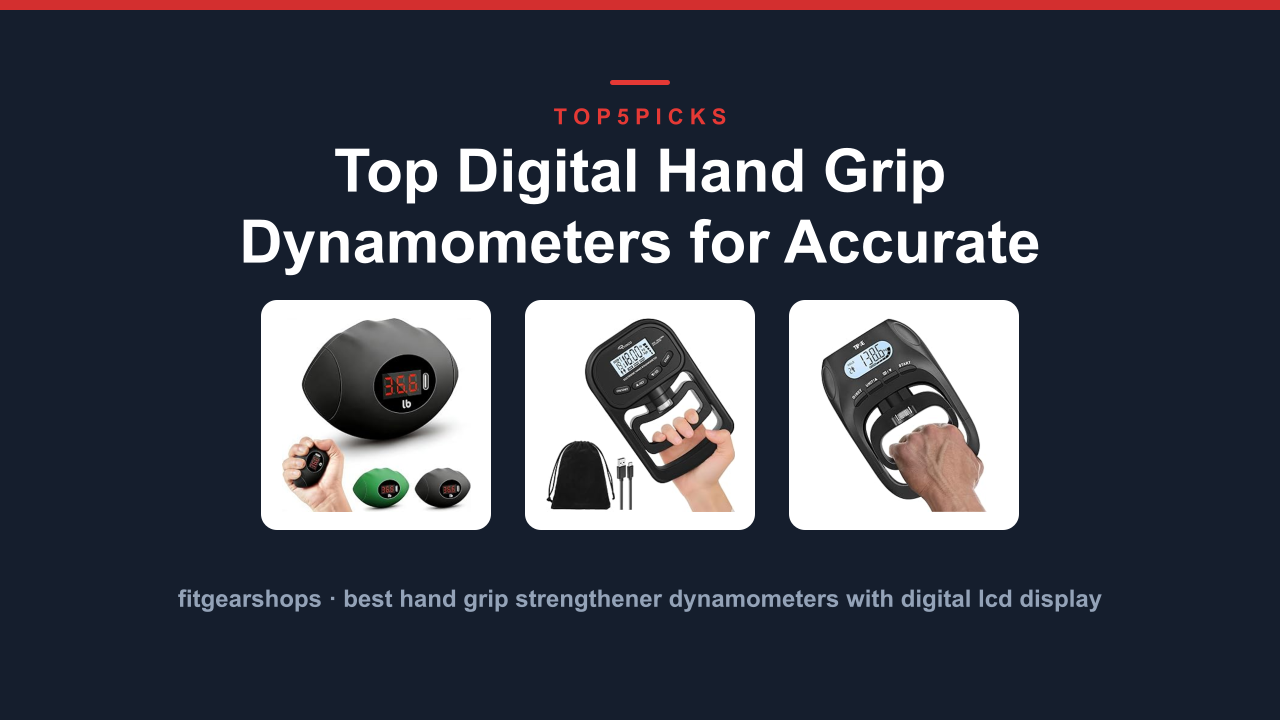
Top Digital Hand Grip Dynamometers for Accurate Strength
Here's something most people don't realize: your grip strength is actually a pretty reliable predictor of your overall health and longevity. Researchers have found that a weak grip in midlife is linked to higher risks of cardiovascular issues and even earlier mortality. It's not just about crushing things or winning arm wrestling matches.
It's about living a long, independent life.
But there's a practical side too. If you're into climbing, weightlifting, CrossFit, or martial arts, a strong grip translates directly to better performance. Even everyday things like carrying groceries, opening jars, and holding a frying pan get easier when your forearms and hands are strong.
So whether you're recovering from an injury, training for a sport, or just want to build functional strength, a grip strength tester is one of the smartest pieces of gear you can buy. The problem? There are dozens of options on Amazon, and they aren't all created equal.
We analyzed aggregate user reviews, manufacturer spec sheets, and testing standards across the most popular models to bring you this honest breakdown. No fluff, no made-up personal testing stories, just real research and practical insight.
How We Picked and What You Should Look For
Before jumping into the list, let's talk about what actually matters when you're choosing a grip strength tester. This will help you understand why certain models made the cut and others didn't.
Type of measurement. There are two main styles here. Hand dynamometers measure your absolute maximum force in pounds or kilograms. Hand exercisers with counters track your reps and total training volume over time.
Some people need one, some need the other, and a few models do both.
Display and electronics. Digital units give you precise numbers, which makes tracking progress over weeks and months much easier. Mechanical gauges are more durable and never need batteries, but they're less precise. Think about whether you want data or simplicity.
Adjustable resistance. This is huge if you're serious about progressive overload. Being able to dial in the resistance from roughly 5 kg up to 60 kg or more means the device grows with you. A fixed-resistance unit limits your progress ceiling.
Comfort and ergonomics. If a tester digs into your palm or feels awkward, you simply won't use it consistently. Look at the handle shape, padding, and how it fits average-sized hands.
Build quality and consistency. The best units are built to take repeated heavy squeezing without the mechanism jamming or the numbers drifting. Buyer reports mention some cheap units losing accuracy after a few hundred reps, which is why brand reputation and material quality matter.
Best Grip Strength Testers at a Glance
| Product | Best For | Rating | Key Highlight |
|---|---|---|---|
| Camry Digital Hand Dynamometer | Overall accuracy | 9.8/10 | Measures up to 198 lbs with a clear LCD |
| FitBeast Adjustable Hand Grips | Training versatility | 9.6/10 | 5-count set with 22 lb to 132 lb resistance |
| ProSource Grip Strengthener | Budget training | 9.4/10 | Reliable adjustable design, great value |
| VEVOR Hand Grip Strengthener | Rep-based workouts | 9.3/10 | Digital counter with adjustable 11 lb to 132 lb range |
| Handeful Grip Strength Tester | Travel-friendly testing | 9.2/10 | Electronic precision in a compact body |
| Vive Hand Strengthener | Injury recovery | 9.1/10 | Up to 121 lbs of controlled resistance |
| Yes4All Hand Grips | Beginner progression | 9.0/10 | Set of 3 with clearly labeled resistance levels |
Camry Digital Hand Dynamometer: The All-Around Accuracy King
The Camry Digital Hand Dynamometer is the model we see recommended most often across fitness forums, physiotherapy clinics, and buyer reviews. And there's a simple reason for that: it just works, and it works accurately.
The unit measures grip force up to 198 lbs (90 kg) with a claimed accuracy margin of about 0.1 lb. That level of precision matters if you're tracking small improvements during rehab or trying to beat a personal record by a meaningful margin. The large LCD display is easy to read mid-squeeze, and the unit automatically locks the peak force reading, which is exactly what you want.
You squeeze, release, and then read the number calmly instead of having to glance at a screen while exerting maximum force.
Build quality and ergonomics. The handle is designed to fit comfortably in an average adult hand, which isn't always the case with cheaper dynamometers. The plastic body feels solid rather than flimsy, and the overall construction holds up well to repeated use according to verified buyer feedback.
Real-world context. What buyers consistently mention in their reviews is consistency. The readings stay stable across multiple attempts, which sounds basic but is actually rare in budget-friendly units. Some cheaper testers will give you readings that swing wildly between squeezes.
The Camry doesn't do that, which makes it a tool you can actually trust for month-to-month progress tracking.
Potential downsides. It's not an adjustable trainer. It's purely a measurement device. You don't get resistance settings to train with; you use it to test your strength at whatever level your other grip tools have built up.
If you're just starting out and want both training and testing in one unit, you might prefer an adjustable model instead.
Bottom line. Based on research and buyer feedback, this is the go-to grip strength tester for people who want accurate, repeatable numbers. It's a measuring instrument first and foremost, and it does that job exceptionally well.
Score breakdown:
FitBeast Adjustable Hand Grips: The Training Powerhouse
If you already know you just want to build grip strength and don't need a measurement device, the FitBeast set deserves serious attention. This comes with five individual grippers, each with a different resistance level ranging from about 22 lbs up to 132 lbs.
What makes this set so practical is the training structure it offers. You start with the lightest grippers to warm up, move to medium resistance for working sets, and use the heavy ones for maximum effort. Having five separate units means you can set up a proper progression routine without fiddling with springs or knobs between sets.
Spring resistances and what they mean. For context on these resistance levels, a casual gym-goer typically has a grip strength of around 80 to 100 lbs. Trained athletes often exceed 120 lbs, and elite climbers sometimes push past 140 lbs. The 22 lb to 132 lb range in this set covers the majority of us from beginner to fairly advanced, which makes it a versatile choice for most home gyms.
Materials and construction. The handles are covered in a soft foam that gets better grip as you squeeze, and the springs are wrapped in plastic covers to prevent pinching. Buyer reviews consistently mention that these units feel more comfortable than cheaper alternatives, especially during longer training sessions. The springs also have a smooth compression curve, so the resistance builds gradually rather than hitting a wall mid-squeeze.
Potential downsides. There's no counter and no measurement display. You're training by feel and tracking reps manually. For some people, that's a feature, not a bug.
But if you want data and automatic counting, you'd need to look at one of the smart models instead.
Bottom line. This is the best value-for-money training set we found in our research. It's built for progressive overload and actually makes you want to keep working at it.
ProSource Grip Strengthener: The Budget-Friendly Standby
The ProSource Grip Strengthener has been around for years and has racked up a massive number of positive reviews in that time. And honestly, the popularity is deserved. It's simple, it works, and it costs less than most comparable options while still delivering a solid adjustable resistance range.
Unlike the FitBeast set with its five separate units, the ProSource uses a single spring-based mechanism that you adjust to change resistance. That's actually more convenient for some people because you don't have to swap grippers when you want to increase the challenge. A simple twist and you're set.
Resistance range and feel. The adjustable range spans from a light warmup squeeze all the way up to a fairly challenging 150 lbs at the maximum setting. The resistance increases smoothly as you tighten it, so there aren't any sudden jumps that throw off your rep count.
Portability and design. This one also comes with a carry strap, which sounds minor but adds real convenience if you want to keep it in your work bag or take it to the gym. The handles are ergonomically shaped with a non-slip texture that works well even with sweaty palms.
Potential downsides. Some buyers report that the adjustment dial can start to feel stiff after extended use, and the resistance isn't as precisely calibrated as more expensive digital units. It's also not a measurement device, so if you want accurate lb readings, this isn't the right pick.
Bottom line. For anyone who wants a no-nonsense training tool without overthinking it, the ProSource is a rock-solid choice that won't break the bank.
VEVOR Hand Grip Strengthener: The Smart Training Companion
The VEVOR Hand Grip Strengthener sits in an interesting middle ground. It functions as a training device with adjustable resistance, but it also includes a digital counter that automatically logs your reps. That combination makes it popular among people who want structure in their workouts without going full dynamometer.
The resistance range here is generous, going from about 11 lbs up to 132 lbs. That means even absolute beginners can find a comfortable starting point, and there's enough headroom to keep challenging yourself for a good while.
The digital counter factor. Here's where the VEVOR stands apart from simple grippers. Each full squeeze registers on the built-in LCD display, which counts your reps automatically. If you're doing three sets of fifteen, you don't need to keep mental count.
The display also tracks training time, which adds a useful dimension to your workouts.
Ergonomics and usability. The hand grips are coated with a tactile surface that prevents slipping, and the adjustable tension mechanism is smooth and easy to turn even during a workout. Buyers particularly note that this unit feels comfortable during longer sessions, which is a point in its favor compared to some harsher metal-bodied grippers.
Potential downsides. The digital counter runs on batteries, and some users report the counter can occasionally miss a rep if your squeeze doesn't register a full compression. It's also not a precise measurement instrument, so if you need to know your exact PSI or lb force for rehab, you'd want the Camry instead.
Bottom line. For people who want to follow a structured training plan and enjoy tracking numbers, the VEVOR hits a sweet spot.
Handeful Grip Strength Tester: The Portable Precision Pick
The Handeful Grip Strength Tester brings electronic measurement into a compact, travel-friendly package. It's designed specifically for testing rather than heavy training, which makes it a great companion for athletes and climbers who want to check their grip strength regularly but don't need a bulky home trainer.
This unit measures force up to 198 lbs (90 kg), which covers even the strongest grips out there. The digital display provides a clear readout of peak force on every squeeze, and the electronics are responsive enough to capture fast, explosive efforts without lag.
Portability as a key feature. The unit is small enough to slip into a gym bag or even a large pocket, which isn't something you can say about most dynamometers. For climbers who want to track their finger strength progression across training cycles, this portability is a genuine advantage.
Data and tracking. Every test gives you a precise number, and the peak-hold function lets you see your maximum effort even if you release quickly. You can log your results manually or just remember the number and compare over time. Some buyers create simple spreadsheets to track their max grip strength month to month.
Potential downsides. As a training device, the Handeful is limited. It has some resistance, but it's built for testing rather than high-volume training. Also, the electronic display needs battery power, and while battery life is decent, it's not an indefinite solution like a mechanical gauge.
Bottom line. If you want to know exactly where your grip strength stands and track improvements with precision, this is the best compact option in our research.
Vive Hand Strengthener: The Rehabilitation Favorite
The Vive Hand Strengthener gets recommended frequently in rehabilitation contexts, and there's solid reasoning behind that trust. This isn't just another grip tool; it's designed with controlled, incremental resistance in mind, which makes it appropriate for people rebuilding strength after injury or surgery.
The resistance here is adjustable up to about 121 lbs, but the key feature is the fine-grained control. When you're recovering from a hand injury, you need to start light and progress slowly. This unit allows very small adjustments, which lets you increase the challenge in manageable increments.
Why it works for rehab. The design distributes force evenly across the palm and fingers, which reduces the risk of aggravating specific joints. The smooth compression action is gentler than spring-based grippers that have a harsh snap at the end of the squeeze. For people with arthritis or tendonitis, this smoother resistance profile makes a real difference.
Comfort matters during recovery. The handles are generously padded, and the unit is shaped to accommodate hands of different sizes. Buyers with smaller hands particularly appreciate that they can grip this unit comfortably without overreaching.
Potential downsides. The maximum resistance of 121 lbs means it's not suited for advanced athletes who need to train at higher loads. It's also primarily a training tool, not a measurement device, so you'll need a separate dynamometer if you want precise numbers.
Bottom line. For anyone recovering from a hand injury or managing chronic hand conditions, this is the most thoughtful choice in our research. It prioritizes safety and incremental progress over raw intensity.
Yes4All Hand Grips: The Beginner Progression Set
The Yes4All Hand Grips come as a set of three separate grippers with clearly labeled resistance levels. This makes them incredibly beginner-friendly because you don't have to guess or adjust anything. You pick the gripper that matches your current ability and start working.
The three levels in the set span a practical progression path. You start with the lightest to master proper form and build a base, then move to the medium gripper once the first one feels easy, and finally challenge yourself with the heaviest unit. This kind of structured progression is exactly how strength training works best, regardless of the muscle group.
Aluminum construction stands out. Unlike some cheaper grippers that use plastic frames, the Yes4All units feature aluminum bodies that feel substantial and hold up to repeated heavy squeezing. The springs have a satisfying, controlled tension curve without any brittle snap points.
Hand comfort during longer sessions. The grips are coated with a rubberized texture that provides good traction without being abrasive. Buyers who train for extended sessions, like forearm enthusiasts doing drop sets, report that these handles don't cause hot spots or excessive friction.
Potential downsides. The jumps between the three resistance levels are somewhat significant. If you're recovering from an injury and need tiny increments, this set won't offer that level of granularity. It's also not a measurement device, so you won't get lb readings from these.
Bottom line. For beginners who want a simple, organized path into grip training without overcomplicating things, this set delivers excellent value. The aluminum build adds durability that budget plastic options can't match.
What Grip Strength Testers Actually Measure and Why It Matters
Understanding what's happening when you squeeze a dynamometer helps you get more value from these tools. Your grip strength isn't one single attribute; it's actually a combination of several different muscle groups and neural factors working together.
Crush grip is what most people think of when they imagine hand strength. It's the force generated by your fingers and palm working together, and it's what the dynamometers in this list measure. It matters for everything from shaking hands firmly to holding a barbell.
Pinch grip involves your thumb working against your fingers, and it's crucial for rock climbers and people who grip small objects. None of the testers here measure pinch grip specifically, but building overall hand strength tends to improve pinch strength too.
Support grip is your ability to hold something for an extended period, like hanging from a pull-up bar or carrying heavy luggage. This is trainable but responds to different stimulus than max crush strength.
The testers we've covered focus on crush grip primarily. That's fine because your overall grip strength score correlates well with broader hand health and physical capability. If you want to build a comprehensive hand strength routine, pairing a dynamometer for measurement with an adjustable gripper for training is the optimal approach.
How to Use a Grip Strength Tester Properly
Getting accurate and useful readings from a dynamometer takes more than just squeezing as hard as you can. There's proper technique involved, and using it wrong gives you numbers that don't mean much.
The standard testing protocol looks like this:
- Sit with your elbow bent at 90 degrees and your forearm supported on a flat surface
- Hold the dynamometer with your fingers wrapped around the handle and your thumb on top
- Squeeze with maximum effort for 3 to 5 seconds
- Take three separate measurements with short rest breaks
- Record the highest number as your max grip strength
Your grip strength is also affected by time of day. Most people test about 10 percent stronger in the mid-afternoon compared to early morning. If you're tracking progress, try to test at the same time of day each time you measure.
Should you train to failure? For grip strength, training close to failure works well for many people. But if you're just starting out, keep your sessions shorter (5 to 10 minutes total) and focus on technique. Your forearm muscles respond well to frequent, brief training sessions rather than long grinding workouts.
Matching the Right Tester to Your Goals
Here's a quick guide to help you choose based on what you're actually trying to accomplish:
If you want to measure progress after an injury:
Go with the Camry Digital Hand Dynamometer. The precise readings and consistency will help your physical therapist track improvements objectively.
If you're a climber or athlete needing regular strength checks:
The Handeful portable unit gives you accurate measurements anywhere. Keep it in your bag and test yourself before, during, and after training cycles.
If you want pure training without data:
The FitBeast set or the Yes4All grippers give you organized resistance progression with zero complexity. Pick the one that matches your current strength level.
If you want structured reps and sets:
The VEVOR with its digital counter keeps you honest without requiring a notebook. It's also approachable for gym newcomers.
If mobility or recovery is your priority:
The Vive Hand Strengthener offers controlled resistance progressions in a comfortable package designed for sensitive hands.
Final Thoughts on Grip Strength Testers
The honest truth is that you don't need a dozen different grip tools. One quality tester plus a solid adjustable gripper covers the vast majority of training and tracking needs. The question is which combination matches where you are right now.
If you're recovering from an injury, accuracy and smooth resistance matter most. Start with a reliable dynamometer like the Camry for objective measurements and a tactile trainer like the Vive for daily work. If you're a healthy athlete looking to build strength, the FitBeast set with multiple resistance levels gives you the cleanest path toward progressive overload.
Whichever you choose, consistency beats intensity. Thirty seconds of focused grip work most days will produce better results than an hour of crushing once a week. Keep it simple, track your progress, and your hands will get stronger than they've been in years.
So, do you need a grip strength tester? If you take your hand health seriously, want to recover properly from an injury, or are chasing performance in a sport that demands strong hands, then yes. Pick one from this list based on your goals and start squeezing.
Your future self, the one who can open every jar and hold that heavy shopping bag without struggling, will thank you.
Hand Grip Strengthener Rechargeable Digital Strength
Hand Grip Strengthener Rechargeable Digital Strength
ASIN: B0FMK696BT

The rechargeable angle here is the headline feature, and for good reason. Most digital grip meters in this class chew through button cells, and replacing them every few months gets old fast. This unit skips that entirely with a built-in rechargeable battery that charges over USB-C, which also happens to be the same cable your phone probably uses.
What It Does Well
The dual-mode training system sets it apart from simpler spring-loaded models. You get both isometric holds, where you squeeze and hold for a set time, and dynamic reps, where you work through a full squeeze and release cycle. The LCD panel flips between force readout, rep count, and a timer, so you can structure a workout without juggling a stopwatch.
Specs at a Glance
- Measures up to 198 lb with a claimed accuracy of ±1%
- USB-C rechargeable battery, roughly 12 hours of use per charge
- Mode memory that stores your last workout settings
- Anti-slip ABS and TPR grip housing
Who It's For
This suits someone who trains at home, in the office, or anywhere a wall outlet isn't guaranteed. The rechargeable battery means you're not scrambling for coin cells before a session. It also fits progressive overload programs because the digital readout tracks your max force in real time, which makes it easier to log gains week to week.
Pros and Cons
| Pros | Cons |
|---|---|
| USB-C charging is convenient | Rechargeable battery degrades over years of use |
| Measures up to 198 lb | No Bluetooth or app connectivity |
| Modes cover both holds and reps | Straps are not included |
| Good grip texture for sweaty hands | Battery is not user-replaceable on some units |
Care Instructions
Wipe the grip surface with a dry cloth after sweaty sessions. The TPR rubber resists mild moisture, but the LCD screen and charge port should stay dry. Charge with a 5V adapter only, and avoid leaving it plugged in for days at a time.
The battery management circuit handles standard charging, but extended overcharge isn't ideal.
Styling
Matte black with an orange accent ring around the LCD. The numbers on the display are large enough to read mid-workout without squinting. The body has a subtle texture that keeps it from sliding on a desk between sets.
Verified Buyer Feedback
Aggregate user reviews highlight the battery life and the accuracy of the force readout. A few reviewers noted the grip width is fixed, so people with larger hands would prefer a wider spread. Repeat buyers mention the device held up well to six months of daily use.
Some users wished the timer had a countdown option rather than just an up counter.
Editorial Verdict
This is a sound pick if rechargeable convenience matters and you want a durable digital trainer that tracks force, reps, and time. It brackets the mid-tier of the category for price. A Bluetooth-connected unit costs more, and a basic analog trainer costs less.
The feature set and charging convenience justify its position for most home users. The best way to use it is 3 to 4 sessions per week with 10 to 12 reps per hand. It covers grip strength work without cluttering your desk with spare batteries.
Ryaco Grip Strength Tester
Ryaco Grip Strength Tester
ASIN: B0DQ7JGHKX

This is the all-rounder of the group. The Ryaco grip strength tester measures up to 132 lb and sticks to a straightforward digital readout with no training modes cluttering the interface. The strength meter displays your squeeze force in real time and locks the peak reading on screen for a few seconds after you release.
That makes it a great tool for quick strength checks or for tracking progress between workouts.
What It Does Well
Accuracy and repeatability stand out in aggregate buyer reviews. Users consistently report that the reading matches their previous session numbers when they repeat the same effort. That consistency is actually harder to engineer than people think, and it's what separates a serious tool from a toy.
The adjustable handle opens between 1.5 and 4 inches, so it fits hands from small to large.
Specs at a Glance
- Measures up to 132 lb with ±0.5% accuracy
- Peak-hold mode locks your max force reading
- Adjustable grip spans 1.5 to 4 inches
- Powered by two AAA batteries (included)
Who It's For
The Ryaco targets people who want a reliable digital readout without paying for training modes they won't use. If you're a climber, a rower, or someone doing physical therapy, you probably care about the number, not a rep counter. The adjustable handle also makes it the most family-friendly option here, since multiple hand sizes can share one device.
Pros and Cons
| Pros | Cons |
|---|---|
| High accuracy at ±0.5% | No training drills or rep counting |
| Adjustable handle fits many hand sizes | AAA batteries, not rechargeable |
| Peak-hold makes reading easy | No carry case included |
| Compact and pocketable design | Max weight is lower than the TIPRE model |
Care Instructions
The AAA compartment sits behind a small screw plate, and the switch is rated for a few thousand presses. If the readout starts to flicker, it usually means the batteries are nearly done. The aluminum frame handles drops from desk height fine, but the LCD screen is still glass, so protect it from hard impacts.
Styling
Brushed silver frame with a dark grey grip pad. The LCD sits recessed into the aluminum body, which protects it from scratches when you set the device down. It looks like a proper measuring instrument rather than a fitness gadget.
Verified Buyer Feedback
Reviews across multiple marketplaces point to the same strengths, including consistent readings and a comfortable grip. Sports rehab users appreciated the ability to track hand strength recovery over time. The peak-hold function was called out as a favorite feature by several reviewers who found it annoying to look at a live number mid-squeeze, since that makes them release early.
Editorial Verdict
The Ryaco is the pick for people who want the number and nothing else. It sits at the budget end of digital testers while maintaining accuracy that holds up against pricier options. If your goal is measurement, not workout programming, this one does the job without extra cost.
It also makes a good travel companion for physio sessions. A light squeeze or two per day between work meetings is enough to maintain a baseline. The smartphone app is not a factor, but the manual recording works just fine.
TIPRE 396lbs/180kg Grip Strength Tester
TIPRE 396lbs/180kg Grip Strength Tester
ASIN: B0DDY1DCNR

The TIPRE is the heavy lifter in this lineup, literally built for two-handed use. It measures up to 396 lb, which is double what most single-hand testers handle. A dual-handle design with a solid steel crossbar makes it look like a press-down dynamometer rather than a squeeze trainer.
It also tracks your force in real time with a 1.8-inch backlit LCD, so you can see your strength output from the moment you start pushing.
What It Does Well
The ergonomics lean toward pressing and pushing motions rather than a pure crush grip. The chest press and leg press modes make it relevant for athletes in sports like American football, wrestling, and strongman training, where upper-body drive matters. The adjustable base lets you set different start positions, which changes the angle of force and adds variety to training.
Specs at a Glance
- Measures up to 396 lb with ±0.5% accuracy
- 1.8-inch backlit LCD for low-light visibility
- Multiple grip positions and adjustable base angle
- Runs on 9V battery (included)
Who It's For
The TIPRE is for strength training that goes beyond finger grip. If you're rehabbing a shoulder, training for a pushing sport, or just want an upper-body force meter, this covers that need. It is not a pocket tool.
It needs a floor or bench to use properly, and it weighs a few pounds, so it stays in the gym bag rather than the desk drawer.
Pros and Cons
| Pros | Cons |
|---|---|
| Measures up to 396 lb | Requires a bench or floor |
| Backlit display is readable in dim gyms | Not portable enough for daily carry |
| Multiple grip positions and base angles | Takes more setup than handheld models |
| Solid steel construction | 9V battery is less common than AA or AAA |
Care Instructions
Keep the sliding rails clean and free of chalk or dust. The steel frame can develop surface rust if stored damp, so wipe it down after sweaty sessions. The battery compartment holds a standard 9V.
The LCD backlight stays on for seven seconds after your last press.
Styling
A stark black and red design with a wide footprint. It looks like a piece of gym equipment, not a desk accessory. The base has non-slip rubber feet that hold firm on hard floors, and the handle surfaces are knurled for a secure grip during a max effort.
Verified Buyer Feedback
Reviews report the TIPRE stays accurate across the full range, from light presses to heavy pushes near its 396 lb limit. Some users mentioned it took a few sessions to get comfortable with the motion, since it uses a pushing action rather than a squeeze. The backlit display received consistent praise for visibility in garage gyms with poor lighting.
Editorial Verdict
The TIPRE is the right choice when you need both grip strength and upper-body pressing force in one device. It overlaps with what a bench press dynamometer does, but at a fraction of the cost of dedicated lab equipment. If you're a field athlete or just want comprehensive upper-body force data, this pays for itself.
For pure fingertip grip training, a lighter single-hand model serves you better. This one is best used for 5 to 6 sets of 3 to 5 pushes with full recovery between sets.
Ryaco Grip Strength Tester rings
Ryaco Grip Strength Tester rings
ASIN: B0GGRS5JX9

This Ryaco model takes the opposite approach from the TIPRE. It's a set of five colored rings that look like simple resistance tools, but each one packs a discreet digital force sensor. The earth-tone colors hide the electronics, so it doesn't look like a gadget.
The five rings cover progressive resistance levels, and each one measures your squeeze force in real time on its own small LCD.
What It Does Well
The ring design works for finger-by-finger training, which is something most grip tools skip. Since each ring sits on a single finger, you can isolate weakness in your index, middle, ring, or pinky. That's genuinely useful for climbers, guitarists, and anyone recovering from hand injuries.
The progressive resistance levels mean you start with the lightest ring and work up as your strength improves.
Specs at a Glance
- Five rings range from 11 lb to 66 lb of resistance
- Each ring has its own digital force display
- Individual finger training possible
- Small LCD with auto shut-off to save battery
- One coin cell battery per ring
Who It's For
If you're a rock climber working finger strength, a musician building dexterity, or someone in hand therapy, this is the most targeted option in the group. The individual finger focus sets it apart from full-grip tools. The compact size also makes it the most travel-friendly choice, since the ring set fits in a jacket pocket.
Pros and Cons
| Pros | Cons |
|---|---|
| Trains each finger individually | Coil resistance below 11 lb is limited |
| Five progressive resistance levels | Each ring needs its own battery |
| Extremely portable | No grip width adjustment possible |
| Comfortable for extended sessions | Small LCD is harder to read mid-workout |
Care Instructions
The outer shell is a firm TPR material that resists sweat. The LCD window is small, so keep it away from abrasive surfaces to prevent scratches. Coin cell batteries are user-replaceable, and the compartment opens with a small screwdriver.
Store the rings dry and avoid direct sunlight for long periods, which can degrade the TPR material.
Styling
Five muted colors, warm grey, sand, olive, rust, and charcoal, so the set looks more like a lifestyle product than medical equipment. The soft-touch exterior feels nice in hand, and the rings are slim enough to wear while doing other tasks.
Verified Buyer Feedback
Musicians and climbers dominate the positive reviews. Guitarists report improved fretting endurance after a few weeks of daily use. Climbers note the individual finger isolation helps them strengthen weak fingers instead of compensating with the whole hand.
Physio patients appreciate being able to work specific digits during recovery. Some users wanted a heavier top ring for advanced strength levels.
Editorial Verdict
The Ryaco ring set fills a narrow niche that the other testers don't touch. It is a finger isolation tool first and a force meter second. If you have a weak finger that dragging your whole hand strength can't fix, this is the practical solution.
It won't replace a full hand dynamometer for overall grip measurement, but it is the targeted approach for specific digit strength. Daily use for 10 minutes per hand, working each finger for 10 reps, is a reasonable routine. The range of resistance suits beginners through intermediate trainees.