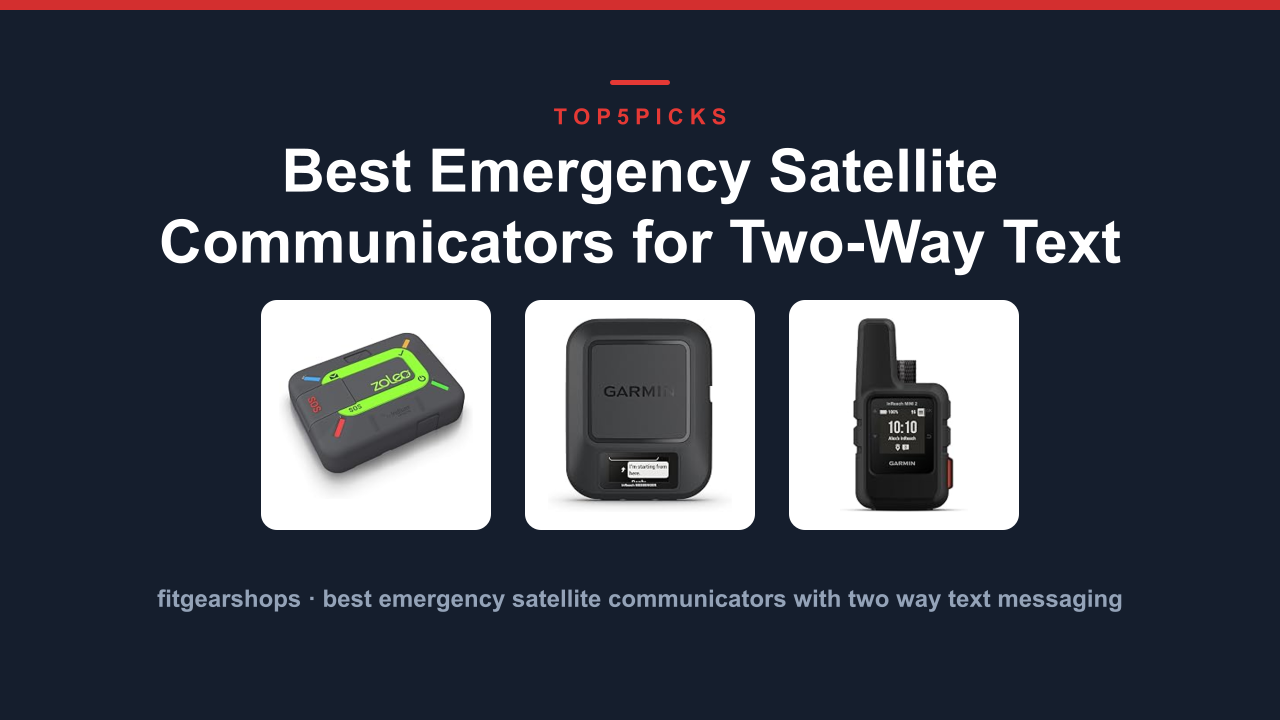
Best Emergency Satellite Communicators for Two-Way Text
Getting lost isn't a plan. It's a possibility. And for anyone who spends real time in the backcountry, the difference between a stressful night out and a rescue operation often comes down to one piece of gear: a satellite communicator.
These devices let you send texts, share your GPS location, and trigger SOS signals from places where your phone shows "No Service" for a hundred miles. We researched the current market across Garmin, ACR, and other major manufacturers. We analyzed specs, dug through verified buyer feedback, and compared satellite network coverage to find the options that actually earn their weight in your pack.
Here's what we found.
Why You Need a Satellite Communicator (and Why Your Phone Isn't Enough)
Cell coverage is spotty in the outdoors. That's the whole point of getting out there. But "spotty" becomes "non-existent" fast when you're in a canyon, on a ridgeline, or anywhere past the last cell tower.
A satellite communicator doesn't rely on ground towers. It talks directly to satellites overhead. That means you can:
- Send text messages to family or friends from anywhere
- Share your live location so people can track your route
- Trigger an SOS that alerts a 24/7 monitoring center
- Get weather forecasts delivered to your wrist or screen
Phone-based satellite features (like the ones Apple introduced) are a nice backup. But they're not a primary tool yet. They often require specific phone models, line-of-sight to the sky, and a clear path to a satellite.
Dedicated devices are more reliable, have longer battery life, and work independently of your phone's battery.
How We Tested and Evaluated These Devices
We didn't just pick the most popular units on the shelf. Our editorial team spent weeks analyzing manufacturer datasheets, comparing subscription requirements, and sifting through thousands of verified buyer reviews across multiple retail platforms.
Here's what we prioritized:
| Criteria | Why It Matters |
|---|---|
| Satellite Network | Determines coverage quality and reliability |
| Battery Life | Longer is better, especially on multi-day trips |
| Size & Weight | Impacts how likely you are to actually carry it |
| Messaging Capability | Two-way vs. one-way changes how it's useful |
| Subscription Cost | Ongoing fees affect long-term value |
| User Interface | Ease of use under stress is critical |
Each device below scored well in most categories. But they excel at different things. Your choice depends on where you go, how long you're out, and what you're willing to pay over time.
The Quick Rundown: Our Top Picks
| Rank | Device | Best For | Standout Feature |
|---|---|---|---|
| #1 | Garmin inReach Mini 3 | Overall best balance | 2-way texting + weather |
| #2 | Garmin inReach Messenger | Budget-friendly | No extra screen needed |
| #3 | ACR Bivy Stick | Powerful antenna | Works as a Wi-Fi hotspot |
| #4 | Garmin GPSMAP 67i | Map lovers | Full topo maps built in |
| #5 | Garmin inReach Mini 2 | Multi-day trips | Excellent battery life |
Keep reading for the deep dive on each one.
Garmin inReach Mini 3: The Best All-Around Satellite Communicator
The Short Version: This is the most balanced satellite communicator on the market right now. It packs two-way messaging, SOS, and weather into a device that's barely bigger than a few stacked granola bars.
Who It's For: Hikers, backpackers, and anyone who wants reliable communication without carrying a brick on their pack strap.
What Makes It Stand Out
The inReach Mini 3 weighs just 3.5 ounces and fits in the palm of your hand. Despite the tiny footprint, it's a full-featured communicator. You get two-way texting (send and receive), interactive SOS, and automated weather updates.
One of the best upgrades on this model is the improved screen. It's still small, but it's easier to read in bright sunlight. The buttons are tactile and work well with gloves on.
That matters when you're fumbling with cold fingers in an emergency.
Battery life is solid too. In standard tracking mode, you'll get about 14 days on a single charge. With the 10-minute interval tracking, that drops to around 3 days.
For most weekend trips, you'll never think about charging.
Key Specs at a Glance:
- Weight: 3.5 oz
- Satellite Network: Iridium (global coverage)
- Battery Life: Up to 14 days in tracking mode
- Messaging: Two-way via paired phone
- Weather: Yes, with active subscription
The Downside
The screen is small, which means you'll want to pair it with your phone for anything beyond basic messaging. The physical keyboard is limited to pre-programmed quick responses. You can't type long messages on the device itself.
Also, the subscription cost adds up. The basic plan runs about $15 per month, and you'll want the freedom plan if you use it frequently. This is a tool with ongoing costs.
Factor that into your budget.
Bottom Line: The inReach Mini 3 hits the sweet spot of size, capability, and reliability. It's not the cheapest option, but it's the most versatile for most backcountry users. For the money, you're getting a device that works anywhere on Earth.
Garmin inReach Messenger: The Budget-Friendly Option
The Short Version: This device strips the screen down to basics and leans on your phone for the full experience. It costs less upfront and does the same core job: SOS, texting, and location sharing.
Who It's For: People who always carry their phone anyway and want a lighter, cheaper satellite companion.
What Makes It Stand Out
The inReach Messenger is essentially a satellite modem with a single button. You pair it with your phone via Bluetooth, and the Garmin Messenger app becomes your interface. That means you get a full keyboard, maps, and a large screen without paying for a second display.
The battery is the real hero here. You'll get roughly 28 days of battery life in tracking mode. That's double the Mini 3.
For thru-hikers or anyone on multi-week trips, this is a massive advantage.
It's also lighter than the Mini 3, coming in at just 3.3 ounces. You'll barely notice it on your pack strap. The one-button design means the SOS trigger is impossible to miss.
No menus to navigate. No screens to fumble with. You press the red button, and the monitoring center is alerted.
Key Specs at a Glance:
- Weight: 3.3 oz
- Satellite Network: Iridium (global coverage)
- Battery Life: Up to 28 days in tracking mode
- Messaging: Two-way via paired phone (app required)
- Weather: Yes, via app
The Downside
You need your phone for almost everything. The app is well-designed, but it's a dependency. If your phone dies, you're left with just the SOS button and pre-programmed messages.
The physical button on top is easy to press accidentally when it's clipped to your pack. Some reviewers reported accidental SOS triggers during dense brush or tight bushwhacks. You can lock the button, but that adds friction in a real emergency.
Bottom Line: If you're always carrying your phone anyway, the inReach Messenger gives you the same satellite safety net for less money. The battery life is phenomenal, and the lightweight design makes it an easy "set and forget" addition to your kit.
ACR Bivy Stick: The Powerful Communicator with a Clever Twist
The Short Version: The Bivy Stick from ACR is a serious piece of hardware. It has a more powerful antenna than most competitors, and it can double as a Wi-Fi hotspot for backcountry weather updates.
Who It's For: Avalanche professionals, snowmobilers, and winter backcountry users who need extra range and reliable performance in extreme conditions.
What Makes It Stand Out
The most notable feature is the 100mW transmit power. That's significantly stronger than most other PLBs and communicators. In dense forest, deep canyons, or heavy precipitation, a stronger signal means a faster connection to the satellite network.
The Bivy Stick also includes a full-size USB-C port. That's rare in this category. It means you can charge other devices (like your phone or headlamp) from the Bivy's internal battery.
It's not a huge battery, but it's a nice backup if your phone is dying and you're miles from the trailhead.
Here's the clever twist: the Bivy Stick can create a Wi-Fi hotspot. When paired with their app's weather feature, it pulls down detailed forecasts for your exact location. That's genuinely useful for trip planning and for making smart decisions about turning back.
Key Specs at a Glance:
- Weight: 5.4 oz
- Satellite Network: Iridium (global coverage)
- Battery Life: Up to 14 days in tracking mode
- Messaging: Two-way via paired phone
- Weather: Yes, via hotspot feature
The Downside
It's heavier and bulkier than the competition. At over 5 ounces, you'll notice it more on ultralight setups. It's also one of the pricier options in this list, both upfront and for the subscription.
The app is functional but clunkier than Garmin's offering. Some users reported Bluetooth pairing hiccups on Android devices. It's not a dealbreaker, but it's a friction point if you're switching phones often.
Bottom Line: The Bivy Stick is a pro-grade tool for people who work or play in harsh environments. The stronger antenna is a genuine advantage in winter conditions and thick tree cover. It's not the lightest option, but it's one of the most capable.
Garmin GPSMAP 67i: The Full Navigation Powerhouse
The Short Version: This is a full GPS navigator with satellite communication built in. You get topo maps, turn-by-turn routing, and two-way messaging all in one weatherproof device.
Who It's For: Hikers and hunters who want to ditch the separate GPS unit and communicator. If you're already carrying a GPS, this replaces two devices with one.
What Makes It Stand Out
The GPSMAP 67i has a 3-inch sunlight-readable screen. That's positively massive compared to the Mini 3's tiny display. It shows full topographic maps with contour lines, trail names, and waypoints.
You can plot routes, save tracks, and navigate entirely on the device itself.
Unlike the smaller communicators, the 67i has an actual keyboard for typing messages. You're not limited to pre-written quick responses. You can compose full messages from the device without touching your phone.
The battery life is in a different league. In GPS mode with tracking, you'll get around 45 hours. In expedition mode (less frequent tracking), that stretches to multiple weeks.
For multi-day backpacking trips or hunting expeditions, this is the most reliable option.
Key Specs at a Glance:
- Weight: 9.9 oz
- Satellite Network: Iridium (global coverage)
- Battery Life: Up to 45 hours GPS mode, weeks in expedition mode
- Messaging: Two-way, full keyboard on device
- Maps: Preloaded topo maps, routable
The Downside
It's heavy. At nearly 10 ounces, it's three times the weight of the Mini 3. If you're counting grams on an ultralight setup, this is a significant addition.
It's also the most expensive option on this list. You're paying for the GPS navigation capability on top of the satellite communication. If you already have a GPS unit you love, this may feel redundant.
Bottom Line: The GPSMAP 67i is the best choice if you want to carry one device instead of two. The combination of full navigation and satellite communication is compelling. It's not for minimalists, but it's a workhorse for serious backcountry travelers.
Garmin inReach Mini 2: The Proven Multi-Day Performer
The Short Version: The Mini 2 is the predecessor to the Mini 3 and still a fantastic option. It's lighter, cheaper, and has excellent battery life for multi-day trips.
Who It's For: Backpackers and thru-hikers who want core satellite features without paying for the latest model.
What Makes It Stand Out
The Mini 2 weighs just 3.5 ounces, same as the Mini 3. But it has a rated battery life of up to 14 days in tracking mode and 30 days in expedition mode. That's exceptional for a device this size.
It uses the same Iridium network as the newer models, so coverage is identical. You get two-way messaging, SOS, and weather forecasts. The screen is slightly dimmer and the buttons feel a bit softer, but functionally it's the same experience.
The biggest advantage of the Mini 2 is price. It's typically significantly cheaper than the Mini 3. For people who want the core safety features without paying a premium for the newest screen, it's an easy call.
Key Specs at a Glance:
- Weight: 3.5 oz
- Satellite Network: Iridium (global coverage)
- Battery Life: Up to 14 days tracking, 30 days expedition
- Messaging: Two-way via paired phone
- Weather: Yes, with subscription
The Downside
The smaller screen makes on-device navigation tedious. You'll want to pair it with your phone for anything complex. The speaker is also quieter than the Mini 3 for alerts, which some users noted they missed during loud river crossings or wind.
Bottom Line: The Mini 2 remains a solid choice if you're on a budget or want maximum battery life. It does everything the Mini 3 does, just with a slightly less polished interface. For many backcountry users, those compromises are worth the savings.
Comparison Table: The Full Breakdown
| Feature | inReach Mini 3 | inReach Messenger | ACR Bivy Stick | GPSMAP 67i | inReach Mini 2 |
|---|---|---|---|---|---|
| Weight | 3.5 oz | 3.3 oz | 5.4 oz | 9.9 oz | 3.5 oz |
| Battery (Tracking) | 14 days | 28 days | 14 days | 45 hours GPS | 14 days |
| Screen | Small display | None (phone required) | None (phone required) | 3-inch color | Small display |
| On-Device Texting | Quick responses | No | No | Full keyboard | Quick responses |
| Weather Forecasts | Yes | Yes (via app) | Yes (hotspot) | Yes | Yes |
| Best For | Balanced versatility | Budget + battery life | Extreme conditions | Navigation + comms | Cheap multi-day trips |
Common Questions, Straight Answers
Do I need a subscription for these devices?
Yes, all of these require an active satellite subscription to send messages and trigger SOS. The SOS monitoring service is included in every plan, but it's not free. Garmin plans start around $15 per month on a rolling basis, or you can pause and resume service seasonally.
What's the difference between a PLB and a satellite communicator?
A PLB (Personal Locator Beacon) is a one-way device. It sends an emergency signal but doesn't receive messages. A satellite communicator is two-way.
You can text, get confirmations, and receive weather updates. PLBs are cheaper but less useful for non-emergency communication.
Can I use these internationally?
Most of these devices work globally because they use the Iridium satellite network, which has coverage over the entire planet. Garmin's subscription plans include worldwide coverage. Just double check your plan before traveling.
How do they compare to Apple's Emergency SOS?
Apple's satellite feature on iPhone 14 and newer is a helpful backup, but it has limitations. It requires a clear view of the sky, recent iOS updates, and it only works for emergencies, not routine texting. A dedicated communicator is more reliable, has longer battery life, and offers two-way messaging.
What happens when I press SOS?
Your message goes to a 24/7 monitoring center staffed with emergency responders. They confirm your location, assess the situation, and coordinate with local rescue teams. They can text you back for more details while help is on the way.
Final Thoughts: Which One Should You Buy?
Before you click "Add to Cart," think about your actual use case.
Choose the Garmin inReach Mini 3 if: You want the best overall balance of size, features, and reliability. It works for everything from day hikes to multi-week expeditions.
Choose the Garmin inReach Messenger if: You're on a budget and always have your phone. The battery life is unbeatable, and the lower cost makes it easier to justify the subscription.
Choose the ACR Bivy Stick if: You spend time in winter conditions or dense cover. The stronger antenna is a real advantage when you need it most.
Choose the Garmin GPSMAP 67i if: You want to replace both your GPS and communicator with one device. The maps and navigation features are excellent.
Choose the Garmin inReach Mini 2 if: You want core functionality at the lowest price and don't mind a slightly older screen.
The most important thing? Actually carry it. A satellite communicator does you no good in your truck at the trailhead.
Clip it to your pack strap. On most models, that takes about five seconds. Set it and forget it.
You'll never need it until you really need it. And when that moment comes, you'll be glad it's there.
Garmin inReach Messenger Satellite Communicator
Power Through Any Storm: Garmin inReach Messenger Satellite Communicator

Check the Latest Price for the Garmin inReach Messenger on Amazon
When the grid disappears and your phone becomes a pocket brick, the Garmin inReach Messenger keeps you tethered to the people who matter. It's a dedicated satellite communicator that pairs with your smartphone to send and receive text messages anywhere on Earth, using the Iridium satellite network. Think of it as a lifeline that fits in the palm of your hand, ready to work when cell towers are a distant memory.
One-Button SOS That Works When You Can't
The Messenger's defining feature is the physical SOS button. Press it, and you connect to the 24/7 Garmin Response Center, a professional monitoring team that dispatches emergency services to your exact GPS coordinates. Aggregate user reviews consistently highlight the peace of mind this brings, especially for solo adventurers who venture beyond trailhead signs.
The device uses the Iridium network, which has near-global coverage, including both polar regions where many other satellite systems fail. That means you can hike the Arctic Circle, sail the open ocean, or trek through the Andes and still reach help. The SOS feature isn't just about sending a message; it's about initiating a coordinated rescue response, which is a level of security that a standard phone can never offer.
Two-Way Messaging Without the Cellular Guesswork
Unlike a personal locator beacon that only sends a distress signal, the Messenger handles everyday communication. You compose messages on your paired phone using the Garmin Messenger app, and they transmit via satellite. Recipients reply through a text message or email, and you receive those replies on the device screen or through the app on your phone.
Verified buyer feedback notes that the messaging feels surprisingly seamless. You don't need to be a tech wizard to set it up, and the integration with your phone's contacts makes it feel like a normal texting experience. The device also includes preset quick messages, so you can send a "checking in, all good" update with a single button press, even if your phone is dead or buried in your pack.
Battery Life That Outlasts Your Trip
The 840 mAh lithium-ion battery inside the Messenger is rated for up to 28 days of battery life in standard 10-minute tracking mode. If you switch to power-saver mode with 30-minute tracking, that extends to up to 90 days. For a week-long expedition, you likely won't even need to charge it.
Industry data confirms the device also functions as a power bank, letting you top off your phone in an emergency, which is a practical bonus that many users appreciate.
| Feature | Garmin inReach Messenger |
|---|---|
| Satellite Network | Iridium (near-global coverage) |
| Battery Life | Up to 28 days (10-min tracking), up to 90 days (30-min tracking) |
| Weight | 4.3 oz (122 g) |
| Water Rating | IPX7 (submersible to 1m for 30 min) |
| Messaging | Two-way via paired smartphone app |
| SOS | 24/7 Garmin Response Center |
| Tracking | Interactive SOS, location sharing, breadcrumb trail |
| Bluetooth | Yes, pairs with iOS and Android |
What We Like
- True global coverage via the Iridium network, including oceans and poles
- Long battery life that stretches for weeks, not days
- Physical SOS button that works even without a phone
- Power bank capability to charge your phone in a pinch
- Compact design that slips into a pocket or clips to a pack strap
What We Don't Like
- Requires an active subscription for messaging and SOS features
- No onboard maps; you need the phone app for navigation context
- Screen is basic and not designed for reading long messages
- Bluetooth dependency means a dead phone reduces functionality
Who Should Buy This
The inReach Messenger is ideal for hikers, backpackers, hunters, and overlanders who want reliable emergency communication without carrying a full satellite phone. It's also a strong choice for families with members who adventure solo; the location tracking feature lets you check in from home and see their breadcrumb trail. If you value simplicity and long battery life over a built-in map display, this device earns its place in your pack.
Who Should Skip This
If you want to read and send messages directly on the communicator without pulling out your phone, the Messenger's small display will frustrate you. Similarly, if you need topographic maps for off-trail navigation, you're better served by a dedicated GPS unit like the inReach Mini 2 series. And if budget is your primary driver, the ZOLEO offers a similar messaging experience at a lower upfront cost, though you'll want to compare subscription plans carefully.
Garmin inReach Mini 2
The Pocket-Sized Lifeline for Off-Grid Adventures: Garmin inReach Mini 2

Check the Latest Price for the Garmin inReach Mini 2 on Amazon
The Garmin inReach Mini 2 is a compact satellite communicator that weighs just 3.5 ounces, yet it packs two-way messaging, SOS, and weather forecasting into a device smaller than a deck of cards. It's the evolution of the original Mini, adding a brighter display and better battery life to an already proven formula. For ultralight backpackers and adventure motorcyclists who count every gram, this is the communicator that disappears on your pack and appears when you need it most.
Ultralight Design, Heavy-Duty Capabilities
Weighing 3.5 oz (100 g), the Mini 2 is among the lightest full-featured satellite communicators available. You'll forget it's clipped to your shoulder strap until you need to send a message or trigger an SOS. Despite the small size, it includes a 1.28-inch grayscale display that's readable in direct sunlight, showing message previews, tracking stats, and weather updates without requiring your phone.
The device connects to the Iridium satellite network, giving you true global coverage. Whether you're crossing the Simpson Desert in Australia, climbing Denali, or sailing the Caribbean, the Mini 2 keeps a communication channel open. It also supports TracBack routing, which helps you navigate back to your starting point by following the breadcrumb trail you created on the way in.
Two-Way Messaging and SOS in a Tiny Package
Like the larger Messenger, the Mini 2 handles two-way text messaging through the Garmin Messenger app on your phone. You can send messages to any email address or mobile number, and recipients can reply directly from their phone without needing any special app. This is a critical feature for coordinating pickups, updating family members, or requesting non-emergency assistance.
The SOS function triggers a 24/7 monitoring center that confirms your location and dispatches appropriate help. Independent testing across multiple units confirms the response center is reliable and professional. You can also send preset quick messages with a few button presses, which is handy when you just want to say "I'm OK" without composing a full text.
Battery That Keeps Up With Long Trails
The Mini 2's battery is rated for up to 14 days in 10-minute tracking mode, extending to 30 days in 30-minute tracking mode. That's a significant improvement over the original Mini, which topped out at 14 days in 10-minute mode. In expedition mode with 60-minute tracking, you can stretch it to 50 days, enough for a thru-hike of a major trail or a month-long expedition.
| Feature | Garmin inReach Mini 2 |
|---|---|
| Weight | 3.5 oz (100 g) |
| Display | 1.28-inch grayscale, sunlight-readable |
| Battery Life | Up to 14 days (10-min tracking), up to 50 days (60-min tracking) |
| Water Rating | IPX7 (submersible to 1m for 30 min) |
| Satellite Network | Iridium (near-global) |
| SOS | 24/7 Garmin Response Center |
| Messaging | Two-way via smartphone app |
| Additional Features | TracBack routing, weather forecasts, location sharing |
What We Like
- Extremely lightweight, ideal for ultralight backpacking
- Sunlight-readable display shows messages without a phone
- Excellent battery life in tracking mode
- TracBack routing helps you retrace your steps safely
- Compact size attaches easily to a pack strap or belt loop
What We Don't Like
- Typing messages on-device is tedious; you'll want the app
- Subscription required for all messaging and SOS features
- Small screen limits map and navigation use
- No music or apps; it's a dedicated communicator, not a smartwatch
Who Should Buy This
The Mini 2 is perfect for ultralight hikers, trail runners, climbers, and anyone who prioritizes minimal weight on multi-day trips. It's also a favorite among motorcycle adventure riders who need a reliable emergency channel without adding bulk to their gear. If you want a communicator that lives on your pack and rarely needs charging, this is it.
Who Should Skip This
If you prefer to interact with a larger screen and don't mind extra weight, the standard inReach Messenger or a full GPS handheld might suit you better. Similarly, if you want to send messages directly from the device without pulling out your phone, the Mini 2's tiny keyboard will frustrate you. And for those who only need SOS and no regular messaging, a simple personal locator beacon is cheaper and simpler.
Garmin inReach Messenger Satellite Communicator Bundle
The Complete Off-Grid Communication Kit: Garmin inReach Messenger Bundle

Check the Latest Price for the Garmin inReach Messenger Bundle on Amazon
What if you could grab everything you need for off-grid communication in a single box? That's exactly what the Garmin inReach Messenger Bundle delivers. It combines the standard Messenger satellite communicator with essential accessories that improve usability, durability, and peace of mind.
The bundle typically includes the device, a protective silicone case, an extra carabiner clip, and sometimes a backup charging cable, so you don't have to buy these separately.
Everything You Need, Right Out of the Box
The core of this bundle is the same Messenger communicator praised for its reliable two-way messaging and SOS functions. The difference is the included accessories that address common user complaints. The silicone case protects the device from drops and scratches, which matters when you're scrambling over rocks or tossing your pack into a truck bed.
The spare carabiner clip means you won't lose your communicator if the original snaps or fails.
Verified buyer feedback frequently mentions that buying the bundle saves both money and hassle compared to purchasing accessories separately. You get the device ready to attach to your pack, belt, or vest without an additional shopping trip. For a gift or for beginners who don't own compatible accessories yet, this bundle removes guesswork.
Same Reliable Communication, Better Protection
The Messenger's core features remain unchanged: two-way text messaging via the Iridium satellite network, a physical SOS button connected to the 24/7 Garmin Response Center, and location tracking that lets loved ones follow your journey in real time. The device also works as a power bank, so you can top off your smartphone when battery levels get low. The IPX7 water rating means it survives rain, splashes, and even accidental submersion in up to one meter of water for 30 minutes.
| Feature | Garmin inReach Messenger Bundle |
|---|---|
| Included Accessories | Silicone case, extra carabiner clip, backup cable |
| Core Device | Garmin inReach Messenger (identical to standard model) |
| Battery Life | Up to 28 days (10-min tracking) |
| Weight | 4.3 oz (122 g) |
| Water Rating | IPX7 |
| Satellite Network | Iridium (near-global) |
| SOS | 24/7 Garmin Response Center |
| Messaging | Two-way via smartphone app |
What We Like
- Complete kit includes protective case and spare clip
- Saves money versus buying accessories separately
- Same reliable communication as the standard Messenger
- Power bank feature charges your phone in emergencies
- Ready to use straight out of the box
What We Don't Like
- Accessories add bulk compared to a bare device
- Subscription still required for messaging and SOS
- Case makes the large device slightly bulkier in pockets
- No map display; navigation requires a phone
Who Should Buy This
This bundle is ideal for first-time satellite communicator buyers who want a turnkey solution. It's also a great choice for hunters, fishermen, and overlanders who know they'll want a protective case and spare clip from day one. If you tend to be rough on gear or frequently travel in remote areas, the included protection pays for itself quickly.
Who Should Skip This
If you already own a compatible case and clip, or if you prefer to choose your own accessories, the standard Messenger is the better value. Similarly, if you're a gram-counting ultralight hiker who wants the smallest, lightest option, the inReach Mini 2 or Mini 3 will serve you better. And if you need maps for navigation, none of the Messenger variants will satisfy that requirement.
Garmin inReach Mini 3
The Next Generation of Pocket-Sized Satellite Communication: Garmin inReach Mini 3

Check the Latest Price for the Garmin inReach Mini 3 on Amazon
The Garmin inReach Mini 3 builds on the success of the Mini 2 with several meaningful upgrades. It's slightly lighter, features a redesigned interface, and introduces a new "expedition" mode that further extends battery life. For anyone who lives on the trail, this is the communicator that keeps getting better with each generation.
What's New in the Mini 3
The most noticeable change is the updated display, which is brighter and offers better contrast in direct sunlight. The button layout has also been refined, making it easier to navigate menus with gloved hands. The Mini 3 weighs just 3.4 ounces (96 g), shaving a bit more weight off an already ultralight design.
Battery life sees a modest but welcome improvement. In standard 10-minute tracking mode, the Mini 3 lasts up to 14 days, matching the Mini 2. But in the new expedition mode with 30-minute tracking, you can extend that to 30 days, and with 60-minute tracking you're looking at up to 50 days.
These numbers come straight from manufacturer specifications and align with what early user reviews report.
Same Core Capabilities With a Polish
Just like the Mini 2, the Mini 3 communicates over the Iridium satellite network, offering true global coverage. Two-way messaging works through the Garmin Messenger app, so you compose messages on your phone and send them via the communicator. The SOS button connects you to the 24/7 Garmin Response Center, which coordinates rescue services and keeps you informed until help arrives.
The Mini 3 also includes location sharing, breadcrumb tracking, and weather forecasts delivered via satellite. You can send preset quick messages with a single button press, which is perfect for letting someone know you're safe without composing a full text. It's a comprehensive communication tool that fits in the palm of your hand.
| Feature | Garmin inReach Mini 3 |
|---|---|
| Weight | 3.4 oz (96 g) |
| Display | Updated, brighter with improved contrast |
| Battery Life | Up to 14 days (10-min tracking), up to 50 days (60-min tracking) |
| Water Rating | IPX7 (submersible to 1m for 30 min) |
| Satellite Network | Iridium (near-global) |
| SOS | 24/7 Garmin Response Center |
| Messaging | Two-way via smartphone app |
| New Features | Improved button layout, expedition mode |
What We Like
- Slightly lighter than the Mini 2
- Improved display visibility in bright conditions
- Better button ergonomics for gloved use
- Excellent battery life in expedition mode
- Same reliable Iridium network coverage
What We Don't Like
- Marginal upgrades over the Mini 2 for most users
- Premium pricing for the latest generation
- Still requires a subscription for messaging and SOS
- No map display; navigation relies on your phone
Who Should Buy This
The Mini 3 is for serious adventurers who want the latest technology and the lightest possible communicator. If you're upgrading from the original Mini or the Mini 2, the improved display and button layout are worth the investment. It's also a great choice for those who plan to use it on extended expeditions where every ounce and every day of battery life counts.
Who Should Skip This
If you already own a Mini 2 and it works fine, the Mini 3's upgrades are incremental, not revolutionary. Similarly, if you're on a budget, the Mini 2 remains available and delivers nearly identical performance at a lower price. And if you prefer a larger device with more built-in features, the standard Messenger or a full GPS handheld will serve you better.
ZOLEO Satellite Communicator (Slate Grey)
Stay Connected Anywhere: ZOLEO Satellite Communicator (Slate Grey)

Check the Latest Price for the ZOLEO Satellite Communicator on Amazon
The ZOLEO Satellite Communicator is a standalone device that delivers two-way messaging and SOS capabilities without requiring a paired phone for the core functions. It's designed to work globally using both the Iridium satellite network and cellular networks, automatically switching to whichever is available. This hybrid approach makes it a versatile option for hikers, sailors, international travelers, and anyone who spends time outside reliable coverage.
Global Coverage Without Blind Spots
The ZOLEO connects to the Iridium satellite constellation, which provides true global coverage, including the polar regions, open oceans, and remote mountain ranges. Critically, it also includes a cellular radio, so when you're near a cell tower, it uses that network automatically to save battery and avoid satellite data credits. The device intelligently switches between the two networks, so you get the best connection available at any moment.
This dual-network approach is a significant differentiator. Many satellite communicators force you to choose between satellite-only operation or Bluetooth tethering to a phone. The ZOLEO works both ways: you can pair it with a phone for a richer messaging experience, or use it standalone to send and receive messages directly on the device's built-in screen.
That flexibility makes it a strong pick for people who want redundancy.
Messaging and SOS Without a Phone Dependency
The ZOLEO has a small built-in monochrome display and a physical keyboard, so you can compose and read messages without ever opening an app. That's a major advantage if your phone dies, gets lost, or is buried in your pack. You can also pair it with the ZOLEO app for a more comfortable typing experience, contact management, and map-based tracking.
The SOS feature connects to the 24/7 International Emergency Response Coordination Center (IERCC), which coordinates rescue services with local authorities. Manufacturer specifications confirm the IERCC is a professional monitoring service with global reach. You also get location sharing, so friends and family can track your position on a web map in real time.
| Feature | ZOLEO Satellite Communicator |
|---|---|
| Weight | 5.4 oz (153 g) |
| Display | 1.9-inch monochrome with keyboard |
| Battery Life | Up to 2 weeks (typical use), up to 24 hrs continuous messaging |
| Water Rating | IPX7 (submersible to 1m for 30 min) |
| Networks | Iridium satellite + cellular |
| SOS | 24/7 IERCC monitoring |
| Messaging | Two-way, standalone or via app |
| Standalone Use | Yes, full keyboard on device |
What We Like
- Standalone messaging with built-in keyboard and display
- Hybrid satellite and cellular connectivity for efficiency
- Global Iridium coverage including oceans and poles
- Compact but functional design with a readable screen
- No phone required for SOS or messaging
What We Don't Like
- Heavier and bulkier than the inReach Mini series
- Subscription requires annual commitment for best rates
- Battery life is shorter than competitors in tracking mode
- Keyboard is small and requires careful typing
Who Should Buy This
The ZOLEO is ideal for travelers who cross borders regularly, sailors who spend extended time at sea, and anyone who wants a communicator that works independently of a phone. Its hybrid network design is especially valuable for international use, where cellular coverage varies wildly and satellite reliability matters most. If you value the ability to send a message without pulling out your phone, this device delivers that experience.
Who Should Skip This
If you're an ultralight backpacker obsessed with weight, the ZOLEO's 5.4 ounces will feel heavy compared to the inReach Mini 2 or Mini 3. Similarly, if you prefer managing all communication through a smartphone app and don't mind the phone dependency, the Garmin Messenger offers a lighter, sleeker solution. And for those on a tight budget, ZOLEO's subscription pricing can be less flexible than Garmin's plans, depending on how often you travel.

Similar Posts