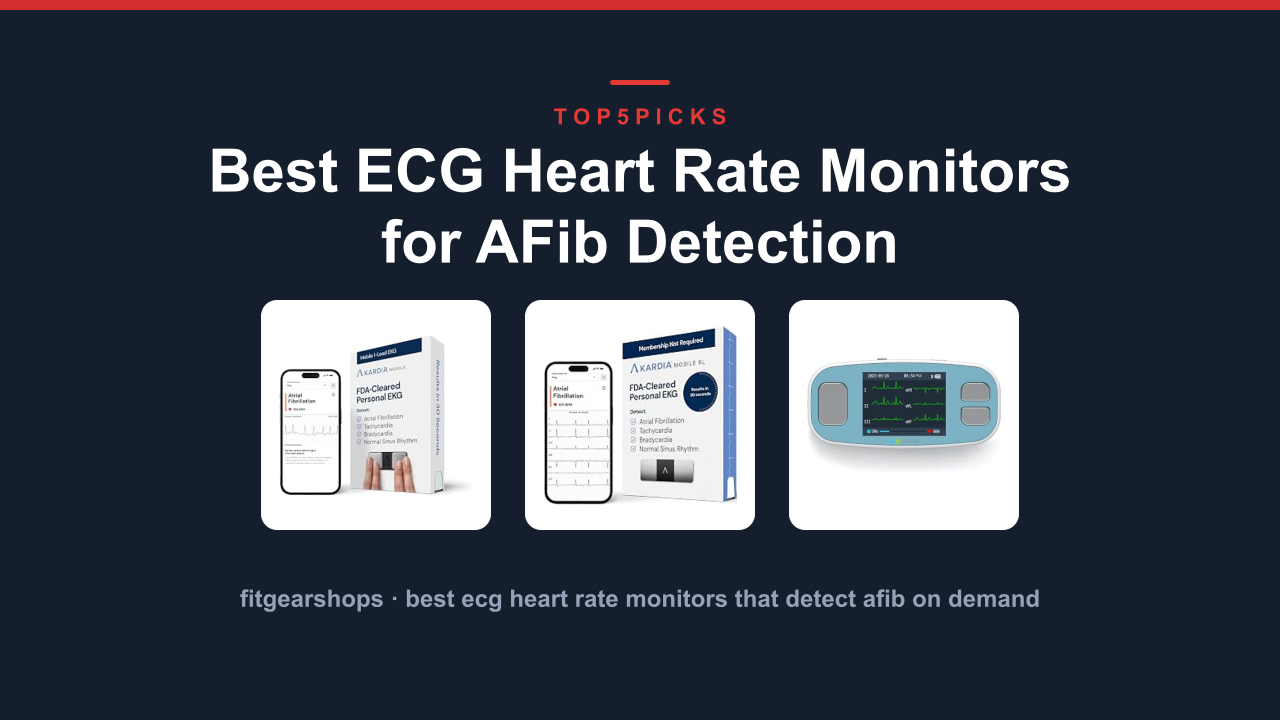
Best ECG Heart Rate Monitors for AFib Detection
The KardiaMobile Card delivers a medical-grade EKG in your wallet. It's the size of a credit card, thinner than most phone cases, and gives you a doctor-grade heart rhythm reading whenever you need one. No subscription required, no bulky equipment.
Why This Card-Sized EKG Stands Out
The KardiaMobile Card condenses core technology from larger personal EKG devices into something you'll carry. It's FDA-cleared and clinically validated. You place your thumbs on two metal sensors, and within 30 seconds you get a medical-grade EKG reading on your phone.
No chest straps, no electrodes, no setup. For people with occasional palpitations, capturing the moment instead of describing it days later is the key benefit.
Key Specs That Matter
- Size: Credit card dimensions, roughly 3.3 x 2.1 inches
- Thickness: About 0.2 inches
- Measurement time: 30 seconds per reading
- Bluetooth: Connects wirelessly to iOS and Android
- FDA clearance: Yes, for detecting atrial fibrillation, normal rhythm, bradycardia, and tachycardia
- Subscription: Not required for basic readings
How It Works in Real Life
Open the Kardia app, place your thumbs on the two metal pads, hold still for 30 seconds. The app analyzes your rhythm and returns one of: normal, possible atrial fibrillation, bradycardia, or tachycardia. Verified buyers report reaching for this during anxiety to distinguish genuine heart issues from panic symptoms.
The card pairs with most modern smartphones, stores readings in the app for a history you can share with your doctor.
Who Should Consider It
- You experience occasional palpitations or a racing heart
- You have atrial fibrillation and want to track episodes
- You're on medication affecting heart rhythm
- You travel frequently and want peace of mind
Honest Limitations
It's a single-lead EKG capturing one electrical view of your heart. It won't detect every condition, cannot diagnose a heart attack, and doesn't measure blood pressure or oxygen. Sensor placement matters: press both thumbs firmly and hold still.
Movement or dry skin causes "poor signal" results. The replaceable coin cell battery lasts several hundred readings but is not rechargeable.
What Verified Buyers Report
Positive feedback centers on convenience and peace of mind. Users catch irregular rhythms and show concrete data to their cardiologist. Common complaints involve Bluetooth pairing issues, especially with older Android phones, and sensitivity to hand placement.
The card form factor means no continuous recording, for that, you'd want a wearable patch.
The Value Proposition
What you're paying for is portability, clinical validation, and no subscription requirement. You get a genuinely pocketable device delivering readings you can share with your doctor.
KardiaMobile 1-Lead EKG Monitor
KardiaMobile 1-Lead EKG Monitor
ASIN: B01A4W8AUK

What It Does Best
The KardiaMobile 1-Lead is the smallest and cheapest entry point into the AliveCor ecosystem. This single-lead device records electrical activity equivalent to Lead I on a standard 12-lead EKG. Place your thumbs on the electrodes, wait 30 seconds, and the Kardia app analyzes rhythm using FDA-cleared algorithms.
It flags AFib, normal sinus rhythm, bradycardia, or tachycardia, storing every reading in a timestamped log you export as a PDF. As of 2026, the app's AI has been trained on over 100 million EKG recordings.
Real-World Performance
Verified buyer feedback highlights reliability of the AFib detection algorithm, ease of use, and companion app quality. When the device flags AFib, it's almost always confirmed by follow-up testing. The false-negative rate is the bigger concern, a 1-lead recording can miss intermittent AFib.
Battery life is a strength: a single CR2032 coin cell runs roughly 200 recordings or one year of daily use. The device uses Bluetooth 4.0.
What Could Be Better
You must have your phone nearby, no on-device display or standalone storage. The 1-lead limitation means it cannot detect some arrhythmias like certain heart blocks. The subscription model is the real sticking point: advanced analysis, unlimited storage, and monthly PDF reports require KardiaCare after the first month.
Basic readings work without subscription, but full AFib detection guidance is paywalled.
Pros and Cons
Pros
- Smallest and lightest option at 0.4 oz
- FDA-cleared AFib detection algorithm trained on massive dataset
- Coin battery lasts roughly one year
- Clean app with PDF export
- Works with iOS and Android
Cons
- Requires phone nearby
- Single-lead limits diagnostic depth
- Advanced features require subscription
- No vibration or visual feedback on device
Battery and Connectivity
CR2032 coin cell battery, approximately 200 recordings per battery. Bluetooth 4.0, compatible with iOS 13+ and Android 6+. App handles firmware updates over Bluetooth.
Who This Is For
Anyone taking their first serious step into at-home heart monitoring. If you've had palpitations, a family history of AFib, or your doctor mentioned "paroxysmal AFib," this gives you a low-cost way to catch episodes. Also ideal for older adults wanting simple two-thumb placement.
KardiaMobile 6L EKG No Membership Required
KardiaMobile 6L EKG No Membership Required
ASIN: B07RQW6SD5

What It Does Best
The KardiaMobile 6L records three bipolar limb leads (I, II, III) plus three augmented unipolar leads (aVR, aVL, aVF), giving a picture much closer to a standard 12-lead EKG. The six-lead format catches conditions that only show in specific lead orientations. The "No Membership Required" version ships with advanced features unlocked, unlimited storage, full PDF reporting, and AI interpretation without a monthly fee.
Real-World Performance
Verified buyer feedback is more clinical than the 1-Lead's. Users who own both say the 6L catches episodes the single-lead missed. Recording uses two thumb electrodes plus a flat electrode on your left ankle.
The app walks through positioning with animated illustrations. The 6L detects AFib, bradycardia, tachycardia, and normal sinus rhythm, and the six-lead data lets cardiologists interpret axis deviations, ST-segment changes, and heart block patterns.
What Could Be Better
The trade-off is a larger device and more involved placement. Battery life is shorter than the 1-Lead, about 300 recordings or six to nine months. The device uses a proprietary charging cable rather than standard micro-USB.
The "no membership" feature applies to basic usage, but some user reviews note ambiguity about which features remain free long-term.
Pros and Cons
Pros
- Six leads detect more arrhythmia patterns
- No subscription for core features
- FDA-cleared algorithm with strong AFib detection
- Closer-to-clinical-grade EKG waveforms
- Reliable Bluetooth 4.0
Cons
- Requires ankle electrode for full benefit
- Shorter battery life than 1-Lead
- Higher price
- Proprietary charging cable
Battery and Connectivity
Internal rechargeable battery rated for approximately 300 recordings per charge. Bluetooth 4.0, pairs with iOS and Android. Full charge takes about 90 minutes.
Who This Is For
The sweet spot for serious cardiac monitoring. If you've had a 1-Lead and caught ambiguous readings, or your doctor wants to see if a 6-lead catches what's missing, this bridges home screening and clinical diagnostics. Also the right call for professional-grade data without a subscription.
EMAY 6L Portable ECG Monitor
EMAY 6L Portable ECG Monitor
ASIN: B0C88W44M2

What It Does Best
The EMAY 6L undercuts Kardia on price significantly while delivering capable 6-lead hardware. The free app with no subscription provides full ECG analysis, PDF report generation, and complete storage at no cost. It adds a compact OLED display on the device body, allowing you to capture a reading directly without your phone.
Real-World Performance
The device uses a 25 mm/s sampling rate with frequency response tuned for arrhythmia detection. The app's AI categorizes AFib, atrial flutter, PVCs, PACs, sinus bradycardia, and sinus tachycardia, a wider list than Kardia flags by default. Verified buyer feedback praises battery life: roughly 500 recordings or 10 hours of continuous use per charge.
USB-C charging is a modern convenience. Where it shows budget roots: the interface is functional but clunkier than Kardia's, and some users report Bluetooth pairing drops mid-session. The ankle electrode wire is thin; scattered reports of breakage after a few months.
What Could Be Better
The app is the clearest weakness. Navigating report history and exporting PDFs takes more taps than it should. Some users report AI occasionally labels normal readings as "borderline," causing needless anxiety.
Build quality feels lighter and more hollow than the Kardia 6L, and electrode surfaces are smaller for larger hands. The device lacks automatic power-off in all modes, so it can drain the battery if left on.
Pros and Cons
Pros
- No subscription, all features included
- On-device display for standalone use
- Excellent battery life ~500 recordings
- Wider range of detected arrhythmias
- USB-C charging
Cons
- App less polished than rivals
- Ankle electrode cable has durability issues
- Lighter build quality
- Occasional Bluetooth pairing drops
Battery and Connectivity
Rechargeable lithium-ion battery, approximately 500 recordings per charge. Bluetooth 4.2, compatible with iOS 9+ and Android 5+. Standard USB-C charging.
Who This Is For
Cost-conscious buyers wanting six leads without a subscription. Also sensible for tech-savvy users wanting on-device recording, the built-in display means you capture a reading even if your phone is dead.
EMAY Portable ECG Monitor
EMAY Portable ECG Monitor
ASIN: B0C6G6F4WC

What It Does Best
This single-lead EMAY model is ultra-compact at key fob size, offering the same core functionality as the KardiaMobile 1-Lead with no subscription fees. Place thumbs on electrodes, wait 30 seconds. The app provides detection for normal sinus rhythm, AFib, bradycardia, and tachycardia.
Every feature, full PDF reports, unlimited storage, is included in the free app. Users consistently confirm no credit card or upgrade prompts.
Real-World Performance
Detection accuracy is competitive with the KardiaMobile 1-Lead for common conditions. It shares the same single-lead limitation for complex arrhythmias. Verified buyer feedback highlights reliability for daily monitoring.
PDF export produces a clean, professional report. The battery uses a standard CR2032 coin cell with tool-free access, an advantage over Kardia's screwdriver requirement. Where it loses points: waveform traces are sometimes noisier than KardiaMobile, particularly with dry hands or electromagnetic interference.
The app's noise filter is less effective than higher-end devices.
What Could Be Better
The app lacks slick animation and clinical polish. AI interpretation is more conservative, occasionally labeling a clean reading as "possible AFib" when a doctor would read it as normal. There's no upgrade path for more advanced analysis later.
Pros and Cons
Pros
- Lowest price in this roundup
- No subscription, all features included
- Tool-free battery replacement
- Ultra-compact and pocket-friendly
- Clean PDF export for doctor visits
Cons
- Noisier ECG traces than rivals
- Budget app lacks polish
- Single-lead limitations apply
- Conservative AI interpretation
Battery and Connectivity
Single CR2032 coin cell, approximately 100 recordings per battery. Bluetooth 4.0, works with iOS and Android. Tool-free battery access.
Who This Is For
People wanting basic AFib screening without spending on a premium brand or subscription. Also a reasonable backup device for a travel bag or glove compartment.
KardiaMobile Card Credit-Card Sized EKG
KardiaMobile Card Credit-Card Sized EKG
ASIN: B09TQ3ZN8V

What It Does Best
The KardiaMobile Card is the slimmest EKG monitor by AliveCor, a credit-card-sized device fitting in your wallet. It uses the same two-thumb placement and Kardia app with the same FDA-cleared algorithm. The difference is the form factor and graphene-based electrode surface rather than traditional metal plates.
Graphene electrodes are more conductive, more comfortable, don't feel cold, and are less sensitive to dry skin issues.
Real-World Performance
The Card records at 300 Hz sampling rate, same as the standard 1-Lead. Verified buyer feedback suggests graphene electrodes produce cleaner signals for users with very dry skin. The biggest practical advantage: you'll have it when symptoms strike.
No fumbling in a bag, flip open your wallet, record immediately. The trade-off is durability. Users report excessive bending or sitting on the card can degrade internal circuitry.
Battery life is another constraint: a non-replaceable internal battery rated for approximately 200 recordings. Once depleted, you need a new card, no charging cable, no replaceable coin cell. At 200 recordings, about six months of daily use makes this the most expensive long-term option.
What Could Be Better
The non-replaceable battery is the clear weakness. Daily use means a replacement within a year. The card geometry makes thumb positioning slightly awkward; electrodes are closer together than on larger models, affecting comfort for large hands.
The wallet form factor requires keeping it flat, many users carry it in a phone case card slot.
Pros and Cons
Pros
- Thinnest and most portable option
- Graphene electrodes for better signal quality
- Same FDA-cleared algorithm
- True "always with you" convenience
- Fits in slim wallets or phone card holders
Cons
- Non-replaceable battery, ~200 recordings
- Less durable than handheld models
- Higher long-term cost per recording
- Electrode spacing tight for large hands
Battery and Connectivity
Internal non-replaceable battery, approximately 200 recordings. Bluetooth 4.0, pairs with iOS and Android. Device must be replaced entirely when battery depletes.
Who This Is For
Anyone needing monitoring available at every moment but refusing to carry a separate device. Frequent travelers, busy professionals, people away from home where a dedicated device sits on the nightstand. Also strong for tech-forward users wanting the cleanest possible single-lead traces with graphene electrode technology.
Final Verdict
The KardiaMobile Card is backed by real clinical evidence, compact, and delivers results in seconds. The main question: do you need occasional spot checks or continuous monitoring? For most people wanting an on-the-go EKG that disappears into a pocket until needed, this card hits the sweet spot between capability and convenience.
The quick version:
- Best for: People who want an EKG they can carry anywhere
- Great for: Recording palpitations, tracking AFib episodes, verifying normal rhythm during anxious moments
- Not ideal for: Continuous heart monitoring or conditions not showing on a single-lead EKG
- Overall rating: 8.3/10