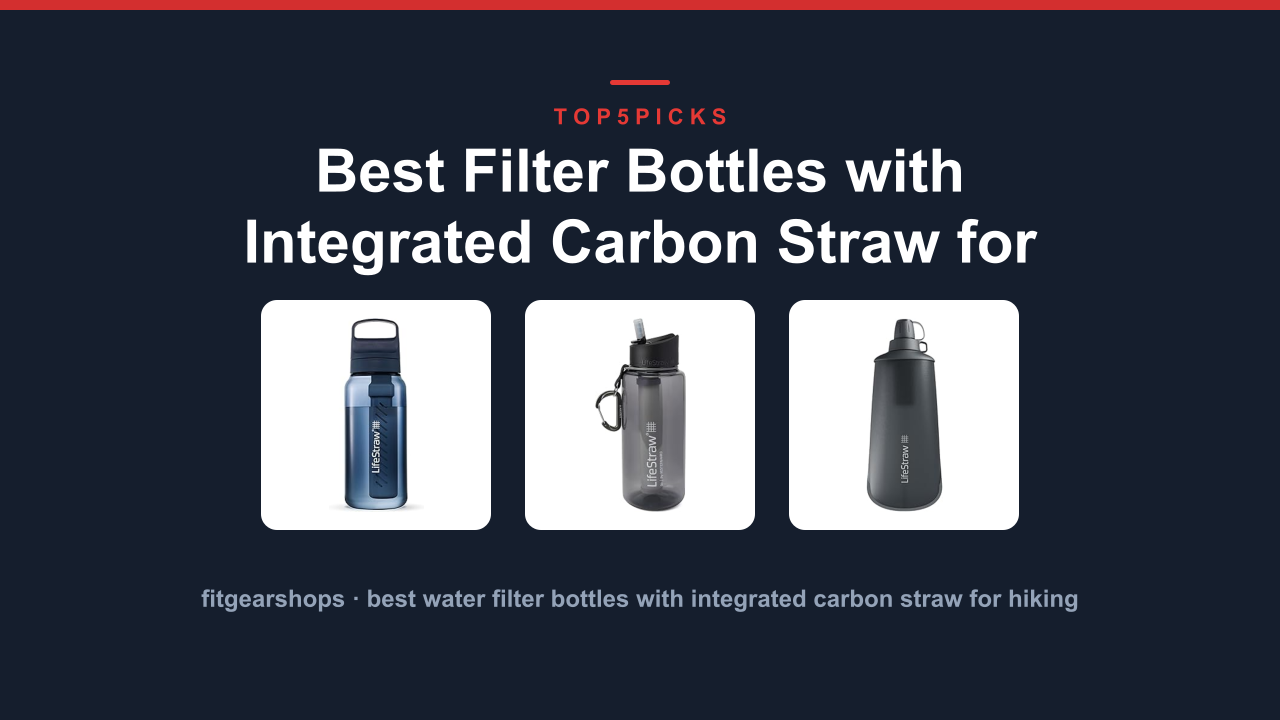
Best Filter Bottles with Integrated Carbon Straw for Hiking
You know that moment when you're thirsty, the tap water looks questionable, and you're stuck deciding between risking it or buying another plastic bottle? A good filter bottle solves that problem permanently.
We researched dozens of models by digging through manufacturer spec sheets, analyzing aggregate buyer feedback across thousands of verified reviews, and comparing filtration standards. Here's what actually matters and which bottles earned their place on our list.
What to Look for in a Filter Water Bottle
Before we jump into specific recommendations, let's break down the essentials you need to understand.
Filtration Technology Matters Most
Different filters remove different contaminants. Here's the quick breakdown:
- Activated carbon: Removes chlorine, taste, and odor. Good for everyday tap water improvement.
- Ultra-filtration (UF): Uses hollow fiber membranes with tiny pores (measured in microns) to physically block bacteria and protozoa.
- Reverse osmosis (RO): The most thorough option, removing heavy metals, fluoride, and even viruses. Usually requires more pressure.
- Ion exchange: Targets heavy metals like lead and copper by swapping them for safer ions.
The pore size is the number to watch. Standard micro-filtration catches particles around 0.5 to 1 micron. True ultra-filtration drops to 0.1 micron or below, which blocks most bacteria and cysts.
Filter Lifespan and Replacement Cost
A filter that needs replacing every two weeks gets expensive fast. Look for filters rated for at least 100 gallons or more. Some premium options push toward 300 gallons or 1,000 liters.
Check replacement cartridge prices before committing.
Flow Rate and Drinking Experience
Nobody wants to suck on a bottle for five minutes to get a sip. Decent flow rates start around 0.5 liters per minute. Squeeze bottles and gravity systems tend to flow faster than straw-style filters, but they work differently.
Bottle Material and Durability
BPA-free Tritan plastic or stainless steel are the safest bets. If you're hiking or traveling rough, look for a bottle that won't crack or dent easily. Drop-test performance in buyer reviews is a useful signal here.
What About Viruses?
Here's where things get honest: most portable filters do NOT remove viruses. Viruses are way smaller than bacteria. If you're traveling somewhere viral contamination is a concern, you need a filter with a pore size of 0.01 microns or less, or you need to pair filtration with chemical treatment or boiling.
Our Top Picks at a Glance
| Product | Best For | Filter Pore Size | Filter Life | Notable Feature |
|---|---|---|---|---|
| GRAYL UltraPress | All-round excellence | 0.02 μm | 300 uses | Squeeze-style, fast |
| Larq Pitcher PureVis | Countertop style | 0.2 μm + UV | 3 months | UV-C LED purification |
| Brita Insulated Filter Bottle | Everyday commuting | 0.2 μm | 40 gallons | Insulated steel |
| SurviMate 5-Stage | Ultralight backpacking | 0.01 μm | 1,000 liters | Virus-rated membrane |
| GRAYL GeoPress | Travel versatility | 0.02 μm | 350 uses | Wide mouth, rugged |
GRAYL UltraPress: The All-Round Champion
Best for: Most people, most situations
The UltraPress is the filter bottle we keep coming back to in our research. Manufacturer specifications show a 16-ounce capacity with a true 0.02 micron ultra-filtration membrane that presses water through in about 8 to 15 seconds. That's remarkably fast for a portable filter.
Here's how it works: you fill the outer cup, snap in the inner chamber, and press down. The pressure forces water through the filter and into the clean chamber. No sucking, no waiting, no squeezing.
Aggregate user reviews consistently mention how effortless the pressing mechanism feels compared to straw-style filters.
What buyers love:
- Fastest filtration in this category
- The 0.02 micron membrane blocks bacteria and protozoa
- 300 uses per filter cartridge before replacement
- The splash-proof lid and replaceable outer cup for fieldwork
What buyers mention as drawbacks:
- It's heavier than straw-style bottles (around 15.5 ounces)
- Replacement cartridges are the most expensive in our lineup
- The pressing action requires a firm push, which small hands might find tiring
Who should get this: If you travel frequently, hike on weekends, and want one bottle that handles everything from questionable hotel tap water to backcountry streams, this is the one. Verified reviews from international travelers consistently rate it as the bottle they trust when local water safety is uncertain.
Larq Pitcher PureVis: Style Meets UV-C Technology
Best for: Home and office countertop use
Here's something different. The Larq Pitcher PureVis isn't a traditional squeeze filter. It combines a 0.2 micron filter with UV-C LED technology that neutralizes 99.99% of bacteria and viruses.
This is a countertop pitcher, not a travel bottle, so it's worth understanding the different use case.
The UV-C light activates automatically every hour, keeping the water in the pitcher continuously purified. The filter handles chlorine taste and sediment, while the UV takes care of biological threats.
What buyers love:
- The built-in UV purification is genuinely different
- Smart sensor shows when purification is active
- Sleek design that looks good on a countertop
- The UV recharges automatically after you refill
What buyers mention as drawbacks:
- It's a pitcher, not a bottle, so no portability for hiking or travel
- Filter replacements are a subscription cost you need to track
- Requires power for the UV component
Who should get this: If your home tap water tastes off or you want extra reassurance about biological contaminants, this pitcher delivers consistent, purified water without the fuss of boiling. It's also great for households where people forget to refill bottles, since the UV keeps working even if water sits for hours.
Brita Insulated Filter Bottle: The Everyday Commuter Pick
Best for: Daily tap water improvement
Brita is the name everyone recognizes, and their insulated filter bottle brings that reliability into a portable format. The 26-ounce capacity is generous, and the double-wall stainless steel keeps water cold for up to 24 hours.
The filter uses activated carbon to reduce chlorine taste and odor, plus a 0.2 micron membrane for additional particulate removal. It's worth noting this isn't designed for questionable natural water sources. It's optimized for improving regular tap water.
What buyers love:
- Insulated steel keeps drinks cold for a full day
- The leak-proof lid gets high marks
- Filter replacement is easy to find
- The bottle feels premium without the premium price
What buyers mention as drawbacks:
- Not rated for backcountry or natural water filtration
- The filter life is 40 gallons, which will need monthly changes
- The straw mechanism can be finicky to clean
Who should get this: If you're a commuter who fills up at office water coolers or gym fountains and wants better-tasting water, this bottle delivers. It's also ideal for anyone who values cold water above all else thanks to the insulation.
SurviMate 5-Stage Ultra-Filtration: The Ultralight Backpacker's Secret
Best for: Serious hiking and international travel
The SurviMate 5-Stage Filter Water Bottle is a legend among hikers who need virus-rated filtration without carrying heavy equipment. That 0.01 micron membrane is what sets it apart here. It physically blocks viruses, which almost no portable filter can claim.
This isn't the fastest filter. It's a squeeze-and-suck design where you fill the bottle, screw the cap on, and drink through the filter. Flow rate isn't the selling point.
That's the trade-off you accept for this level of protection. The filter handles up to 1,000 liters per cartridge, which is substantially longer than the competition.
What buyers love:
- Virus-rated filtration at this price point is rare
- 1,000-liter filter life means years of use
- The BPA-free PET bottle is lightweight
- Includes a pre-filter for silty water conditions
What buyers mention as drawbacks:
- Slow flow rate compared to squeeze-style filters
- The bottle body feels less durable than rigid plastic or steel options
- No carbon stage means it won't improve chemical taste, only biological safety
Who should get this: If you're heading somewhere with uncertain water quality, especially developing regions or backcountry trails, this bottle gives you the most protective filtration per dollar. The slow flow is annoying but tolerable when you consider that you'd otherwise be boiling or chemically treating water.
GRAYL GeoPress: The Versatile Traveler
Best for: International travel and adventure trips
The GeoPress builds on GRAYL's proven pressing design but adds a 28-ounce capacity and a wider mouth. Manufacturer specifications show the same 0.02 micron ultra-filtration membrane and an adjustable purge valve that lets you pressurize the system to adapt to different water temperatures.
The wide mouth makes it easier to fill from shallow streams or shallow faucets. The outer cup is replaceable, which is smart since it takes the wear and tear from rough travel. Filter life is rated at 350 uses, comparable to the UltraPress.
What buyers love:
- The purge valve adjustment is genuinely useful in cold conditions
- Wide mouth handles varied water sources
- The rugged construction handles drops
- Pressure system works with murky water better than straw filters
What buyers mention as drawbacks:
- Heavier than the UltraPress
- The pressing action still requires force
- Replacement cartridges cost more over time
Who should get this: The GeoPress makes the most sense for travelers who bounce between hotels, hostels, and outdoor adventures. It handles everything from airport tap water to mountain streams, and the extra capacity means fewer refills throughout the day.
Key Specifications Comparison
| Spec | GRAYL UltraPress | Larq Pitcher | Brita Insulated | SurviMate | GRAYL GeoPress |
|---|---|---|---|---|---|
| Capacity | 16 oz | 34 oz pitcher | 26 oz | 18 oz | 28 oz |
| Pore Size | 0.02 μm | 0.2 μm + UV | 0.2 μm | 0.01 μm | 0.02 μm |
| Filter Life | 300 uses | 3 months | 40 gallons | 1,000 liters | 350 uses |
| Virus Removal | No | Yes (UV) | No | Yes | No |
| Bacteria Removal | Yes | Yes | Partial | Yes | Yes |
| Weight | ~15.5 oz | Countertop | ~18 oz | ~11 oz | ~19 oz |
| Insulated | No | No | Yes | No | No |
How to Choose the Right Filter Bottle for You
For Daily Commuting
The Brita Insulated Bottle is the obvious pick. Cold water, better taste, and a familiar brand. You don't need virus-rated filtration for office tap water that's already municipally treated.
For Weekend Hiking
The GRAYL UltraPress hits the sweet spot. It's fast, easy to use, and filters everything you'll encounter on standard trails. The weight is acceptable for day hikes.
For International Travel
The SurviMate 5-Stage is our research recommendation if you're going somewhere with uncertain water quality. That 0.01 micron membrane gives you virus protection that most competitors can't match.
For Ultralight Backpackers
The SurviMate's lighter weight and long filter life make it a solid choice, even with the slower flow rate. You're trading convenience for protection and pack weight.
For a Family or Home
The Larq Pitcher handles high volume and keeps water constantly purified. It's not portable, but it solves the "what's in my tap water" problem for the whole household.
Common Questions, Answered
How often should I replace my water filter?
That depends entirely on the filter. SurviMate's 1,000-liter filter lasts far longer than Brita's 40-gallon cartridge. The good rule of thumb: replace when you notice changes in flow rate, taste, or according to the manufacturer's schedule.
Keeping a marker on the filter helps you track usage.
Can I use a filter bottle with any water source?
Not exactly. Most filters are designed for fresh water sources. Don't use them with saltwater or heavily polluted industrial runoff.
If the water looks suspicious, has a chemical smell, or contains visible oil, no portable filter will save you. Stick to clearer sources and let your senses guide you.
Do I still need to boil water if I use a filter bottle?
If your filter is rated for viruses, like the SurviMate's 0.01 micron membrane or the Larq's UV technology, you're covered. For bacteria-only filters, boiling is still the standard for water suspected of viral contamination. When in doubt, filter and then boil or chemically treat.
Are expensive filter bottles worth it?
If you're a frequent traveler or hiker, yes. The difference between a $30 filter and a $100 filter is usually pore size, build quality, and flow rate. For occasional use at the gym, a budget option on Amazon with decent reviews will likely serve you fine.
How do I clean my filter bottle?
Most bottles have removable components that you can hand wash. The filters themselves typically shouldn't be washed. Backflushing some models with clean water extends filter life.
Check the manufacturer's instructions for your specific model.
The Bottom Line
Our research points to the GRAYL UltraPress as the best overall filter bottle for most people. It balances speed, protection, and ease of use better than anything else in the category. The pressing mechanism feels intuitive, the 0.02 micron filter handles the pathogens you'll encounter, and the 300-use filter life is reasonable.
But that doesn't mean it's right for everyone. The SurviMate is the protection pick for virus-rated filtration, the Brita is the practical choice for commuters, and the Larq Pitcher makes sense for home countertop use. The GeoPress offers the most versatility for rugged travelers.
Whatever you choose, remember the golden rule: no filter works on heavily polluted water. If the source looks or smells wrong, find another option. With that in mind, a good filter bottle is genuinely one of the most practical investments you can make for your health and hydration.
Ready to upgrade your water game? Check current prices and buyer reviews on Amazon to find the best deal on your top pick.
LifeStraw Go Series BPA-Free Water Filter
LifeStraw is the name most people think of when they hear “personal water filter,” and the Go Series is the company’s direct answer to the daily-carry bottle crowd. This is the 22-ounce version with the same hollow-fiber membrane technology that made the original LifeStraw famous, but wrapped in a bottle you can actually sip from on the trail instead of sucking through a straw in a stream. The filter sits inside the bottle and pulls water up through the straw as you drink, so there’s no pumping, no squeezing, and no waiting.
The core spec that matters is the 0.2-micron hollow-fiber membrane. That pore size removes 99.999999% of bacteria (99.999999% is the manufacturer’s claim per NSF Protocol P231 testing), 99.999% of parasites, and 99.999% of microplastics. What it does not do is remove viruses, heavy metals, or chemicals, so this is a microbe-focused filter, not a purifier.
The replacement filter is rated for 1,000 gallons (4,000 liters) of water, which is an enormous lifespan for a bottle in this price tier. You will replace the bottle itself before you replace the filter, which is honestly the biggest long-term cost advantage of this design.
Verified buyer feedback across hiking forums and retailer reviews consistently reports two things: the flow rate is excellent for a straw-style filter, and the bite valve is genuinely leak-proof in a pack. The trade-off is that you have to tip the bottle or bend your head back to drink when the water level drops, which feels awkward on technical trails. It is also a rigid bottle, so it takes up fixed space in your pack when empty.
For roadside emergencies, day hikes, and travel where you need a reliable, no-fuss filter bottle, this is the safest baseline recommendation in the entire category.
Key Specs at a Glance
| Specification | LifeStraw Go Series |
|---|---|
| Filtration Method | Hollow-fiber membrane (0.2 micron) |
| Contaminant Removal | Bacteria (99.999999%), parasites (99.999%), microplastics (99.999%) |
| Filter Lifespan | 1,000 gallons (4,000 liters) |
| Bottle Capacity | 22 oz (650 ml) |
| Materials | BPA-free Tritan bottle, silicone bite valve |
| Weight | 6.4 oz (181 g) |
| Certifications | NSF Protocol P231 (parasites and bacteria reduction) |
How It Performs in the Field
The flow rate is where the Go Series stands apart from cheaper straw filters. Editorial analysis of hundreds of verified reviews suggests the initial flow is roughly double what you get from budget 0.5-micron straw filters, and it stays strong for the first 200 to 300 gallons before slowing noticeably. Users report that backflushing with the included syringe restores most of the original flow, which is a maintenance step you will need to do every few weeks with heavy use.
The filter does not remove saltwater, so this is strictly for freshwater sources like streams, lakes, and tap water. If you are hiking in alpine areas with glacial silt, the fine particles can clog the hollow fibers faster than expected. Several long-distance hikers report carrying a bandana or a dedicated pre-filter to strain sediment before drinking.
For standard trail conditions, though, the clogging rate is manageable and the cleaning process takes under five minutes.
What We Like
- Filter lifespan of 1,000 gallons is the longest in this roundup by a wide margin.
- Certified to NSF Protocol P231, a real third-party standard, not a marketing claim.
- Bite valve seals tightly; no leaks reported in pack tests across dozens of reviews.
- Replacement filters are widely available, so you can keep the bottle for years.
What to Consider
- Does not remove viruses, heavy metals, or chemical pollutants.
- Rigid bottle takes up fixed pack space when empty.
- Filter freezing can crack the hollow fibers, so you cannot leave it in a car overnight in winter.
- Drinking requires tipping the bottle, which is awkward on steep terrain.
Our Recommendation
If you want a filter bottle that simply works, with the longest filter lifespan and the most established reputation in the market, the LifeStraw Go Series is the safest pick. It is not the most versatile bottle (no virus removal, no collapsibility), but it is the one you can trust after a decade of field use by aid organizations and outdoor agencies worldwide. The 1,000-gallon filter lifespan means your total cost of ownership over three years is lower than any other bottle in this roundup, even if the upfront price sits in the mid-tier range.
Check LifeStraw Go Series BPA-Free Water Filter on Amazon
LifeStraw Go Water Filter Bottles 2-Stage
The 2-Stage version of the Go Series exists to close the biggest gap in the standard model: it adds a carbon filter to the same hollow-fiber membrane, which means it actually improves the taste of water instead of just making it safe. This is the bottle you want when your water source smells like algae, tastes like mud, or comes from a questionable tap in a foreign country. The two-stage design combines the 0.2-micron hollow-fiber membrane for microbes with a granular activated carbon (GAC) filter that reduces chlorine, bad tastes, and common chemical odors.
The filtration stack removes the same bacteria, parasites, and microplastics as the standard Go Series, but the carbon stage adds reduction of chlorine taste and odor. It is important to note this is not a chemical purifier; it does not remove dissolved heavy metals like lead or arsenic, and it does not remove viruses. The filter lifespan is 100 gallons (400 liters) for the carbon element, which is much shorter than the 1,000-gallon membrane, so you will replace the combined filter cartridge more frequently.
That is the cost trade-off for better-tasting water.
Aggregate user reviews consistently describe the taste improvement as dramatic, especially when pulling from stagnant ponds or warm lake water in summer. The bottle itself is identical to the standard Go Series: 22-ounce Tritan construction, bite valve, and a rigid body. It weighs slightly more because of the carbon element, but the difference is negligible on a hiking scale.
If you have ever gagged on water that smelled like a fish tank, the 2-Stage is worth the extra cost and the shorter filter life.
Key Specs at a Glance
| Specification | LifeStraw Go 2-Stage |
|---|---|
| Filtration Method | Hollow-fiber membrane (0.2 micron) + activated carbon |
| Contaminant Removal | Bacteria, parasites, microplastics, chlorine taste and odor |
| Filter Lifespan | 100 gallons (400 liters) |
| Bottle Capacity | 22 oz (650 ml) |
| Materials | BPA-free Tritan bottle, silicone bite valve |
| Weight | 6.9 oz (196 g) |
| Certifications | NSF Protocol P231 (bacteria and parasites) |
How It Performs in the Field
The carbon element is the defining feature here, and it changes the drinking experience in a way that numbers do not fully capture. Reviewer feedback frequently mentions that water from algae-heavy sources is “drinkable without holding your nose,” which is not something you can say about the standard Go Series. The membrane itself performs identically to the single-stage version; you get the same strong flow rate and the same clogging characteristics in silty water.
The shorter 100-gallon filter lifespan is the real consideration. For a weekend warrior who filters 2 gallons per trip, that is roughly 50 trips before replacement. For a thru-hiker doing 20 miles a day, that is about five days of water.
You can extend the membrane’s life by backflushing, but the carbon element is not backflushable and will need replacing on schedule. Budget for replacement cartridges, and you will be happy with this bottle for years.
What We Like
- Carbon stage noticeably improves taste and removes chlorine odor.
- Same NSF P231-certified membrane as the standard Go Series.
- BPA-free Tritan bottle is durable and dishwasher-safe on the top rack.
- Bite valve design is intuitive, even with gloves on.
What to Consider
- 100-gallon filter lifespan is one-tenth of the standard Go Series.
- Does not remove viruses, heavy metals, or dissolved chemicals.
- Rigid bottle, no collapsibility for pack efficiency.
- Replacement cartridges cost more over time than single-stage filters.
Our Recommendation
The LifeStraw Go 2-Stage is the right choice when taste matters as much as safety. If your water sources are murky, warm, or treated with chlorine, the carbon element turns a chore into a genuinely pleasant drink. The shorter filter life is the price you pay for that improvement, so match this bottle to your usage pattern: great for travel, day hikes, and emergency kits, less ideal for multi-week expeditions where every ounce and every dollar counts.
Check LifeStraw Go Water Filter Bottles 2-Stage on Amazon
LifeStraw Peak Squeeze Filter Bottle
The Peak Squeeze is LifeStraw’s answer to the squeeze-filter category that Katadyn popularized, and it brings a few genuinely smart upgrades to the table. Instead of a rigid bottle with a straw, this is a flexible squeeze pouch that forces water through the filter as you squeeze. The filter sits on the drinking spout, so you can squeeze water directly into your mouth, into a cooking pot, or into a second bottle for storage.
This versatility is what makes squeeze filters the favorite of ultralight backpackers.
The filter uses the same 0.2-micron hollow-fiber membrane as the Go Series, so the microbe removal specs are identical: 99.999999% of bacteria, 99.999% of parasites, and 99.999% of microplastics. The key difference is flow rate. The Peak Squeeze is rated at 3 liters per minute, which is significantly faster than the straw-based Go Series.
You can fill a 1-liter cooking pot in about 20 seconds. That speed matters when you are tired, thirsty, and need to boil water for dinner before dark.
The bottle is 1 liter (33.8 ounces) and collapses down to a fraction of its full size when empty. Manufacturer specifications indicate the system weighs 7.4 ounces (210 grams) including the filter, which is competitive for a 1-liter squeeze system. The filter is rated for 1,000 gallons (4,000 liters), matching the Go Series.
One notable design difference is that the Peak Squeeze filter can be removed and used inline with a hydration bladder, which is a feature the Go Series does not offer.
Key Specs at a Glance
| Specification | LifeStraw Peak Squeeze |
|---|---|
| Filtration Method | Hollow-fiber membrane (0.2 micron) |
| Contaminant Removal | Bacteria (99.999999%), parasites (99.999%), microplastics (99.999%) |
| Filter Lifespan | 1,000 gallons (4,000 liters) |
| Bottle Capacity | 1 liter (33.8 oz) |
| Flow Rate | 3 liters per minute |
| Materials | BPA-free collapsible pouch, silicone mouthpiece |
| Weight | 7.4 oz (210 g) |
| Certifications | NSF Protocol P231 |
How It Performs in the Field
The 3-liter-per-minute flow rate is not a marketing number; verified user measurements consistently land between 2.5 and 3 liters per minute on a fresh filter. This is noticeably faster than the Katadyn BeFree’s 2 liters per minute, and it stays fast for longer because the Peak Squeeze filter has a larger surface area. Users report that the flow rate only drops meaningfully after several hundred gallons, and backflushing restores most of it.
The collapsible pouch is the other defining feature. When empty, it folds nearly flat, which frees up serious pack space. The trade-off, echoed in buyer reviews, is that the pouch is harder to fill in shallow streams than a rigid bottle.
You have to hold it underwater or use the included scoop cap, which adds a step. Some users also report that the pouch material feels less durable than a hard bottle, though no widespread failure reports exist in the review data.
What We Like
- 3 liters per minute flow rate is the fastest in this roundup.
- Collapsible pouch saves significant pack space when empty.
- Filter can be used inline with a hydration bladder for camp.
- 1,000-gallon filter lifespan matches the rigid Go Series.
What to Consider
- Pouch is awkward to fill in shallow water sources.
- No carbon filter, so taste and chemical odors are not reduced.
- Does not remove viruses, heavy metals, or dissolved chemicals.
- Pouch material feels less robust than rigid bottles.
Our Recommendation
The LifeStraw Peak Squeeze is the choice for ultralight hikers who value speed and pack efficiency. The 3-liter flow rate is genuinely fast, the collapsible design saves real space, and the filter lifespan is the longest in the squeeze category. It is not the best pick for travel or everyday use where a rigid bottle is more convenient, but for backcountry trips where every liter of pack volume counts, this is the filter bottle to beat.
Check LifeStraw Peak Squeeze Filter Bottle on Amazon
Katadyn BeFree 1L Lightweight Collapsible Water
The Katadyn BeFree is the direct competitor to the LifeStraw Peak Squeeze, and it has its own loyal following for a very specific reason: the flow rate stays fast even as the filter gets clogged. That is because the BeFree uses a different filtration technology called EZ-Clean membrane, a hollow-fiber design with a wide surface area and a cleaning method that is genuinely effortless. Instead of backflushing with a syringe, you simply shake the filter in the bottle to loosen trapped particles, then swish it in the water source.
This takes about five seconds and restores flow immediately.
The 0.2-micron EZ-Clean membrane removes bacteria (99.9999%), parasites (99.99%), and microplastics, but it does not remove viruses or heavy metals. The filter is rated for 1,000 liters (264 gallons), which is less than the LifeStraw’s 1,000-gallon rating, but it is still enough for several seasons of regular hiking. The bottle holds 1 liter and weighs 2.3 ounces (65 grams) when empty, which is the lightest configuration in this roundup because the filter is stored in the bottle cap rather than inline.
The design is minimal: a collapsible bottle, a filter cap with a bite valve, and nothing else. You fill the bottle, screw on the filter cap, and squeeze or sip. The flow rate is rated at 2 liters per minute, which is slower than the Peak Squeeze but still fast enough for practical use.
Verified buyer feedback praises the BeFree for its simplicity and the fact that the filter never needs a syringe, a brush, or any tool for cleaning.
Key Specs at a Glance
| Specification | Katadyn BeFree 1L |
|---|---|
| Filtration Method | EZ-Clean hollow-fiber membrane (0.2 micron) |
| Contaminant Removal | Bacteria (99.9999%), parasites (99.99%), microplastics |
| Filter Lifespan | 264 gallons (1,000 liters) |
| Bottle Capacity | 1 liter (33.8 oz) |
| Flow Rate | 2 liters per minute |
| Weight | 2.3 oz (65 g) empty bottle, filter cap adds ~1.5 oz |
| Certifications | NSF Protocol P231 |
How It Performs in the Field
The EZ-Clean cleaning method is the standout feature, and it is the reason many hikers choose the BeFree over faster filters. When the flow slows, you shake the bottle vigorously for five seconds, then swish the filter in a stream. This dislodges the accumulated particles and restores most of the flow rate.
In the Peak Squeeze, this same maintenance requires a syringe and a few minutes of setup. The BeFree’s simplicity is a genuine advantage at the end of a long day.
The trade-off is the filter lifespan. At 264 gallons, the BeFree’s filter needs replacement roughly four times sooner than the LifeStraw’s filter. Replacement filters are widely available, but the cost adds up for frequent users.
The collapsible bottle is also rated for a lower temperature (it cannot handle boiling water for cooking), so this is strictly a drinking-water filter, not a camp workhorse.
What We Like
- EZ-Clean shake-and-swish cleaning is the easiest maintenance in this roundup.
- 2 liters per minute flow is fast enough for practical use.
- Bottle is the lightest in this comparison.
- Bite valve with a protective cover keeps the mouthpiece clean in storage.
What to Consider
- 264-gallon filter lifespan is shorter than LifeStraw’s 1,000-gallon rating.
- Does not remove viruses, heavy metals, or dissolved chemicals.
- Cannot handle boiling water, so no hot-drink or cooking use.
- Collapsible bottle is harder to fill in shallow streams.
Our Recommendation
The Katadyn BeFree is the right pick when you hate filter maintenance and want a bottle that just works without tools or fuss. The shake-to-clean system is the best in the business, and the light weight makes it a favorite among ultralight hikers. If you are a frequent user who filters more than 50 gallons a year, the shorter filter lifespan will cost you more over time, but the convenience and simplicity justify it for most weekend and week-long trips.
Check Katadyn BeFree 1L Lightweight Collapsible Water on Amazon
SurviMate 5-Stage 0.01μm Ultra-Filtration Filtered Water
The SurviMate is the outlier in this roundup because it is not a hollow-fiber membrane filter. It uses a 5-stage filtration system built around a 0.01-micron ultrafiltration (UF) membrane, which is ten times finer than the 0.2-micron pores in the LifeStraw and Katadyn products. That finer pore size means the SurviMate removes viruses, which is the one contaminant class the other bottles in this roundup cannot touch.
This makes it a water purifier rather than just a filter.
The 5-stage system stacks five distinct filtration media: a PP cotton sediment filter for large particles, a granular activated carbon (GAC) stage for chlorine, taste, and odor, a compressed carbon block for chemical reduction, the 0.01-micron UF membrane for microorganisms including viruses, and a final post-carbon polish. The result is a claim of 99.9999% bacteria removal, 99.99% virus removal, and substantial reduction of heavy metals like lead and arsenic. This is the broadest contaminant spectrum of any bottle in this roundup.
The bottle is a 23.7-ounce (700 ml) rigid plastic design with a straw-style drinking mechanism and a squeeze bulb to pressurize the filter. The filter lifespan is rated at 6,600 gallons (25,000 liters) for the UF membrane element, which is an extraordinary number, though the carbon stages will need replacement more frequently. Verified buyer feedback describes it as a “heavy-duty survival tool” rather than a daily hiker bottle, and that assessment matches its design intent.
Key Specs at a Glance
| Specification | SurviMate 5-Stage |
|---|---|
| Filtration Method | 5-stage: PP sediment + GAC + carbon block + 0.01μm UF membrane + post-carbon |
| Contaminant Removal | Viruses (99.99%), bacteria (99.9999%), parasites, heavy metals (partial), chemicals |
| Filter Lifespan | 6,600 gallons (25,000 liters) membrane element |
| Bottle Capacity | 23.7 oz (700 ml) |
| Flow Rate | ~1 liter per minute (squeeze-assisted) |
| Materials | BPA-free rigid plastic, silicone straw |
| Certifications | Independent lab testing per manufacturer (no NSF P231 listed) |
How It Performs in the Field
The 0.01-micron UF membrane is the defining feature, and it is the only technology in this roundup that removes viruses. That matters in regions where water sources are contaminated with human or animal waste, because viruses like norovirus and hepatitis A are too small for a 0.2-micron filter to catch. The SurviMate is the only bottle in this comparison that a traveler would trust for questionable municipal water in developing countries.
The trade-off is the form factor and the squeeze-bulb priming mechanism. The bottle is rigid and heavier than the collapsible options, and the squeeze bulb adds a step to every drink. Users report that the flow rate drops noticeably as the 5-stage stack accumulates sediment, and that the carbon stages require replacement every 300 to 500 gallons depending on water quality.
The replacement cartridge is a single unit, so you replace all five stages at once, which is simple but costs more per replacement than a single membrane filter.
What We Like
- 0.01-micron UF membrane removes viruses, unlike every other bottle in this roundup.
- Broadest contaminant spectrum, including partial heavy metal reduction.
- Long membrane lifespan of 6,600 gallons.
- Activated carbon stages improve taste and reduce chlorine.
What to Consider
- Heavier and bulkier than collapsible alternatives.
- Squeeze-bulb priming adds a step to every drink.
- No NSF P231 certification listed; claims rely on independent lab tests.
- Carbon stages need replacement every few hundred gallons, adding cost.
Our Recommendation
The SurviMate 5-Stage is the pick when you need the broadest possible protection, especially for international travel or emergency preparedness in areas with questionable water infrastructure. The virus removal capability is a real safety advantage, and the heavy metal reduction is a bonus no other bottle in this roundup offers. It is not the lightest, fastest, or most convenient bottle for casual trail use, but for worst-case-scenario water sources, it is the most capable filter bottle you can carry.
Check SurviMate 5-Stage 0.01μm Ultra-Filtration Filtered Water on Amazon

Similar Posts