How Many Earths Can Fit in the Sun: Mind-Blowing Facts Revealed
Have you ever wondered just how huge the Sun really is? It’s hard to imagine something so massive, but comparing it to Earth can help you grasp its true size.
If you’ve ever asked yourself, “How many Earths can fit in the Sun? ” you’re not alone. Understanding this mind-blowing scale will change the way you see our place in the universe. Keep reading, and you’ll discover fascinating facts that will surprise you—and make you appreciate the vastness of space like never before.
Size Comparison Between Earth And Sun
The Sun and Earth are vastly different in size. Understanding their size difference helps us grasp how many Earths fit inside the Sun. The comparison focuses on diameter, volume, mass, and density. Each aspect shows how huge the Sun really is compared to our planet.
Diameter And Volume
The Sun’s diameter measures about 1.39 million kilometers. Earth’s diameter is roughly 12,742 kilometers. This means the Sun is over 100 times wider than Earth.
Volume shows an even greater difference. The Sun’s volume is about 1.41 x 10¹⁸cubic kilometers. Earth’s volume is around 1.08 x 10¹²cubic kilometers. The Sun can hold about 1.3 million Earths inside it by volume. This huge difference explains why the Sun dominates our solar system.
Mass And Density
The Sun’s mass is approximately 1.99 x 1030kilograms. Earth’s mass is roughly 5.97 x 1024kilograms. The Sun is about 330,000 times more massive than Earth.
Density shows the Sun is less dense than Earth. The Sun’s average density is 1.41 grams per cubic centimeter. Earth’s average density is 5.52 grams per cubic centimeter. This means Earth is much denser but much smaller than the Sun.
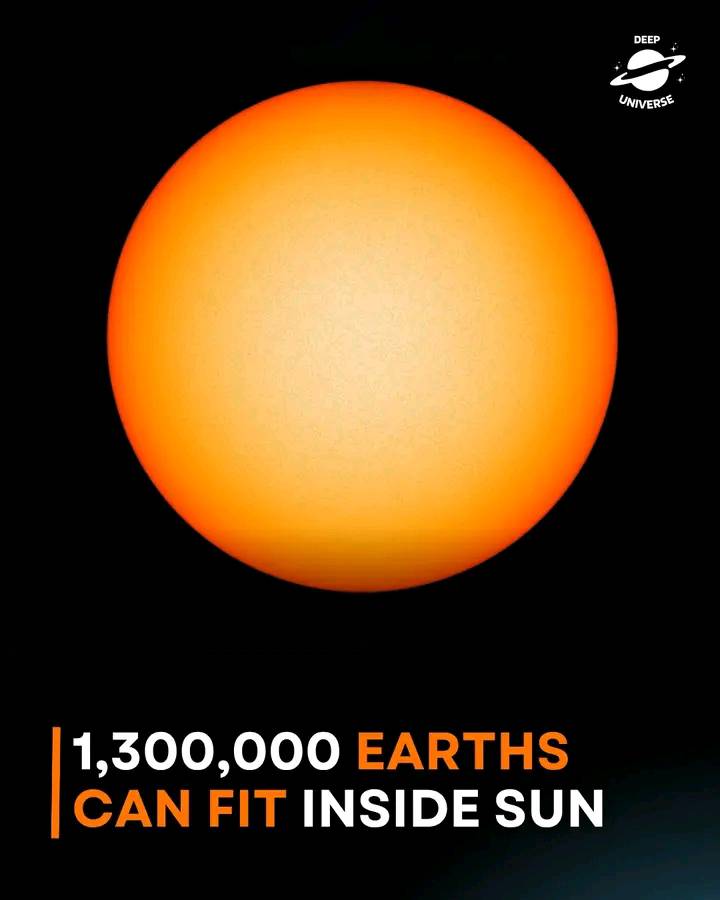
Credit: www.facebook.com
Calculating Earths Inside The Sun
Understanding how many Earths can fit inside the Sun requires more than just imagining the size difference. It demands a closer look at the Sun’s volume compared to Earth’s volume. Once you grasp the numbers, the scale of our solar system becomes much clearer and even more fascinating.
Volume Calculation
The first step is to calculate the volume of both the Earth and the Sun. The formula for the volume of a sphere is (4/3) × π × radius³. Since both Earth and the Sun are roughly spherical, this formula works well.
- Earth’s radius is about 6,371 kilometers.
- The Sun’s radius is approximately 696,340 kilometers.
Using these numbers:
| Celestial Body | Radius (km) | Volume (km³) |
|---|---|---|
| Earth | 6,371 | ~1.08 × 10¹² |
| Sun | 696,340 | ~1.41 × 10¹⁸ |
Dividing the Sun’s volume by Earth’s volume gives us roughly 1.3 million. That means about 1.3 million Earths can fit inside the Sun.
Practical Visualizations
Numbers can feel abstract until you visualize them. Imagine fitting over a million Earth-sized balls inside a giant sphere the size of the Sun. It’s hard to picture, but breaking it down helps.
- If you lined up Earths side by side, it would take around 109 to match the Sun’s diameter.
- Stacking them in layers inside the Sun’s volume shows how densely packed this number really is.
Try thinking about your own city or town and how many people live there. Now multiply that by a million—this is how many Earths the Sun can hold inside. Does this change how you view our place in the universe?
Sun’s Role In The Solar System
The Sun is the heart of our solar system. It holds everything together and gives life to our planet. Without the Sun, Earth and other planets could not exist as they do. Its size and power shape the entire solar system.
Gravitational Influence
The Sun’s gravity keeps planets in their orbits. It pulls them toward its center, preventing them from flying off into space. This force controls the paths of comets and asteroids too. The Sun’s gravity creates a balance that holds the solar system steady.
Source Of Energy
The Sun produces energy through nuclear fusion. It turns hydrogen into helium, releasing light and heat. This energy warms Earth and drives weather and ocean currents. Plants use sunlight to make food, supporting life on Earth. The Sun’s energy is vital for all living things.
Impact On Earth
The Sun holds immense power over Earth. Its size and energy shape many aspects of our planet. Understanding this impact helps us appreciate Earth’s delicate balance.
Climate And Weather
The Sun drives Earth’s climate by providing heat. Solar energy warms the atmosphere and oceans. This warmth creates winds and weather patterns. Without the Sun’s energy, Earth would be a frozen ball. Changes in solar activity can alter weather conditions. Sunspots and solar flares influence temperatures and storms. The Sun’s energy affects rainfall and drought cycles too.
Life Sustenance
Sunlight is essential for life on Earth. Plants use sunlight to make food through photosynthesis. This process supports the entire food chain. Animals and humans rely on plants for oxygen and nutrition. The Sun also helps regulate biological rhythms. Day and night cycles guide sleeping and eating habits. Without the Sun, life as we know it would not exist.
Fascinating Sun Facts
The Sun is more than just a bright ball in the sky. It’s a powerful star that influences life on Earth in countless ways. Understanding its features can change how you see the universe and your place in it.
Solar Flares And Sunspots
Solar flares are sudden bursts of energy from the Sun’s surface. They release huge amounts of radiation, which can affect satellites and even your phone signals here on Earth.
Sunspots look like dark patches on the Sun but are actually cooler areas caused by magnetic activity. These spots often signal the Sun’s changing mood and can predict solar flares.
Have you ever wondered how these solar events could impact your daily life? They remind us that the Sun is dynamic, not static.
Nuclear Fusion Process
The Sun shines because of nuclear fusion happening in its core. Hydrogen atoms smash together to form helium, releasing immense energy.
This process powers the Sun and gives us sunlight and warmth. Without fusion, Earth would be a frozen wasteland.
Think about the energy inside the Sun—that’s like billions of atomic bombs going off every second, yet it’s controlled and steady. What does that tell you about the balance of nature?

Credit: www.youtube.com
Exploring Beyond Our Solar System
Exploring beyond our solar system opens a vast universe full of wonders. The Sun, a massive star, is just one among billions in the Milky Way. Each star has unique features, sizes, and potential to host planets. Understanding how the Sun compares to other stars helps us grasp the scale of the cosmos.
Comparison With Other Stars
The Sun is a medium-sized star, classified as a G-type main-sequence star. Some stars are much larger and brighter, such as supergiants and giants. For example, Betelgeuse can fit millions of Earths inside it. Others, like red dwarfs, are smaller and cooler than the Sun.
Stars vary in size from tiny neutron stars to huge blue supergiants. The Sun’s size and energy output allow life on Earth. Many stars may not have this balance, making our Sun quite special.
Potential For Other Life Forms
Stars beyond our solar system may host planets with conditions for life. Scientists search for planets in the “habitable zone,” where water can stay liquid. This zone depends on the star’s size and heat.
Life elsewhere might look very different. Different stars give different energy, affecting how life could evolve. Studying other stars helps us imagine the variety of life forms in the universe.

Credit: www.instagram.com
Frequently Asked Questions
How Many Earths Fit Inside The Sun?
About 1. 3 million Earths can fit inside the Sun by volume. This shows the Sun’s massive size compared to Earth.
Why Is The Sun So Much Larger Than Earth?
The Sun is a giant star composed mainly of hydrogen and helium. Its mass and volume are vastly greater than Earth’s.
Can Earth Fit Inside The Sun’s Core?
No, Earth cannot fit inside the Sun’s core. The core is extremely hot and dense, unlike Earth’s solid surface.
How Does The Sun’s Size Affect The Solar System?
The Sun’s large size generates gravity that holds planets in orbit. It provides energy essential for life on Earth.
Conclusion
The Sun is incredibly huge compared to Earth. About 1. 3 million Earths can fit inside the Sun. This shows how small our planet really is in space. The Sun’s size helps it provide light and heat to Earth. Understanding this size difference helps us appreciate our place in the universe.
It also reminds us how vast and amazing space truly is. Such facts make learning about the solar system exciting and easy to grasp.