Can All Planets Fit between Earth And Moon? Unveiling the Myth
Have you ever wondered if all the planets in our solar system could fit in the space between the Earth and the Moon? It sounds like a fun question, but the answer might surprise you.
You’re about to discover how vast our cosmic neighborhood really is and why the distance between Earth and the Moon is both huge and limited at the same time. Keep reading, and you’ll see the scale of space in a way that changes how you think about our place in the universe.
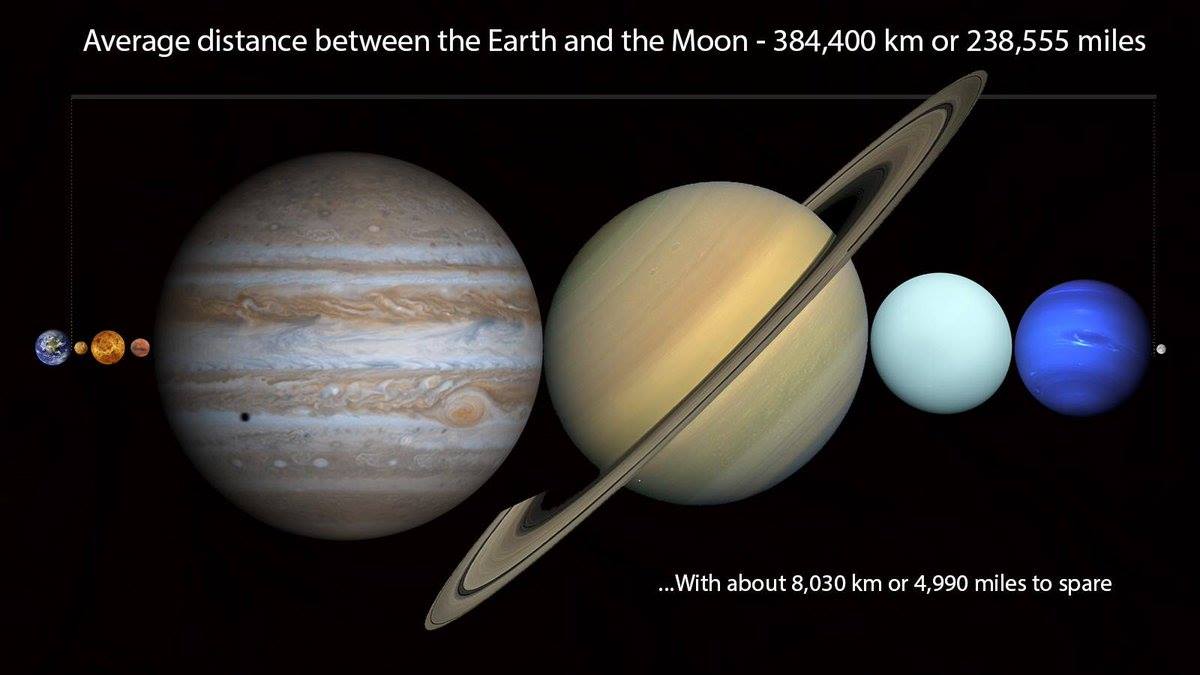
Credit: www.facebook.com
Distance Between Earth And Moon
The distance between Earth and the Moon is a key measure in space science. It helps us understand space travel and the size of our solar system. This gap is not fixed; it changes slightly over time.
Knowing this distance sets the stage for comparing it with the size of planets. It also helps answer if all planets can fit between Earth and the Moon.
Average Space Gap
The average distance from Earth to the Moon is about 384,400 kilometers (238,855 miles). This gap is a simple way to think about the space between these two bodies.
This average is useful for general calculations and space mission planning. It gives a clear number to imagine the vastness of space nearby.
Variations In Distance
The Moon’s orbit is not a perfect circle. It is slightly oval-shaped, which causes distance changes.
- At the closest point, called perigee, the Moon is about 363,300 kilometers away.
- At the farthest point, called apogee, it is about 405,500 kilometers away.
These variations affect how bright and large the Moon looks from Earth. They also influence tidal forces and space missions’ timing.
Sizes Of The Planets
Planets in our solar system come in various sizes. Some are huge gas giants, while others are small rocky worlds. Understanding their sizes helps us imagine if all planets could fit between Earth and the Moon.
Diameter Of Each Planet
| Planet | Diameter (km) |
|---|---|
| Mercury | 4,880 |
| Venus | 12,104 |
| Earth | 12,742 |
| Mars | 6,779 |
| Jupiter | 139,820 |
| Saturn | 116,460 |
| Uranus | 50,724 |
| Neptune | 49,244 |
Comparing Planet Sizes
Jupiter is the largest planet by far. It is more than 10 times wider than Earth. Saturn follows as the second largest. Uranus and Neptune are medium-sized ice giants. Earth and Venus have similar diameters. Mars and Mercury are the smallest planets. Their sizes show huge differences across the solar system.
The distance from Earth to the Moon is about 384,400 km. When lined up, some planets alone are wider than this distance. This comparison helps to understand the vast space between Earth and the Moon.
Calculating Total Planet Length
Calculating the total length of all planets lined up is key to understanding if they can fit between Earth and the Moon. This involves measuring each planet’s diameter and adding space between them. The distance between Earth and the Moon is about 384,400 kilometers. Comparing this distance with the total length of planets helps visualize the scale of our solar system.
Adding Planet Diameters
Each planet has a different size. Their diameters range from tiny Mercury to giant Jupiter. Adding these diameters gives the total length if planets were placed side by side with no gaps.
- Mercury: 4,880 km
- Venus: 12,104 km
- Earth: 12,742 km
- Mars: 6,779 km
- Jupiter: 139,820 km
- Saturn: 116,460 km
- Uranus: 50,724 km
- Neptune: 49,244 km
Adding these gives a total of about 393,753 kilometers. This number is already close to the Earth-Moon distance.
Considering Planet Spacing
Planets cannot touch each other in space. Some space must exist between them. Even a small gap increases the total length significantly.
- Allowing just 1,000 km between each planet adds 7,000 km total.
- More realistic gaps would be larger to avoid overlap.
- Adding spacing pushes total length beyond the Earth-Moon gap.
Space between planets makes fitting all planets between Earth and Moon impossible. The total length exceeds the distance.

Credit: medium.com
Can All Planets Fit?
Have you ever wondered if all the planets in our solar system could fit in the space between Earth and the Moon? It’s a fascinating question that mixes curiosity with some surprising facts about distances and sizes in space. Let’s break down what space you actually need versus what’s available.
Space Needed Vs. Available
The average distance from Earth to the Moon is about 384,400 kilometers. That might sound huge, but when you compare it to the size of the planets, it starts to get interesting.
Here’s a quick look at the approximate diameters of the planets:
- Mercury: 4,880 km
- Venus: 12,104 km
- Earth: 12,742 km
- Mars: 6,779 km
- Jupiter: 139,820 km
- Saturn: 116,460 km
- Uranus: 50,724 km
- Neptune: 49,244 km
Adding these up, the total diameter of all planets is about 393,753 kilometers. That’s actually just a bit more than the Earth-Moon distance! But you have to remember, planets are three-dimensional spheres, so lining them up perfectly side by side without gaps is not practical.
Visualizing The Fit
Imagine placing these planets one after another between Earth and the Moon. Jupiter alone takes up over a third of the distance. Could you really squeeze all eight planets in there? It’s unlikely if you want to maintain their round shapes and proper spacing.
Think about the gaps you’d need to avoid overlap. Even if you tried to line them up tightly, the combined diameters slightly exceed the Earth-Moon distance. This means the space is just not enough to fit all planets side by side without some distortion or overlapping.
What does this tell you? Space between Earth and the Moon is vast but still limited compared to the sheer size of the planets. Next time you look at the Moon in the sky, consider the incredible scale of our solar system packed into the space between.
Common Myths And Misconceptions
Many people wonder if all the planets in our solar system could fit between Earth and the Moon. This question often leads to several myths and misconceptions. These ideas spread because space distances are hard to imagine. It is important to clear up these misunderstandings with facts.
Origins Of The Myth
The myth began from simple comparisons of planet sizes and distances. Some assume planets are small enough to line up between Earth and the Moon. Others confuse the vast space with visual images from movies or illustrations. These sources often show planets close together for effect. This causes a false idea about actual distances in space.
Clarifying Facts
The distance from Earth to the Moon is about 384,400 kilometers. The planets vary greatly in size and distance from Earth. For example:
- Jupiter, the largest planet, has a diameter of about 140,000 kilometers.
- Mercury, the smallest, is about 4,880 kilometers wide.
Even if you placed the planets side by side, their total width would exceed the Earth-Moon distance. Planets also orbit at millions to billions of kilometers apart. The space between Earth and the Moon is too small to fit all planets together.

Credit: www.instagram.com
Implications For Space Science
The question of whether all planets can fit between Earth and the Moon opens new doors in space science. It challenges our understanding of distances and sizes in the solar system. This thought experiment helps scientists and students grasp the vastness of space. It also highlights how small Earth and Moon are compared to the distances between other planets.
Understanding Scale In Space
Space is huge. Distances between planets are much larger than they seem. Earth and the Moon are about 384,400 km apart. This distance is tiny compared to the gap between planets like Earth and Mars. Realizing this scale helps scientists design better space missions and satellites.
Spacecraft need to travel millions of kilometers. Knowing exact distances helps plan fuel needs and travel time. It also helps in predicting gravitational effects from other celestial bodies. Understanding scale is key to navigating space safely and efficiently.
Importance In Astronomy Education
Many students find space hard to imagine. Using the Earth-Moon distance as a reference point makes learning easier. It gives a clear idea of how far planets are from each other. Teachers can use models and visuals based on this scale to explain space better.
This approach improves interest in astronomy. It makes complex ideas simple and fun. Students can better understand orbits, planet sizes, and distances. Clear learning builds curiosity and encourages more study in space science.
Frequently Asked Questions
Can All Planets Fit Between Earth And The Moon?
No, all planets cannot fit between Earth and the Moon. The average distance is about 384,400 km, which is too small to line up all planets side by side. The combined diameters of the planets exceed this distance by a large margin.
What Is The Distance Between Earth And The Moon?
The average distance between Earth and the Moon is approximately 384,400 kilometers (238,855 miles). This distance varies slightly due to the Moon’s elliptical orbit around Earth.
How Wide Are The Planets In Our Solar System?
Planet diameters range from about 4,880 km for Mercury to 139,820 km for Jupiter. These sizes make it impossible to fit all planets in the Earth-Moon gap.
Why Can’t Planets Fit Between Earth And Moon?
Planets are too large and spaced too far apart. The Earth-Moon distance is relatively small compared to planetary diameters and the vast space between planets in the solar system.
Conclusion
The space between Earth and the Moon is vast but limited. All the planets in our solar system cannot fit in that space. Some planets are much bigger than the distance between Earth and the Moon. This shows just how enormous planets like Jupiter and Saturn really are.
It helps us understand the true size of our solar system better. The universe is full of incredible distances and sizes that are hard to imagine. This comparison makes space feel both closer and more amazing at the same time.