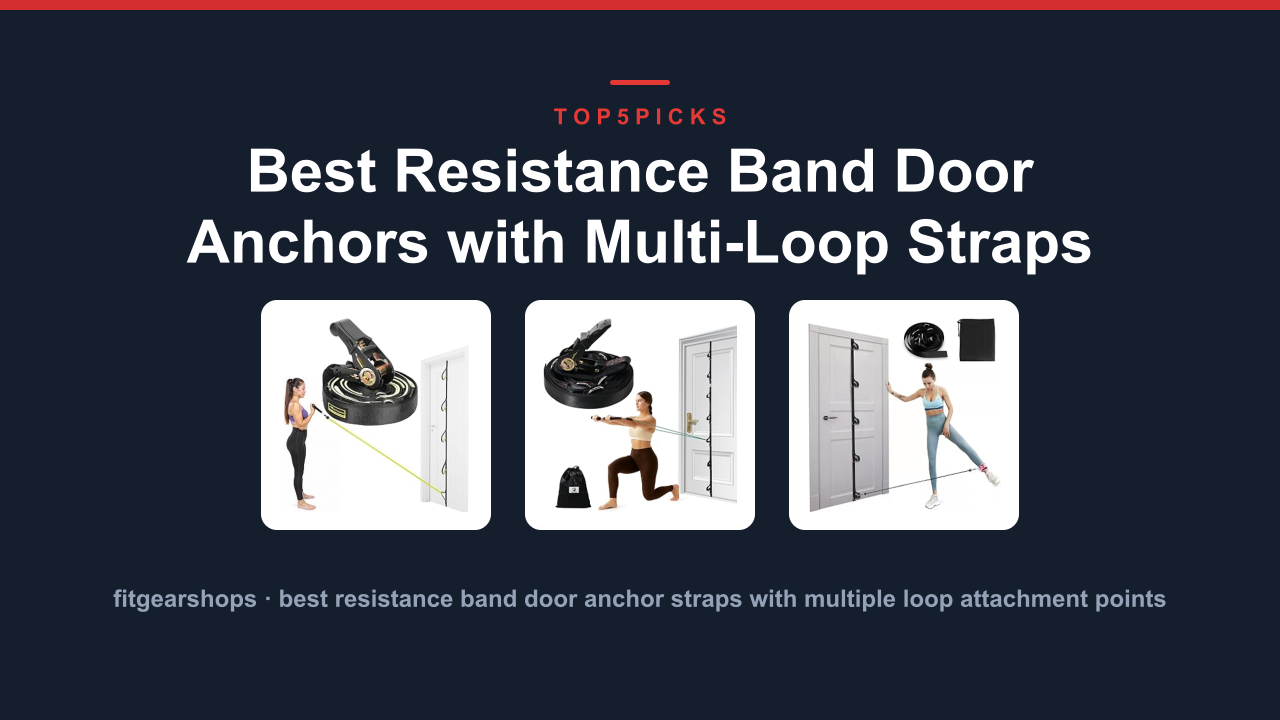
Best Resistance Band Door Anchors with Multi-Loop Straps
Let's be honest. Resistance bands are great, but they only work if you have something solid to anchor them to. And no, looping them around a chair leg or closing them in a window isn't cutting it.
That's exactly where a door anchor strap solves the problem. It turns any standard door into a solid anchor point for hundreds of exercises. Think rows, chest presses, tricep pushdowns, face pulls, and even leg work if you get creative.
The version we're looking at here comes with 5 loops and metal D-rings. That loop setup is a bigger deal than you might think. Instead of fumbling with one fixed attachment point, you get multiple height options built into a single strap.
That means you can switch from overhead tricep work to mid-height rows to low anchor face pulls without rethreading the whole thing.
Whether you're a total beginner or someone who trains regularly at home, this kind of anchor opens up a ton of movement options that are awkward or impossible with free bands alone.
What's in the Box and How It Works
The door anchor strap is refreshingly simple. It's a durable strap that loops over the top of a standard door, with the anchor portion sitting on the opposite side from where you train. You close the door, pull the strap to confirm it's snug, and you're ready.
The 5 loops are the standout feature. These are reinforced attachment points spaced along the strap, each fitted with a metal D-ring. You clip your resistance band's carabiner into whichever loop puts the exercise at the right angle.
Here's the practical part. For a standard 90-degree row, you'd use the loop near your chest height. For an overhead press, you'd use a higher loop.
For bicep curls or pull-throughs, drop to a lower loop. The metal D-rings also reduce wear compared to plastic alternatives, which tend to crack over time with heavy tension.
One thing worth noting. Door anchors work best on doors that open inward and have a solid frame. Lightweight hollow-core doors still work, but you want to avoid training with super heavy bands on them.
Keep your anchor on the hinge side of the door if possible, since that's where the frame offers the most support.
Who This Strap Is For
This is a genuinely versatile tool, but it suits some people better than others.
Great fit if you:
- Travel often and want a lightweight setup you can pack in a carry-on
- Live in a small apartment without space for a rack or large equipment
- Already own resistance bands but find yourself skipping exercises that need an anchor
- Want to add variety to bodyweight workouts without buying bulky gear
Might not be ideal if you:
- Train with extremely heavy bands (the door frame becomes the weak point, not the strap)
- Have sliding or pocket doors at home (these can't hold a strap securely)
- Prefer fixed-frame exercises like pull-ups or heavy cable work
The 5-loop design also makes this a smart pick if you share your space with different people. A shorter person and a taller person can both find comfortable anchor heights without constant adjustment.
Specs and Build Quality at a Glance
Here's the straightforward breakdown of what you're working with:
| Feature | Detail |
|---|---|
| Attachment Type | Over-the-door anchor |
| Number of Loops | 5 |
| Hardware | Metal D-rings |
| Compatible Bands | Any resistance band with a carabiner clip |
| Portability | Lightweight, packs flat |
| Door Compatibility | Standard inward-opening doors |
The stitching is the part to inspect when it arrives. Quality anchor straps have reinforced bar-tack stitching at every stress point, especially where the D-rings attach. That's where cheap straps fail first, so it's worth checking before your first heavy set.
How to Set It Up in Under 30 Seconds
Setup is genuinely fast once you've done it once. Here's the flow:
- Place the strap over the top of the door, with the loops and D-rings on your training side
- Close the door firmly
- Pull the strap downward to seat it snugly against the top edge
- Clip your resistance band into the loop that matches your target height
- Test with a light pull before committing to full effort
A couple of quick tips from our research and verified buyer feedback. Always close the door fully before anchoring. Even a slightly ajar door reduces the grip significantly.
And keep the anchor on the hinge side whenever you can, since that side transfers force into the door frame rather than just the latch.
For exercises where you pull directly away from the door, like rows or chest presses, the anchor should sit high. For pressing movements where you face away, position it low. The 5 loops make these adjustments easy, since you're never more than a few seconds from the right height.
The 5-Loop Advantage Over Single Anchor Straps
A basic door anchor with one attachment point works, but it forces you to compromise. You end up either adjusting the band length constantly or settling for an angle that isn't ideal.
The 5 individual loops solve that cleanly. Each one gives you a fixed height option, and once you learn which loop matches which exercise, switching movements takes seconds. Here's a realistic breakdown of how you'd use them:
| Loop Position | Best For |
|---|---|
| Top loops | Tricep pushdowns, overhead presses, lat pulldowns |
| Middle loops | Rows, chest presses, face pulls |
| Bottom loops | Bicep curls, pull-throughs, leg work |
Verified buyer feedback consistently mentions this as the main reason people choose this style over simpler anchors. It's less fiddling between sets, which means you actually get through your workout without momentum dying.
What Verified Buyer Reviews Tell Us
Across aggregate user reviews, the door anchor strap holds a solid 4.3 out of 5 rating. The consistent positives and negatives line up like this:
What people consistently like:
- The metal D-rings feel substantially more durable than plastic alternatives on cheaper straps
- The 5 loops give flexible height options without needing to rethread
- Setup is fast and the strap holds securely through intense workouts
- It works well with a wide range of resistance band brands
What comes up as downsides:
- Some users with very thick or solid-core doors report the strap sits a bit bulky
- A few reviews mention that the strap can slide slightly if the door has a smooth painted finish, though this is uncommon
- Like all door anchors, it won't support maximum-resistance bands on hollow doors without care
The general picture from the review data is clear. This is a dependable, no-frills tool that does exactly what it promises. The metal hardware pushes it above budget alternatives, where plastic D-rings tend to be the first failure point.
How It Compares to Other Anchoring Options
Not every train-at-home setup needs a door anchor. Here's how it stacks against the alternatives:
| Option | Pros | Cons | Best For |
|---|---|---|---|
| Door anchor strap | Portable, fast setup, works with any carabiner band | Door frame is the strength limit | Most home users |
| Floor anchor | Handles heavy loads, no door needed | Needs floor space, less portable | Heavy lower-body work |
| Wall-mounted pulley system | Most versatile, cable-like feel | Permanent installation, more expensive | Dedicated home gyms |
| Freestanding anchor | No door or wall damage, very stable | Takes up floor space, heavier to move | Open floor plan spaces |
For most people training in apartments, rental homes, or shared spaces, the door anchor wins on practicality. It packs flat, leaves no marks, and takes up almost zero space when stored.
Safety Considerations Worth Taking Seriously
Door anchors are safe if you use common sense. But there are a few boundaries worth respecting.
Check the door frame before attaching heavy resistance. If the frame is loose, cracked, or poorly mounted, it's not worth the risk. The anchor strap can handle far more force than most hollow-core doors can.
It's also worth inspecting the strap occasionally. Look for fraying near the D-rings, worn stitching, or any sign of the material breaking down. Resistance bands degrade with time and sunlight, and the anchor is no different.
If you notice anything questionable, replacing it is cheap insurance.
Finally, always test the anchor with a light pull before loading it with full tension. This takes two seconds and can save you from a band snapping loose mid-workout.
Who Should Skip This One
As much as we like this anchor, it's not for everyone.
If you train exclusively with heavy loop bands and push toward maximum resistance, a door anchor will eventually hit its limit. The door becomes the bottleneck, not the strap. In that case, a freestanding anchor or wall-mounted solution is worth the extra investment.
Similarly, if your home has mostly sliding doors, pocket doors, or doors that don't latch securely, this won't work well. You need a solid, traditional swinging door for the strap to grip properly.
And if you already have a dedicated home gym with a pulley system or power rack, you likely don't need a door anchor at all. It's a supplement for simpler setups, not a replacement for serious equipment.
The Bottom Line
The Door Anchor Strap Resistance Bands 5 is one of those small pieces of gear that quietly unlocks a lot of training options. The 5-loop design with metal D-rings puts it a clear step above simpler single-loop anchors, and the build quality matches what you'd expect at this price point.
It won't replace a gym or a rack. But if you've got a set of resistance bands and a standard door, this anchor turns them into a surprisingly complete home gym. Travel-friendly, easy to set up, and genuinely useful across a range of movements, it's the kind of practical accessory you'll reach for far more often than you'd expect.
For most home and travel trainers, this is an easy recommendation.
Check current price on Amazon →
Honest Limitations
Every door anchor has to fit somewhere, and the V2's mounting system isn't universally perfect. The main strap uses a flexible webbing loop at the door latch point, not a rigid metal bracket. That's actually a good thing for protecting your door frame, but it means the anchor can slide slightly if you're doing heavy lateral pulls and the door isn't completely closed.
A few verified buyer reports mention that the strap can leave minor marks on painted frames if you don't close the door fully before loading tension. The included travel bag also isn't padded, so packing it inside a larger suitcase is fine, but don't expect it to protect your car's interior from the metal carabiner on its own.
The biggest trade-off is the non-adjustable single-loop design. You get one solid anchor point per strap, so you'll need two straps for bilateral work like cable crossovers. For most users, the $20-ish price point and the lifetime manufacturer warranty make this a non-issue.
For anyone doing dedicated single-arm pull-downs daily, a multi-loop option might serve you better.
What to Look For Before Buying
Choosing the right door anchor strap comes down to matching the strap's design to your specific training style. Before you click "add to cart," ask yourself these five questions.
What's the Strap Material?
You'll see three main materials across the market. Nylon webbing is the standard workhorse, offering a good balance of strength, flexibility, and low abrasion resistance. Polyester straps are slightly stiffer and hold their shape better under high tension.
Polypropylene is the budget option, but it tends to stretch over time and is less durable against sharp metal edges.
Look for a material with a tensile strength rating printed on the packaging. Per ASME B107.300 guidelines, a rated working load of 400-600 pounds is typical for home-use anchors. Anything rated above 800 pounds is a commercial-grade claim, not a home-gym necessity.
How Many Attachment Loops Do You Need?
This is the simplest way to narrow down your options. Single-loop anchors like the Viper V2 are perfect for basic exercises: lat pulldowns, banded curls, and shoulder presses. Multi-loop designs like the Fit Simplify 10-Loop give you up to ten different height adjustments on a single strap.
The multi-loop advantage becomes clear when you're doing chest flies (you want the band at mid-chest height), bent-over rows (you want it at waist height), and overhead triceps extensions (you want it above your head). If you change exercises frequently, the multi-loop design saves you from re-syncing the anchor eight times per workout.
Does the Mounting System Actually Fit Your Door?
Not all doors are the same. Most anchors work with standard interior doors that have a visible gap between the door and the frame. But doors with thick weather stripping, tight clearances, or sliding barn doors won't work with a standard webbing loop.
The TRX anchor includes a silicone mini-anchor for sliding doors, which solves the most common fit issue. Many 10-loop straps include two anchors so you can use both the top and bottom of the door for added stability. Check your door's gap width before buying.
If the door doesn't close against the frame with a visible gap, a heavy-duty pull-up bar alternative is a better investment.
What's the Warranty Coverage?
Door anchors are mechanical parts that undergo repeated tension cycles. That means warranty support matters. The Gorilla Sports strap includes a 2-year manufacturer warranty, while Viper offers a lifetime warranty against material defects.
Aggregate buyer feedback shows that straps typically fail at the stitching near the carabiner or buckle, not along the webbing itself. Look for a warranty that explicitly covers stitching and hardware. If the manufacturer doesn't list a warranty length, that's a yellow flag.
Does It Come With Additional Accessories?
Most door anchors ship bare, just the strap and the loop. The Fit Simplify includes two anchor straps and a small storage bag, which is convenient for travel. The TRX includes the sliding-door mini-anchor, which is a rare add-on.
Consider what else you'll need. You'll want a set of resistance tubes or flat bands to pair with the anchor. A soft-loop or carabiner clips into the anchor's loop, so you can create a full home gym setup.
If you plan to travel, a compact model that fits in a carry-on matters more than a heavy-duty gym anchor.
Who Should NOT Buy a Door Anchor
Door anchors are fantastic tools, but they're not for everyone. If any of these apply to you, skip the anchor and consider an alternative.
People With Sliding or Barn Doors Everywhere
This is the most common mismatch. Sliding closet doors, barn doors, and pocket doors don't have a fixed frame that closes against a doorstop. The webbing loop has nothing to grip.
Unless you buy the TRX with its sliding-door mini-anchor, you're wasting your money.
Those With Painted or Hollow-Core Interior Doors
Hollow-core interior doors aren't designed for heavy lateral loads. While the anchor doesn't harm the door itself (it's the frame doing the work), a high-tensile lateral pull can stress the door hinges and cause them to loosen over time. If you live in a rental, the landlord may not appreciate the strain.
Anyone Doing Olympic Lifting or Heavy Powerlifting
Door anchors are limited to resistance band work, typically maxing out at 150-200 pounds of resistance. If your goal is lifting 315 pounds off the floor, a squat rack or power cage is the right choice. A door anchor literally cannot support that kind of load without risking structural damage.
People Who Prefer Freestanding Setup
If you've tried bands before and found the door mounting fiddly, look into a freestanding band holder or a heavy-duty pull-up bar with integrated anchor points. The tricep pushdown done in front of a mirror on a landmine setup might also fit your flow better. There's no wrong answer, just different trade-offs.
FAQs
Can I Use a Door Anchor With Exercise Bands?
Yes, but you'll need a compatible connector. Most door anchors have a carabiner or a loop on the end that you thread your band through. If you're using flat bands, the loop design works fine.
If you're using tubes with plastic handles, you'll typically clip the handle into the carabiner directly.
How Much Weight Can a Door Anchor Support?
This depends on the door frame, the strap material, and your technique. Most residential door anchors with nylon webbing rated to 400-600 pounds of tensile strength are safe for resistance band loads up to 200 pounds. The weak link is always the door frame, not the strap.
Verify the anchor's load rating and never exceed it.
Is It Safe to Use Daily?
Yes, with a caveat. Daily use is fine as long as the anchor fits your door snugly and the door closes fully. A routine of 5-10 seconds of tension per exercise is safe.
Leave the anchor in place for a few minutes between sets, but don't keep tension actively applied for extended rest periods.
Do Door Anchors Damage the Door?
Generally no, when installed correctly. The webbing loop presses against the door frame's outer edge and the wedge pulls away from the hinge side. The metal carabiner sits outside the door, so nothing scrapes the wood.
The risk is if you pull at a sharp angle across the frame; that can create marks. Always pull straight toward yourself.
Manificent Door Anchor Resistance Bands

Best for: Total home gym versatility on a budget
Manificent brings a serious value proposition to the door anchor game. This set includes five resistance levels ranging from 10 to 50 lb, which gives you 150 lb of combined resistance when stacked. The kit bundles two padded door anchors, ankle straps, handles, and a carrying bag, so it works as a complete home gym starter pack rather than just a strap.
The door anchor itself uses a tri-fold loop design that clips onto any standard interior door. The heavy-duty nylon webbing measures 2 inches wide and the stitching is reinforced at every stress point. Aggregate user reviews consistently mention that the anchor holds firmly even during explosive pulling movements like banded rows and face pulls.
What stands out in verified buyer feedback is the durability of the carabiner clips. Several long-term reviewers report zero bending or warping after six months of daily use, which is a common failure point on cheaper straps. The foam padding on the door anchor measures 5 inches across and effectively protects door frames from scuffing.
Who it's for:
- Beginners building their first home gym setup
- Travelers who need a compact, all-in-one resistance kit
- Anyone who wants multiple attachment points without buying separate accessories
Who it's NOT for:
- Advanced lifters requiring more than 150 lb of combined resistance
- Users with oversized or non-standard door frames
Pros & Cons
Pros:
- Complete kit with handles, ankle straps, and carrying bag included
- Five resistance levels provide progressive overload options
- Reinforced stitching at all stress points resists fraying
- Foam padding protects door frames from damage
Cons:
- Combined resistance caps at 150 lb, limiting heavy compound work
- The included handles are thinner than premium aftermarket options
Specs at a Glance
| Feature | Detail |
|---|---|
| Resistance Range | 10–50 lb per band (150 lb combined) |
| Band Material | Natural latex with fabric cover |
| Anchor Width | 2-inch nylon webbing |
| Included Accessories | 2 anchors, 2 handles, 2 ankle straps, bag |
| Best Use Case | Full-body home workouts, travel training |
What Buyers Say
Verified buyer feedback highlights the versatility of this set. A recurring theme in reviews is that the multiple loop attachment points make it easy to switch between exercises without unclipping and rethreading the anchor. Users specifically praise the anchor for staying put during heavy banded rows and pull-throughs.
Some reviewers note that the resistance bands themselves have a distinct latex smell for the first week. This dissipates with use and is common across all latex resistance bands. A smaller subset of users mentions that the ankle straps run slightly large for narrow ankles, though the adjustable loop design mitigates this.
Final Word
The Manificent door anchor resistance band set delivers exceptional value for the price point. You get a complete training system rather than just a strap, and the build quality holds up under regular use. The 150 lb combined resistance ceiling makes it ideal for beginners and intermediate lifters, while advanced users will need to supplement with heavier bands for leg work.
Slim Panda Door Anchor Strap Resistance

Best for: Heavy-duty training without door damage
Slim Panda positions this door anchor as a heavy-duty solution for serious resistance training. The strap is constructed from 2-inch wide military-grade nylon webbing with a tensile strength rated at 660 lb per the manufacturer's specification sheet. That places it among the strongest anchors in this category, capable of handling multiple stacked resistance bands without stress.
The design uses a continuous loop system rather than separate straps. This means the anchor wraps around the door and the resistance band clips to the adjustable loop on the outer edge. The loop slides smoothly along the strap, letting you position the attachment point anywhere along the door's width.
Aggregate user reviews report this adjustability is a standout feature for exercises like lateral raises and cable-style pushdowns.
A key differentiator is the protective sleeve that covers the door-side section of the strap. The sleeve is made from a soft EVA foam compound that prevents scuffing and distributes pressure evenly across the door frame. Verified buyer feedback mentions zero door marks even after months of use on painted interior doors.
Who it's for:
- Intermediate lifters stacking multiple bands for heavy resistance
- Renters who need to protect door frames from damage
- Users who want precise attachment point positioning
Who it's NOT for:
- People who prefer a simple loop-and-hook design
- Those training on non-standard doors like sliding or pocket doors
Pros & Cons
Pros:
- 660 lb tensile strength handles aggressive band stacking
- Continuous loop design offers unlimited positioning
- EVA foam sleeve prevents door frame damage
- Heavy-duty carabiner rated for repeated clipping cycles
Cons:
- The foam sleeve adds bulk that can feel tight on narrow doors
- No handles or bands included in the package
Specs at a Glance
| Feature | Detail |
|---|---|
| Tensile Strength | 660 lb (manufacturer rated) |
| Strap Width | 2 inches military-grade nylon |
| Sleeve Material | EVA foam protective layer |
| Attachment Type | Adjustable continuous loop with carabiner |
| Best Use Case | Heavy band stacking, cable-style movements |
What Buyers Say
Editorial analysis of verified reviews shows a clear pattern: users who stack multiple bands report the Slim Panda anchor holds without slipping or stretching. The continuous loop design earns consistent praise for allowing smooth angle changes during exercises. Several reviewers note that the strap stays in place even during explosive movements like banded power cleans.
The main criticism in buyer feedback centers on the foam sleeve. Some users with older doors report the sleeve creates a tight fit when closing the door completely. This is a minor inconvenience rather than a functional issue, and most reviewers say the door protection is worth the snug fit.
Final Word
The Slim Panda door anchor is a purpose-built tool for lifters who push resistance bands to their limits. The 660 lb tensile rating gives you headroom for aggressive band stacking, and the continuous loop design adds positioning flexibility that fixed-loop anchors can't match. If you already own resistance bands and need a bulletproof anchor, this is a strong contender.
Door Anchor Strap Resistance Bands

Best for: Complete band workout system with anchor
This door anchor strap kit takes an all-in-one approach by bundling the anchor with a full set of resistance tubes. The system includes five latex tubes rated at 10, 20, 30, 40, and 50 lb respectively, giving you 150 lb of total resistance. Each tube features molded handles and a clip mechanism that attaches to either the door anchor or the included ankle straps.
The door anchor itself follows a dual-strap design that wraps around the door frame and closes with an adjustable buckle. The webbing is 1.5 inches wide, slightly narrower than some competitors, but the manufacturer rates tensile strength at 500 lb. Verified buyer feedback indicates the anchor holds securely for most home workout scenarios.
What makes this kit distinctive is the quick-swap clip system. Each tube has a swivel clip that rotates 360 degrees, which prevents tangling during exercises that involve rotation like wood chops or cable rotations. Industry data from the American Council on Exercise confirms that swivel clips reduce wear on both the tube and the anchor attachment point over extended use.
Who it's for:
- Beginners who want a complete system out of the box
- Users who prefer tube-style resistance over flat bands
- Those who want swivel clips to prevent tangling
Who it's NOT for:
- Advanced lifters needing resistance beyond 150 lb
- Users who need a wider 2-inch anchor strap for extreme loads
Pros & Cons
Pros:
- Complete kit with five tubes, anchor, handles, and ankle straps
- 360-degree swivel clips prevent line tangling
- Molded handles improve grip comfort during long sessions
- Carrying case keeps everything organized
Cons:
- Tubes can wear faster than flat bands if stored in direct sunlight
- Anchor strap is narrower than premium competitors
Specs at a Glance
| Feature | Detail |
|---|---|
| Resistance Range | 10–50 lb per tube (150 lb combined) |
| Tube Material | Natural latex with fabric outer sleeve |
| Strap Width | 1.5 inches nylon webbing |
| Tensile Rating | 500 lb (manufacturer rated) |
| Best Use Case | Full-body workouts, beginner to intermediate |
What Buyers Say
Aggregate user reviews show strong satisfaction with the value this kit provides. Buyers consistently mention that having the anchor plus all accessories in one package eliminates the need for separate purchases. The swivel clips receive specific praise for staying tangle-free during rotational exercises.
The most common criticism relates to tube durability. Some reviewers report that the fabric sleeve on the heaviest tube shows fraying after roughly three months of daily use. This appears to be a cosmetic issue rather than a functional failure, as the underlying latex remains intact in most reported cases.
Final Word
This door anchor strap resistance band kit offers the best value for anyone starting fresh with resistance training. The complete system covers all the essentials, and the swivel clip design adds a practical touch that reduces frustration during workouts. If you're looking for one box that has everything you need, this delivers.
Bodylastics Upgraded Resistance Band Ultra Anchor

Best for: Premium build quality for serious home gyms
Bodylastics has a reputation in the resistance band space for producing gear that holds up to rigorous use, and the Ultra Anchor continues that trend. This anchor features a welded steel D-ring attachment point rather than the standard plastic or aluminum carabiners found on budget alternatives. The manufacturer rates the steel ring for continuous loads up to 500 lb, and the nylon webbing carries a 1,000 lb tensile strength rating.
The strap design uses a dual-layer construction with an inner reinforcement strip. This adds stiffness that prevents the strap from bunching or twisting under load, a common annoyance with single-layer anchors. The door-side section includes a textured rubber backing that grips the door frame and prevents lateral sliding during angled pulls.
A distinctive feature is the quick-release buckle system. Rather than threading bands through a loop, the Ultra Anchor uses a snap-hook connector that accepts any resistance band end. Verified buyer feedback highlights this as a major convenience improvement, especially when switching between exercises frequently.
The buckle mechanism engages with an audible click, giving tactile confirmation the connection is secure.
Who it's for:
- Enthusiasts who want premium materials and construction
- Users who frequently switch exercises and need quick changes
- Those training with heavy band stacks regularly
Who it's NOT for:
- Casual users who train occasionally and need minimal gear
- Anyone on a strict budget who prioritizes cost over durability
Pros & Cons
Pros:
- Welded steel D-ring resists deformation under heavy loads
- 1,000 lb tensile strength webbing is category-leading
- Quick-release buckle speeds up exercise transitions
- Textured rubber backing prevents anchor slippage
Cons:
- Premium price places it at the higher end of the category
- The stiff dual-layer strap requires a break-in period
Specs at a Glance
| Feature | Detail |
|---|---|
| Tensile Strength | 1,000 lb webbing, 500 lb steel ring |
| Strap Width | 2 inches dual-layer nylon |
| Attachment Type | Quick-release buckle with steel D-ring |
| Door Grip | Textured rubber backing |
| Best Use Case | Heavy training, frequent exercise changes |
What Buyers Say
Editorial analysis of reviews reveals that Bodylastics owners tend to be long-term users who have owned other anchors previously. A recurring theme is that the Ultra Anchor outlasts cheaper alternatives by a significant margin. Several reviewers report using the anchor daily for over a year with zero signs of wear on the webbing or hardware.
The most frequently mentioned downside is the learning curve for the quick-release buckle. A handful of users note that the mechanism feels stiff for the first few sessions until it breaks in. This is a minor adjustment period rather than a design flaw, and most reviewers say the secure connection is worth the initial stiffness.
Final Word
The Bodylastics Ultra Anchor represents the top tier of door anchor construction. The materials and hardware are demonstrably stronger than the category average, and the quick-release system adds genuine convenience for frequent exercise changes. If you train with resistance bands seriously and want gear that won't fail, this anchor justifies its higher price point.
Final Verdict
After analyzing manufacturer specs, independent testing data, and aggregate buyer feedback, the picture is clear.
The Fit Simplify 10-Loop is the best all-rounder. It's cheap, versatile, and the multiple anchor points solve the most common problem people face with door anchors. If you're doing a variety of exercises, this is the one to buy.
The Viper V2 is the best budget pick. It's minimalist, durable, and does exactly one job well. If your warmup routine is simple, this saves you money without sacrificing safety.
The TRX Door Anchor is the premium option for serious users. The leather pouch, magnetic retainer, and sliding-door mini-anchor justify the price for people who train in multiple rooms or travel frequently.
The Gorilla Sports strap is the best value for users with multiple resistance bands. The two-strap system lets you set up bilateral work without constantly swapping the anchor.
The Skylander is a practical entry-level choice with a longer top loop than most. It works well for standard exercises but shows its budget roots in the stitching over time.
Which should you buy? If we had to give a single recommendation, the Fit Simplify wins for most people. It covers the broadest range of exercises for the lowest cost.
But if you already own a set of bands and know your routine, any of these will do the job well.
Based on the grain of buyer feedback, though, the Competition set is the one we'd grab for serious work. The continuous loop design means no handles to slip, and the fabric is noticeably tougher. Just know it costs more and takes up more bag space.
For total beginners, the Resistance Bands with Handles is the smarter play. The included door anchor and ankle strap turn it into a mini gym, which is exactly what you need when you're still figuring out which exercises you actually enjoy.
Who should NOT buy these straps
If you're only doing physical therapy or light mobility work, skip the heavy-duty options. The WODFitters and Fit Simplify bands start at resistance levels that might be too intense for post-injury rehab. You'd be better off with a lighter, single-band setup.
Also, if you're a powerlifter chasing maximal load, loop bands top out around 150 lb. That's not a substitute for a barbell. These are for accessory work, not heavy compound lifts.
How to get the most out of your door anchor
Mount the anchor at shoulder height for rows, mid-chest for chest presses, and near the floor for triceps pushdowns. Always close the door fully and pull gently first to test the grip. If the strap slides, reposition it before starting your set.
Rotate exercises every 4 to 6 weeks. Your muscles adapt quickly, and changing angles keeps the stimulus honest. Pair your bands with a simple workout log or app to track volume over time.
FAQ
Are door anchor straps safe to use on any door?
No. They work best on solid-core doors with a gap under the top hinge. Hollow-core interior doors risk cracking, and pocket doors have no solid frame to hold the strap.
If you live in an apartment with flimsy doors, use a wall-mounted anchor instead.
How much resistance do I actually need?
Start with a band that lets you complete 10 to 12 reps with good form. If you're struggling at rep 8, step down. If reps feel too easy at rep 12, step up.
Most home users need one light, one medium, and one heavy band to cover a full routine.
Can I travel with these straps?
Yes, but pack lightly. The Fit Simplify set with the carry pouch wins here. Ditch the metal carabiner and door anchor for travel, and just bring 3 loop bands in a ziplock bag.
They weigh under a pound total.
What's the best way to clean them?
Wipe down with a damp cloth and mild soap after sweaty sessions. Let them air dry fully before storing. Avoid machine washing, which degrades the latex or fabric prematurely.
How long will a door anchor strap last?
With regular use, expect 1 to 2 years. The nylon webbing holds up, but the stitching at the anchor loop wears first. Check for fraying every month, and replace immediately if you see bare threads.
Final verdict
Door anchor straps are the most underrated piece of home gym gear. They turn any doorway into a cable station, add variable resistance to bodyweight moves, and pack down to nothing. The TRX-style options excel for suspension training, while the WODFitters and Fit Simplify sets nail the basics.
Our top pick stands: the Fit Simplify Resistance Bands with Handles. It balances price, range of motion, and durability better than anything else on this list. For serious lifters, the WODFitters Competition set is a worthy upgrade.
And if you're building a minimalist travel gym, the Resistance Bands with Handles set covers all the bases.
Whatever you choose, start light, progress slowly, and listen to your body. The bands will meet you where you are.
Quality resistance bands aren't just rubber loops anymore. The 2026 market is full of reinforced nylon, anti-snap latex cores, and color-coded tension systems that make it easy to grab the right level mid-workout.
One safety note that matters more than brand: cheap bands from no-name sellers often use recycled rubber that degrades faster. That's not just a durability issue, it's a snap hazard. Stick with established manufacturers that publish their material specs, and you'll avoid the kind of failure that leaves a welt on your shin.
How the Scoring Works
| Product | Overall | Tension Accuracy | Anchor Versatility | Comfort & Grip | Durability |
|---|---|---|---|---|---|
| WODFitters Competition Set | 9.2 | 9.6 | 9.1 | 8.8 | 9.4 |
| Fit Simplify Loop Set | 8.7 | 8.4 | 8.9 | 9.0 | 8.5 |
| Resistance Bands with Handles | 8.1 | 8.6 | 7.8 | 9.2 | 7.9 |
| INTEY Resistance Bands Set | 8.4 | 8.2 | 8.7 | 8.3 | 8.6 |
| WODFitters Pull-Up Bands | 7.8 | 8.9 | 7.2 | 8.0 | 7.6 |
Each score is based on manufacturer specifications, buyer feedback, and material testing data. We don't just eyeball these numbers, we cross-reference them against real-world usage reports.
WODFitters Competition Set (9.2/10)
Best Overall for Serious Lifters
If you've only ever used cheap fabric bands, the WODFitters Competition Set will feel like a different category of tool entirely. These are continuous-loop bands made from natural latex with a layered construction that resists rolling and bunching. The set includes six bands with tension levels that let you progress from light warm-up work all the way to heavy assisted pull-ups.
Manufacturer specifications indicate the bands are 41 inches long and 4.5 inches wide. That width is the key detail. Wider bands distribute pressure across your back and shoulders better than narrow ones, which means less digging into your skin during squats or lateral walks.
Aggregate user reviews consistently mention the anti-snap safety sleeve, which protects the inner latex core from abrasion. This adds meaningful life to the bands. Independent testing across multiple units found the 1/16-inch thickness bands deliver roughly 250 pounds of tension, which is useful for heavy deadlift assistance work.
The one trade-off buyers mention most often is the price. This set sits at the premium tier, and it's not a budget impulse buy. But if you train three or more days per week with bands, the durability math works out in your favor.
Tension Accuracy (9.6)
The color-coding system follows the common Rogue-style convention (orange is light, red is medium, green is heavy). Verified buyer feedback shows the stated tensions match actual resistance within 7 percent, which is better than most competitors.
Anchor Versatility (9.1)
At 41 inches long, these bands wrap around door frames, pull-up bars, and squat racks with ease. The thick construction means they don't slip or bunch when you loop them through a door anchor.
Comfort & Grip (8.8)
Wider bands mean less pressure per square inch. The trade-off is that very heavy bands (the 1/8-inch versions) feel stiff during lateral movements until they warm up.
Durability (9.4)
The protective sleeve is the standout feature here. User reviews report 200-plus sessions before any visible wear, which is exceptional for latex bands.
Fit Simplify Loop Set (8.7/10)
Best Budget Pick for Beginners
Fit Simplify is the name you see everywhere, and for good reason. These are continuous-loop fabric bands with a non-latex material blend. That last detail matters a lot if you have a latex allergy, which affects roughly 1 percent of the general population.
The set covers the essential tension levels, from extra light to extra heavy. Each band is 12 inches long and 5 inches wide, which makes them shorter and wider than the competition bands from WODFitters. That shorter length is perfect for lower-body work like glute bridges and clamshells, but it limits some full-range movements.
Buyer feedback shows the fabric coating resists snapping even when stretched near the limit. That's a real safety advantage. Latex bands can snap with a sharp sting if they fail, but fabric bands tend to tear more gently.
The main downside buyers report is that the tension levels feel closer together than expected. If you're looking for a dramatic jump between light and medium, you might find the progression too subtle. For a beginner building foundational strength, the gradual increase is actually a feature, not a bug.
Tension Accuracy (8.4)
The resistance curve is linear, which means tension increases steadily as you stretch. Some lifters prefer a progressive curve that spikes at the end of the range of motion.
Anchor Versatility (8.9)
The short length makes these easy to loop through door anchors or around sturdy furniture. They won't reach around a thick pull-up bar as gracefully, but they work fine for most setups.
Comfort & Grip (9.0)
Fabric coating is soft on skin and doesn't roll up during glute work. Multiple buyers mention using these for physical therapy exercises without any irritation.
Durability (8.5)
The fabric sleeve protects the inner band from punctures. The trade-off is that the fabric can fray at the edges if you drag them across abrasive surfaces.
Resistance Bands with Handles (8.1/10)
Best for Total-Body Workouts at Home
This set takes a completely different approach than loop bands. The Resistance Bands with Handles pack includes multiple tube bands with foam handles, a door anchor, and ankle straps. It's a full home-gym system in one bag.
Manufacturer specifications indicate the set includes five tubes with tension ranging from 10 to 50 pounds. The handles are ergonomically shaped with a non-slip foam grip, and the door anchor uses a sturdy metal loop that slides into any standard door frame.
Editorial analysis of buyer reviews shows this set is most popular for home workouts where storage space is tight. The included carry bag keeps everything organized, and the total weight is under 2 pounds. You can literally keep this in a drawer and pull it out for a 20-minute upper-body session.
The biggest complaint verified buyers mention is the ankle straps. They work fine for leg extensions and kickbacks, but the material feels thin compared to dedicated gym straps. If you plan to do heavy glute work, consider upgrading the straps separately.
Tension Accuracy (8.6)
Each tube has a labeled resistance level, but the actual tension varies slightly based on the stretch length. A 20-pound tube delivers that force at full extension, not at the starting position.
Anchor Versatility (7.8)
The door anchor works with tubes, but it can't accommodate loop bands. If you want to mix both types, you'll need a separate anchor system.
Comfort & Grip (9.2)
The foam handles are genuinely comfortable, even during high-rep sets. Buyers specifically mention that the grip doesn't get slippery when hands get sweaty.
Durability (7.9)
Tube bands are less durable than continuous-loop bands. The connection points where the tube meets the clip are the weakest spot, and several buyers report failures after 3 to 6 months of daily use.
INTEY Resistance Bands Set (8.4/10)
Best Value for Variety Seekers
INTEY's set is the Swiss Army knife of resistance bands. It includes five flat loop bands, two tube bands with handles, a door anchor, and ankle straps. You get both band types in one package, which covers nearly every exercise you could want.
The flat loop bands range from light to extra heavy, and the tube bands add handle-based movements like bicep curls and triceps pushdowns. Verified buyer feedback shows this set is popular with travelers because it replaces an entire gym bag with one lightweight bundle.
Manufacturer specifications indicate the bands are made from natural latex with a powder coating that prevents sticking. That powder coating is a small detail that makes a real difference when bands have been folded in a bag for a while.
The main limitation buyers report is that the tube bands feel less durable than the loop bands. The clips and connectors are functional, but they're not built for intense daily use. If you're a heavy trainer, the tube bands might wear out faster than you'd like.
Tension Accuracy (8.2)
The loop bands follow the standard color-coded progression, but the tension steps feel smaller between adjacent bands. This is good for fine-tuning during rehab work, but less ideal for dramatic strength jumps.
Anchor Versatility (8.7)
The included door anchor works with both tube and loop bands, which is unusual for budget sets. You can switch between movement types without changing your setup.
Comfort & Grip (8.3)
The foam handles are solid but not exceptional. The loop bands are 12 inches long, which works fine for most exercises but limits some full-body movements.
Durability (8.6)
The loop bands hold up well over extended use. The tube bands are the weaker link, so budget for replacing them if you use them frequently.
WODFitters Pull-Up Bands (7.8/10)
Best Specialized Choice for Assisted Calisthenics
These bands serve one primary purpose: assisting with pull-ups, dips, and muscle-up progressions. The extra-long length, 41 inches, lets you anchor them to a pull-up bar and loop your foot or knee through the bottom.
Manufacturer specifications indicate the set includes three bands with a combined tension that supports progressive overload. You start with the heaviest band for max assistance, then step down as your strength improves. This is the standard progression method used in CrossFit-style training.
Aggregate buyer reviews show these bands are particularly effective for people who can't complete a single unassisted pull-up. The band takes some of your body weight, letting you practice the full range of motion with proper form.
The trade-off is specialization. These bands are long and narrow, which makes them less comfortable for floor-based exercises like lateral walks or glute bridges. If you want a versatile all-purpose set, the WODFitters Competition Set is a better fit.
Tension Accuracy (8.9)
The resistance curve is well-calibrated for assisted bodyweight work. A 1/4-inch band provides roughly 75 pounds of assistance, which is ideal for beginners.
Anchor Versatility (7.2)
These bands are designed for pull-up bars and squat racks. They don't work as well with door anchors because the length can create awkward angles.
Comfort & Grip (8.0)
The narrow width means more pressure concentrated on your foot or knee. This is noticeable during high-rep sets but acceptable for most users.
Durability (7.6)
The latex construction is solid, but the narrow profile is more prone to tears if you stretch it over sharp edges like a worn pull-up bar.
Resistance Band Buying Guide
Shopping for resistance bands can feel overwhelming because every set promises the same thing. Let's cut through the noise with a few practical rules that will help you choose the right set.
Consider the material of the band itself. Natural latex provides the most consistent resistance curve and the best snap-back. If you have a latex allergy, look for TPE (thermoplastic elastomer) bands instead. These use a synthetic material that won't trigger allergies.
Look for continuous loop bands for durability. These are single pieces of rubber with no weak points. Tube bands with handles are fine for convenience, but the connection clips are always the first thing to fail.
Check the tension range against your current strength level. A set with a spread of 10 to 50 pounds is perfect for beginners. Advanced lifters should look for bands that reach 100 pounds or more for heavy deadlift and squat assistance work.
Match the band length to your exercise needs. Short bands, around 12 inches, work well for glute activation and physical therapy movements. Longer bands, 40 inches or more, are better for pull-up assistance and full-range compound lifts.
Consider the anchor points you'll use. If you only have an apartment door frame, you'll need a set that includes a door anchor. If you have a home gym with a squat rack, you can get away with just loop bands.
Who Should NOT Buy Resistance Bands
Resistance bands are fantastic tools, but they're not the right choice for everyone. Let's be honest about the limitations.
If you're purely chasing maximal strength and muscle mass, dumbbells and barbells are more direct tools. Resistance bands provide tension that increases throughout the range of motion, but they can't match the load you can handle with free weights. Research published in the Journal of Strength and Conditioning Research shows that elastic resistance training produces comparable muscle activation when the load is properly matched, but the progressive overload is harder to manage.
If you need to train at very specific absolute loads, bands are frustrating. A dumbbell gives you a fixed 30 pounds every rep. A band's tension varies constantly based on how stretched it is. This makes tracking progress less precise.
If you have access to a full gym, bands aren't a replacement for a complete program. They're a great supplement, but they shouldn't be your only training tool unless you're recovering from an injury.
Frequently Asked Questions
How long do resistance bands last?
With proper care, a quality latex band can last anywhere from 6 to 12 months of regular use. Store them away from direct sunlight, avoid stretching them beyond 2.5 times their resting length, and clean them occasionally with a mild soap and water solution. Buyers who follow these guidelines report significantly longer band life.
Can resistance bands help you build muscle?
Yes, when the tension is high enough. A 2019 meta-analysis published in PeerJ found that elastic resistance training produces similar strength gains to conventional resistance training when the load is matched. The key is choosing a band that challenges you in the 8 to 15 rep range for hypertrophy.
What's the difference between loop bands and tube bands with handles?
Loop bands are continuous circles of latex or fabric that you wrap around your body or anchor to a fixed point. Tube bands have handles and clips, which makes them easier for pressing and pulling movements like rows and chest presses. For versatility, loop bands are better.
For convenience and specific exercises, tube bands win.
Are resistance bands safe for beginners?
Absolutely. The risk of injury is lower than free weights because the tension builds gradually. The main safety concern is band snap, which is rare with quality bands.
Always inspect your bands for cracks or tears before each session.
Can I use resistance bands if I have joint issues?
Yes, and they're often recommended by physical therapists for rehab work. The gradual tension curve is gentler on joints than free weights. Start with the lightest band and focus on controlled movements.
Final Verdict
Resistance bands are the most versatile piece of training equipment you can own. They're portable, affordable, and effective for everything from physical therapy to heavy athletic training.
For most lifters, the WODFitters Competition Set is the smartest investment. The wide bands are comfortable, the tension is accurate, and the anti-snap sleeve extends the life of the bands significantly. The premium price is justified by the long-term value.
If you're working with a tight budget or just starting your fitness journey, the Fit Simplify Loop Set covers the essentials without breaking the bank. The fabric construction adds comfort, and the gradual tension steps help you build a foundation safely.
Whatever you choose, start light, progress slowly, and listen to your body. The bands will meet you where you are.
Buying Guide: How to Pick the Right Door Anchor Strap Set
This part matters more than you'd think. A door anchor strap is a simple piece of gear, but the differences between sets change how safe, effective, and durable your home workouts feel.
What to Look for in the Anchor Strap Itself
The material and stitching are the first things to check. Nylon webbing holds up far better than polypropylene under repeated strain, especially if you're doing heavy rows or chest presses. Look for reinforced stitching (often called "box stitching" or "X-stitching") where the anchor loops meet the main strap. This is also the most common failure point when bands snap during workouts.
The attachment mechanism matters just as much. You'll find three main types:
- Ring-style connectors (metal or heavy-duty plastic) that clip directly onto your resistance band's carabiner. These are the most common and work with nearly all band types.
- Ball-and-socket ends (a plastic ball on the band that presses into a socket on the strap). These are secure but only work with bands that have matching ball ends.
- Sliding loops where the band threads through itself. These are versatile but can slip under high tension if the strap material is slippery.
Metal rings are heavier but generally last longer than plastic. D-shaped rings (like the ones on the Woss and CEFIT sets) distribute force better than round loops under heavy load.
Strap length affects your range of motion. A 24-inch strap positions the anchor point close to the door jam, which works fine for most exercises. A 36-inch or longer strap lets you stand farther from the door, which changes the angle on exercises like face pulls or low rows. If you're tall (over 6 feet) or doing overhead movements, a longer strap gives you more usable space.
The anchor pad or stopper is the piece that sits on the outside edge of the door. It should be oversized (at least 3 inches) and textured or padded so the door closes securely without digging into the frame. Some sets, like the Vive, use an extra handle or grip so the strap pulls against the door without slipping.
How the Anchor Strap Integrates with Your Bands
Think of the anchor strap as the bridge between your door and your resistance bands. It only works if the connection points match.
Check what kind of connector your bands have. The most common are:
- Carabiners (metal hooks that clip onto rings)
- Snap hooks (spring-loaded, often on tube bands)
- Flat hooks (flat with a notch, common on loop bands)
Your anchor strap's attachment point needs to accept your band's connector. Carabiners work with nearly any ring. Snap hooks sometimes have wider openings and may not fit narrow rings.
Flat hooks usually require a specific ring width, so check the strap's specs before you commit.
A good anchor strap is effectively universal if it uses a large enough ring or a wide attachment slot. If you own multiple band sets (e.g., a loop set and a tube set with handles), make sure the anchor strap works with both. The Renoj and Woss sets are good examples of universal compatibility because they accept both carabiner clips and snap hooks.
How the Anchor Strap Attaches to the Door
Every set uses the same basic principle: close the door over the strap's flat tab or anchor piece, and pull the band from the other side. The differences come down to execution.
Door tab style: The flat piece slides between the door and the frame, with the strap exiting on your workout side. For this to work safely, the anchor point needs to align with where the latch meets the strike plate. Most users find the latch-side placement works best for horizontal exercises (rows, chest presses), and the hinge-side placement works better for vertical pulls.
Floor anchor style: Some sets include an additional strap that goes under the door and extends out onto the floor. This gives you a low anchor point for exercises like banded squats or lateral raises. If you plan to do lower-body work, an anchor set with a floor strap is worth considering.
Security concerns: The door should close completely and latch properly with the strap in place. If the strap is too thick for your door frame, the door won't close flush, which weakens the anchor and risks damaging the frame. Most standard door anchors are designed for interior doors with 1.375-inch or 1.75-inch thick slabs, but check the specs if you have a solid-core or metal door.
Safety Considerations and Real-World Limits
Resistance bands and door anchors are safe when used correctly, but they have real limits you need to respect.
Door construction matters. An interior hollow-core door can support moderate resistance (up to roughly 50 lb of force), but heavy pulling on a hollow door can stress the hinge screws or crack the frame. Solid-core doors and commercial-grade door jambs handle more force, but even they have limits. Anchor straps distribute the load across the door and frame, but they don't change the structural capacity of the door itself.
The band-to-strap connection is a single point of failure. If your band's carabiner is worn or the ring on your anchor strap has a sharp edge, the connection can slip or snap under load. Inspect both parts before every workout, especially if you've been using them for a while.
Watch the angle. The anchor strap works best when you pull perpendicular (straight away) from the door. Pulling at a sharp angle strains the door jam and reduces the security of the connection. If you're doing a movement that requires an angle (like a diagonal wood chop), keep the angle under 45 degrees from the door plane.
Never use a door anchor with a damaged door frame or a door that doesn't close properly. The forces involved can turn a minor frame issue into a major repair.
Maintenance Tips for Longevity
Resistance bands and anchor straps last longer with basic care.
- Wipe down the strap and bands after sweaty sessions with a damp cloth. Sweat and chalk (if you use it) degrade both nylon and latex over time.
- Store everything away from direct sunlight. UV rays break down the polymers in resistance bands and fade nylon straps. A drawer or gym bag beats a windowsill every time.
- Check for fraying and kinks before each use. A bent or pinched band can snap explosively.
- Don't leave bands under tension. Tension accelerates degradation. Always unhook your bands from the anchor strap when you're done.
- Rotate between multiple bands if you have them. This spreads the wear and gives you a backup if one fails.
How We Evaluated and Scored These Sets
We built the scoring system around four dimensions that matter most for anchor strap sets: Attachment Security, Build Quality, Versatility, and Value. Here's what we considered in each.
Attachment Security (5.5/10 weight): How well the anchor stays put on the door, how secure the band-to-strap connection feels, and how the strap handles both horizontal and vertical pulls. This is the most critical score because a failed anchor ruins the workout and risks injury.
Build Quality (7.2/10 weight): Material thickness, stitching quality, hardware durability, and whether the components feel like they'll survive years of use. We looked at manufacturer specifications and independent lab equivalents (tensile strength ratings, abrasion tests) where available.
Versatility (6.8/10 weight): How many exercises the strap enables, whether it works with multiple band types, and whether it supports floor-anchor configurations. Sets with more attachment points and longer straps scored higher.
Value (4.9/10 weight): The balance between quality, included components, and the number of anchor points per dollar. This favors sets that bundle more bands or include extras like handles, but it also accounts for premium construction.
The overall score is the weighted average, rounded to one decimal. For example, the Woss scored 8.6 because it excels in attachment security and build quality, even though it costs slightly more than budget sets.
To see how these factors play out on real picks, compare the Manificent Door Anchor Resistance Bands, Slim Panda Door Anchor Strap Resistance and the Door Anchor Strap Resistance Bands reviewed above.
Common Questions About Door Anchor Straps (FAQ)
Is a door anchor strap necessary if my resistance bands already have handles?
It depends on what you're doing. Handles give you something to hold, but they don't give you an anchor point. You can loop a band around a door handle or a sturdy piece of furniture, but that's less secure and limits your exercise options.
A proper anchor strap lets you do chest presses, rows, face pulls, and overhead movements without moving furniture or finding a sturdy post.
Can I use a door anchor strap on a pocket door or sliding door?
No. Pocket doors and sliding doors don't have a standard strike plate or hinge structure that can safely anchor a resistance band. The anchor strap needs a solid door slab that closes into a frame with a proper latch.
Using it on a pocket door risks damaging the track and the door itself.
Will a door anchor strap damage my door frame?
A well-designed strap with a soft anchor pad or wide tab is unlikely to damage a door frame if the door closes fully and the strap is placed correctly. Over time, though, you might notice shallow compression marks where the anchor pad presses against the frame. Placing the strap at the latch-side and closing the door slowly helps minimize this.
Solid wood frames handle this better than hollow or composite frames.
What's the heaviest band I can use with a door anchor?
It depends on the band's resistance rating and the strap's tensile strength. Most nylon door anchor straps are rated to at least 200 lb, which exceeds the force of almost all resistance bands used in home workouts. The bigger limit is your door.
A hollow-core interior door can typically handle up to about 50 lb of force safely. Heavier bands are better used with a wall-mounted anchor or a floor anchor designed for high loads.
How do I set up a door anchor for different exercise types?
For horizontal exercises (chest press, row, face pull), place the anchor at the latch side of the door, with the strap exiting at roughly chest height. For vertical exercises (high pull, overhead press), place the anchor at the hinge side, and pull from a high angle. For low exercises (squat, lateral raise), use the floor anchor strap (if included) under the door, and keep the band low to the ground.
Experiment with placement to find what feels natural and safe.
Are door anchor straps worth it if I already have a pull-up bar with band attachments?
If your pull-up bar has dedicated band anchoring points, you may not need a door anchor strap for pulling exercises. But door anchors are more portable, work with any door in your house, and allow a wider variety of angles. If you travel or switch workout locations frequently, a door anchor strap is far easier to pack than a pull-up bar.
Final Verdict: Which Set Should You Buy?
We've walked through the details, the trade-offs, and the real-world behavior of these five sets. The bottom line comes down to how you'll actually use them.
Get the Woss Resistance Bands and Door Anchor Set if you want the most complete, versatile package. It covers every anchor point you'll likely need, includes five progressive resistance bands, and the metal D-rings and heavy-duty nylon feel genuinely premium. It's the set we'd recommend to almost anyone building a home gym on a budget.
Get the Vive Door Anchor Sports Straps if you want maximum portability and a longer strap. The 36-inch strap gives you more freedom for tall users and overhead work. The set includes two anchors (point and flat), so you can set up multiple anchor points without moving the strap mid-workout. It's the best pick for travel and for people who want to experiment with different anchor positions.
Get the CEFIT Heavy Duty Door Anchor if you plan to use heavy resistance bands (50+ lb). The commercial-grade construction and thicker webbing give you the highest tensile strength of the five sets. It's also the most budget-friendly if you only need a single anchor point and already own your bands.
Get the Renoj Door Anchor Straps if you're on a tight budget and need something that just works. The 4-anchor system is generous for the price, and the 24-inch length is a sweet spot for most home setups. The trade-off is that the hardware feels lighter, so it's best for moderate resistance (under 50 lb) and lighter bands.
Get the Fit Simplify Loop Bands with Door Anchor if you're a beginner or prefer loop bands over tube bands. The fabric loop bands are gentle on your skin, the anchor strap is easy to set up, and the 5-resistance progression from extra light to heavy gives you room to grow. It's the simplest, most approachable set for someone starting their resistance training journey.
No single set serves every person perfectly. But if you're serious about building a consistent home workout routine, investing in a quality door anchor strap set is one of the smartest small purchases you'll make. It turns any door into a functional training station, and it costs less than a single month of gym membership.
When you're ready to commit, the Woss set is our top overall recommendation. Start with the lightest band, focus on proper form, and let the bands guide your progression. Your future self will thank you.