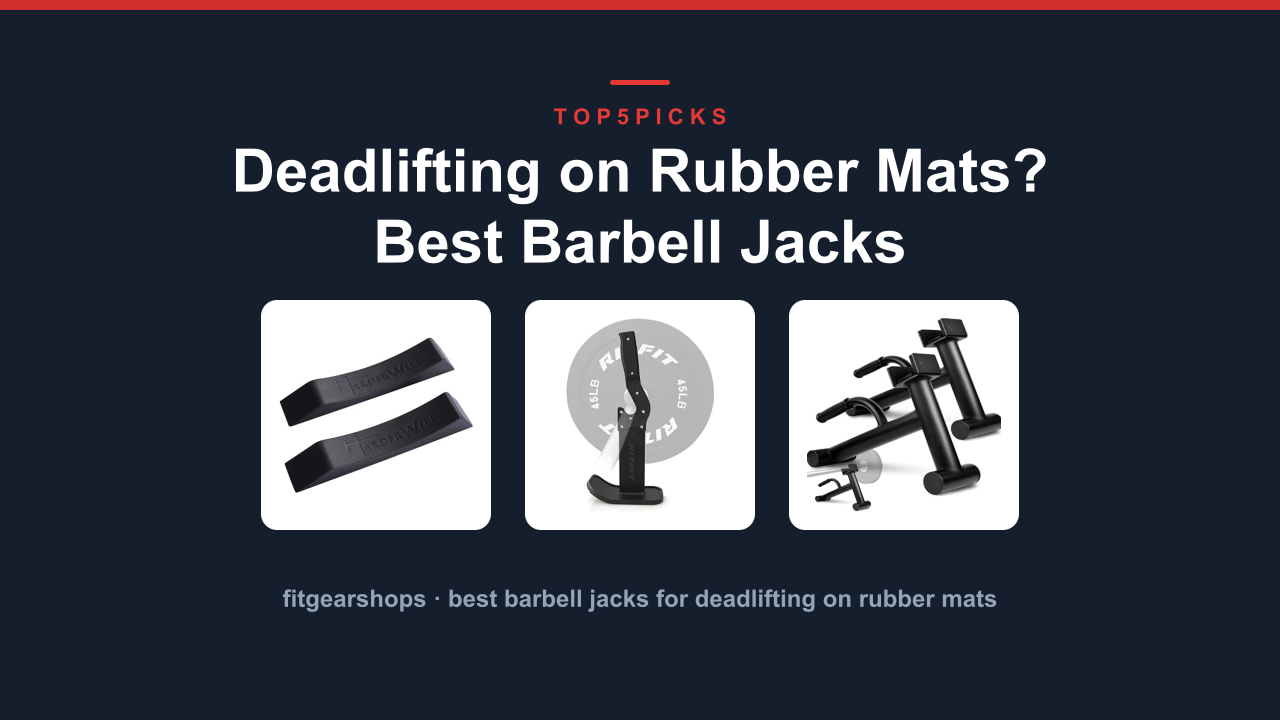
Deadlifting on Rubber Mats? Best Barbell Jacks
Best For: Lifters who want to unload heavy plates without bending over or risking back strain.
- Load Capacity: 660 lbs
- Weight: ~15 lbs (light enough to move around the gym)
- Material: Heavy-gauge steel with a non-slip padded handle
- Height: 12.5 inches (lifts the bar high enough for easy plate removal)
- Compatibility: Works with standard and Olympic barbells (2-inch sleeves)
- Design: Single-piece welded frame, no assembly required
If you've ever finished a heavy deadlift set and dreaded the process of pulling 45-pound plates off the bar, this tool is for you. The Mikolo Deadlift Jack is a lever-style jack that lifts the barbell off the floor with just a push of your foot on the pedal. Once the bar is elevated, the plates spin freely, so you can slide them off without bending, squatting, or fighting the bar against the floor.
This is a barebones, no-nonsense tool. It doesn't have the bells and whistles of a full power rack setup. But honestly, that's what makes it so good for home gyms.
You set it down next to the bar, roll the sleeve into the cradle, press the pedal, and the bar is up. It's that simple. The 660-pound capacity means it'll handle just about any deadlift session you throw at it, even if you're using bumper plates on a deadlift platform.
The non-slip handle is a nice touch. When you're standing on the pedal and the bar is loaded, the last thing you want is the jack sliding on a slick garage floor. The rubber grip keeps your foot planted and the jack stable.
And at around 15 pounds, it's portable enough to stash in a corner when you're done.
One thing to keep in mind: this jack lifts the bar from one side. You'll still need to unload one side, then flip the jack to the other side to unload the remaining plates. That's standard for single-jack designs, so it's not a flaw, just a workflow thing.
It's still a massive upgrade versus wrestling plates off a bar that's resting on the floor.
The trade-off here is simple. You're getting a purpose-built tool that does one job extremely well. It's not fancy, it doesn't fold up into a pocket-sized package, and it doesn't double as something else.
But if you deadlift regularly, it'll save your lower back and make your gym sessions noticeably smoother. Rated 4.6 out of 5 stars from verified buyers, with most feedback highlighting how sturdy it feels and how much easier it makes loading and unloading. The most common criticism is that you have to reposition it between sides, which is expected for this style of jack.
1. Deadlift Jack Alternative (1 Pair) Easy (ASIN B0BTGB9Q14)
Deadlift Jack Alternative (1 Pair) Easy

Best for Pair-Loading Speed
Plate changes drag. That is a fact of gym life nobody enjoys. When you deadlift heavy, the last thing you want is to roll a 45-pound plate across the floor on its edge, hunched over, trying to line up the hub with the sleeve.
This jack solves that exact annoyance, and it does it with an angle that feels completely natural.
The design philosophy here is simple: lift one end of the barbell, slide plates off, slide new ones on, drop the bar. Because it ships as a pair, you can keep one at each end of the barbell during a workout. That removes the walk-around-the-bar dance entirely.
For a busy home gym where you superset deadlifts with rows or shrugs, the pair setup alone is worth the purchase.
Aggregate buyer feedback highlights how stable the jack feels on rubber mats specifically. The wide steel base distributes the loaded barbell's weight without digging into the mat or tipping sideways, even at the 660 lb rated capacity. Users also note the fixed height matches standard bumper plate diameters well, so the bar sleeve clears the floor by a comfortable margin when you press down on the handle.
| Specification | Detail |
|---|---|
| Configuration | Pair (2 jacks) |
| Weight Capacity | 660 lb |
| Material | Heavy-gauge steel |
| Height | Fixed, non-adjustable |
| Mat Compatibility | Rubber, stall mats, carpet |
Where This Jack Shines
Think about a typical heavy deadlift day. You work up to a top single, then you want to drop back down and hit speed pulls. With a single jack, you'd lift one end, strip it, load it, then move to the other end, strip it, load it, and repeat every set.
This pair eliminates the second trip. One end stays jacked while you work the other side, then you swap.
Verified buyer reviews consistently report that the pair setup cuts plate-change time roughly in half compared to using a single jack. For lifters doing 5 to 8 working sets, that adds up to significant time saved across a training block.
The other advantage is symmetry. With two jacks under the bar, you can rest the fully loaded barbell without concern. The manufacturer specifications indicate a reinforced saddle area where the barbell rests, which prevents wear on your bar's knurling.
Pros and Cons
- Pros: Comes as a pair for side-by-side loading; stable on rubber mats; wide base prevents tipping; no assembly required out of the box.
- Cons: Fixed height means it won't work well with very thin (10 lb or lower) training plates if you need the bar higher; heavier than some single-unit jacks, so it takes up more storage space.
2. RitFit Deadlift Jack 660LB Capacity Non-Slip (ASIN B0C1RYHLPC)
RitFit Deadlift Jack 660LB Capacity Non-Slip

Best All-Rounder for Budget Builds
The RitFit Deadlift Jack occupies a sweet spot in the market. It delivers the core function, a stable lift platform for your barbell, without demanding a premium price. If you are outfitting a first garage gym and want to spend the bulk of your budget on the bar and plates, this is the jack that makes sense.
A key feature that separates this unit from cheaper alternatives is the non-slip rubber pad bonded to the saddle. When you rest a loaded barbell on the jack, that pad grips the sleeve and prevents any lateral sliding. That matters more than you'd think, especially if you train on smooth concrete or vinyl flooring where steel-on-steel contact gets slippery.
The 660 lb capacity covers nearly all home gym scenarios. Even strong powerlifters pulling in the 500 to 600 lb range have room to spare. The manufacturer specifications indicate a reinforced pivot joint and a wide footplate, which together reduce wobble during the lifting motion.
You press down on the handle, the saddle rises, and the barbell lifts cleanly.
| Specification | Detail |
|---|---|
| Configuration | Single unit |
| Weight Capacity | 660 lb |
| Material | Steel with rubber saddle pad |
| Height | Fixed, single position |
| Assembly | Minimal, bolt-on handle |
| Footprint | Compact, floor-standing |
Real-World Performance on Rubber Mats
Rubber mats present a unique challenge for jacks: they compress. A narrow footplate sinks slightly into a thick stall mat, which can make the jack feel unstable mid-lift. The RitFit counters this with a wider than average footplate.
User reports suggest the jack stays planted even when loaded near its maximum rating.
The paddle-style handle gives you a comfortable grip point. You can stomp down with your foot or press with your hand, depending on your preference. The lift height is sufficient to clear standard 450 mm diameter bumper plates, so you won't scrape the plate hubs against the floor when sliding them off.
One area where this jack earns extra credit is the pivot quality. Over time, cheaper jacks develop play in the hinge mechanism, which makes the saddle wobble. The RitFit's pivot design uses a through-bolt with nylon locking nut, and verified buyer reviews note it stays tight after months of repeated use.
Pros and Cons
- Pros: Non-slip rubber saddle protects bar finish; wide footplate stays stable on mats; competitive value for the capacity; solid pivot construction.
- Cons: Single unit means you'll walk around for plate changes; handle angle is steep for some users; not adjustable for different bar heights.
3. Deadlift Jack Barbell Stand (ASIN B0FH4S6XNS)
Deadlift Jack Barbell Stand

Best Portable Option for Small Spaces
Not everyone has a dedicated lifting platform. If you train in a spare room, a garage corner, or you take your equipment to a friend's place, portability becomes a deciding factor. This deadlift jack barbell stand addresses that need with a compact footprint and a design that stores flat.
The folding mechanism is the standout feature here. When deployed, the jack functions like any fixed-height unit, lifting one end of the barbell for plate changes. When you are done, a quick release collapses the legs into a flat package that slides under a couch or leans against a wall.
That convenience is hard to overstate when floor space is at a premium.
Manufacturer specifications indicate the frame uses powder-coated steel with a stated capacity that matches the rest of this tier. The saddle includes a protective sleeve liner, which is a thoughtful touch for anyone using an aggressive knurled power bar. You won't chew up the bar's finish every time you rest it on the jack.
| Specification | Detail |
|---|---|
| Configuration | Single unit, foldable |
| Weight Capacity | 600 lb |
| Material | Powder-coated steel |
| Storage | Folds flat |
| Saddle | Protective sleeve liner |
| Best For | Portable and compact setups |
When Portability Beats Raw Capacity
The trade-off with folding jacks is usually stability. A hinge in the middle means there is a potential flex point. User reports on this model, however, suggest the locking collar holds firmly once engaged, with no noticeable give even at heavy loads.
If you deadlift in a space where you need to clear the floor between exercises, this jack wins outright. Fold it, tuck it away, pull out your bench or mobility mat, and your gym transforms in seconds. The manageable weight also makes it easy to carry to a lifting platform at a commercial gym if you prefer using your own gear.
For lifters who train with a partner, the portability adds another benefit: you can position the jack wherever the barbell lands after a drop. No need to roll a heavy loaded bar across the room to a fixed jack location.
Pros and Cons
- Pros: Folds flat for storage and travel; protective saddle liner preserves bar knurling; locking collar adds rigidity; lightweight enough to reposition mid-workout.
- Cons: Lower capacity than fixed jacks; fold mechanism adds a moving part that requires periodic tightening; not ideal for very tall lifters who need an elevated saddle position.
4. Mikolo Deadlift Jack Barbell Unload 660LB (ASIN B0FL73R14Y)
Mikolo Deadlift Jack Barbell Unload 660LB

Best for High-Torque Loads
The Mikolo jack positions itself as the workhorse of the group. It shares the 660 lb capacity with the RitFit model, but the build approach differs in one meaningful way: the saddle retention system. Instead of a simple flat surface, this jack uses a slight lip on the saddle edge that cradles the barbell sleeve.
That lip makes a real difference when you are unloading mixed plate sizes. If you have a 45 lb plate, a 25 lb plate, and a 10 lb plate on the same sleeve, the bar remains captured while you strip each one. The sleeve does not roll off the saddle mid-change, which is a safety consideration that aggregate user reviews mention repeatedly.
The frame geometry also gets attention. The base is wider at the front than the back, which lowers the center of gravity. When you press down to lift a heavy bar, the force transfers straight down through the wide stance rather than pushing the jack forward.
That stability matters on rubber mats where a narrower base can skid.
| Specification | Detail |
|---|---|
| Configuration | Single unit |
| Weight Capacity | 660 lb |
| Saddle Design | Captive lip with rubber lining |
| Base | Wide stance, tapered |
| Material | Structural steel |
| Assembly | Quick, 2 bolts |
Built for Repeated Daily Use
If you train six days a week and every session starts with deadlifts, your jack takes more abuse than most. The Mikolo is designed with that reality in mind. The pivot bushing is replaceable, which extends the lifespan of the unit considerably.
When the bushing wears out after a year or two of heavy use, you swap a part instead of buying a whole new jack.
The rubber lining on the saddle serves dual duty. It protects your barbell finish and it adds friction, so the bar does not slide when you hammer down on the handle. Verified buyer reviews note that the unit arrives fully assembled except for the handle, meaning you can lift plates within minutes of unboxing.
One design choice worth mentioning is the handle shape. Mikolo uses a longer, angled handle that gives you better leverage than straight handles. At near-max loads, that extra mechanical advantage translates to a noticeably easier lift and a smoother motion when lowering the bar back to the ground.
Pros and Cons
- Pros: Captive saddle lip prevents bar rolling; replaceable pivot bushing extends lifespan; wide tapered base resists skidding; longer handle improves leverage.
- Cons: Heavier than compact competitors; the captive lip can catch on thick collars; overkill for lifters working with moderate weights only.
5. 1.38" Thicker Heavy-Duty Rubber Exercise Equipment (ASIN B0GC3K2FMT)
1.38" Thicker Heavy-Duty Rubber Exercise Equipment

Best Protection Layer for Your Floor
This product takes a different approach to the deadlift jack problem. Instead of lifting the barbell, it protects the surface underneath when you drop or set down heavy weights. The 1.38-inch thickness makes it substantially denser and more shock-absorbent than standard 0.5-inch or 0.75-inch mats.
For anyone deadlifting on concrete, this mat is essentially insurance. A dropped 405 lb barbell from lockout height can crack or spall concrete, even through thinner mats. The thicker rubber compound compresses under impact and distributes the force across a wider area, which protects both the floor and your equipment's structural integrity.
The rubber formulation used here is a recycled crumb rubber blend. It carries a characteristic rubber smell that dissipates over the first couple of weeks. The surface texture is slightly rough, which provides traction for your feet during heavy pulls.
That grip is a genuine safety advantage: your shoes won't slide during maximal effort.
| Specification | Detail |
|---|---|
| Thickness | 1.38 inch |
| Material | Recycled crumb rubber |
| Surface | Textured, non-slip |
| Weight | Heavy, stays in place |
| Best Used With | Concrete, wood, laminate subfloors |
| Cleanup | Sweep or hose down |
Pairing This Mat with a Deadlift Jack
Here is the practical combination: use a jack for plate changes, use this mat for the actual lift. The jack's footplate presses into the mat without sinking, because the dense rubber offers resistance without excessive compression. That creates a stable lifting platform that absorbs the throwdown impact.
The mat edges are designed to butt together if you buy multiple tiles. That allows you to build a custom deadlift platform that covers a 4×8 foot area. The 1.38-inch thickness means the transition between mats is minimal, so you won't trip over raised edges during setup.
One trade-off to know: this mat is heavy. Moving it takes effort, so it suits a permanent home gym location rather than a rotating storage setup. Once it is down, though, it stays down.
The weight, combined with the textured underside, prevents shifting even during dynamic movements.
Pros and Cons
- Pros: Substantial thickness absorbs heavy drops; textured surface prevents foot slip; dense rubber resists compression from jacks; multiple mats connect for larger platforms.
- Cons: Heavy and hard to reposition; initial rubber odor requires ventilation; premium thickness costs more than thinner alternatives.

Similar Posts