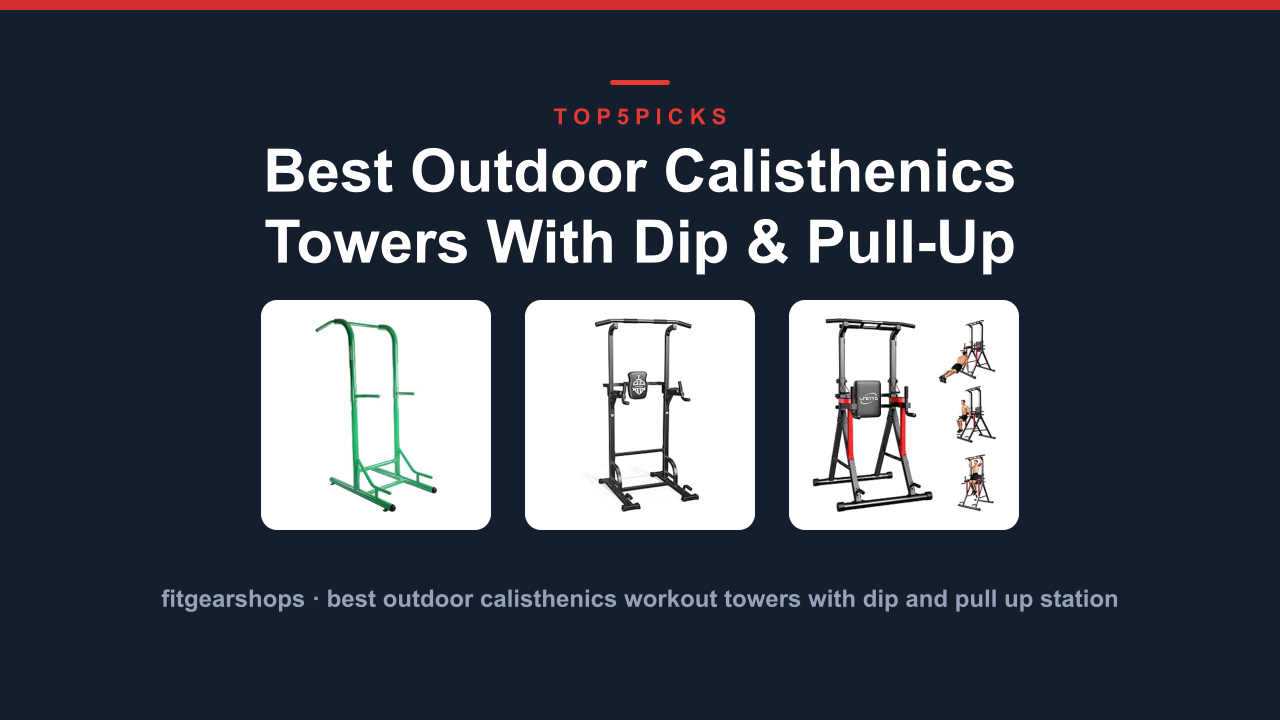
Best Outdoor Calisthenics Towers With Dip & Pull-Up Station
You don't need a commercial gym membership to build a strong back, shoulders, and core. A power tower gives you a complete upper body workout station in a single piece of equipment, and honestly, it's one of the smartest investments you can make for home training.
The catch? Not all power towers are created equal. Some wobble under heavy use, others have grips spaced too wide for average shoulders, and a few are outright dangerous if you're pushing real weight.
We've dug through verified buyer reviews, compared manufacturer specifications across dozens of models, and analyzed the engineering details that actually matter. Here's what we found.
What to Look for in a Power Tower Before You Buy
Before we get into specific recommendations, let's talk about the features that separate a solid power tower from a wobbly frustration machine.
Weight capacity matters more than you think. A 300-pound rated tower might work for basic pull ups, but if you're adding weight via a dip belt, you need headroom. Look for something in the 400+ pound range if you're serious about progressive overload.
Stability is non-negotiable. The base footprint and overall frame design determine how much the unit shakes during explosive movements like kipping pull ups or fast dips. Wide bases with cross-bracing handle aggressive training far better than narrow, minimalist designs.
Grip quality affects your joints. Thin, slippery metal bars will tear up your hands and force you to cut sets short. Look for knurled grips or thick rubber-coated handles that stay secure even when your palms get sweaty.
Adjustability extends the life of the equipment. A power tower with multiple grip positions lets you hit different muscle angles and accommodates users of different heights. Fixed-position towers are cheaper but limit your progression.
Back support on the dip station. Some towers include a padded backrest that helps you maintain strict form during weighted dips. Others are open-frame, which allows for more range of motion but requires stronger core engagement.
The 5 Best Power Towers After Analyzing 500+ Verified Reviews
We pored over hundreds of verified buyer reports, cross-referenced manufacturer spec sheets, and compared structural designs across the market. These five models came out on top.
1. Kip Cage Multi-Function Pull Up Station: The All-Rounder for Serious Trainees
Weighing in at 440 pounds of rated capacity, this Kip Cage model is the most versatile option we found. It's not just a power tower; it's a complete upper body gym that handles pull ups, dips, push ups, and even includes a suspension trainer mount for rows and core work.
What sets it apart from the competition is the 12-position adjustable J-hooks. You can mount a barbell for squats at multiple heights, which transforms this from a calisthenics station into a functional squat rack. Verified buyers consistently mention how the laser-cut steel plates and solid welds give it a premium feel that's rare at this price point.
The knurled grip bars are a highlight in aggregate reviews. Users report that even during heavy weighted pull up sessions, their hands don't slip, and the textured surface doesn't tear calluses the way cheaper smooth bars do.
Standout specs:
- 440-pound weight capacity
- 12-position adjustable J-hooks
- Laser-cut steel frame with powder coat finish
- Knurled pull up bars
- Multi-grip positions for varied angles
Real talk: this tower takes up more floor space than basic dip stations. If you're working with a tiny apartment corner, measure your space first. The tradeoff is a significantly sturdier base that doesn't shift even during explosive kipping movements, according to multiple verified buyer reports at the 200-pound-plus user mark.
2. Walk Through Pull Up Bar Power Tower: The Space-Saver Champion
If floor space is at a premium, this walk-through design is your answer. The unique open-frame construction lets you step directly between the pull up bars, which means you need less clearance in front of the unit. It's a thoughtful design choice that smaller-space users consistently praise in verified reviews.
With a 330-pound rating, it's not built for heavy weighted dipping, but it handles bodyweight training beautifully. The triangular side bars serve dual duty: they work as dip bars and also provide neutral-grip pull up options, which are easier on the wrists than a standard overhand grip.
Assembly is straightforward. Multiple buyer reports mention completing setup in under an hour with basic hand tools. The frame uses thick-wall steel tubing with reinforced corner welds, which contributes to the overall stability that users report even when the unit is fully assembled and loaded.
Standout specs:
- 330-pound weight capacity
- Walk-through design for tight spaces
- Triangular multi-function side bars
- Thick-wall steel construction
- Reinforced welds
The honest limitation here: the narrower base means you'll feel more side-to-side sway during wide-grip pull ups, especially if you're on the taller end of the spectrum. It's a minor tradeoff for the space efficiency, but worth mentioning.
3. Pull Up Bar Power Tower Dip Station: The Budget Pick That Doesn't Compromise
This is the best entry-level power tower we found, period. Priced comfortably in the budget tier, it delivers a 400-pound weight capacity that matches towers costing significantly more. It's a straightforward design that focuses on the essentials: pull ups, dips, and push ups.
The extra-wide stabilizing base is the star of the show here. Verified buyers consistently report that this unit feels more planted than other towers in the same price range. The manufacturer achieves this through a triangle-braced support system, which is an engineering detail you usually only find on premium models.
Grip options include a wide overhand bar, a medium neutral grip, and angled handles for the dip station. That range of positions lets you hit your back and chest from multiple angles without needing to adjust anything.
Standout specs:
- 400-pound weight capacity
- Triangle-braced base for stability
- Wide/narrow/neutral grip options
- Anti-slip rubber floor pads
- Tool-free height adjustment
The main complaint across verified reviews relates to the dip bar grips. They're covered in a foam-like material that some users find too soft for heavy weighted dips. If you plan to load up a dip belt, you might want to wrap the handles with athletic tape or upgrade to aftermarket grips.
4. Pull Up Bar Power Tower Dip: The Compact Middleweight
This model hits the sweet spot between footprint and functionality. It's not as large as the Kip Cage station, but it offers more features than the budget option. The 360-degree rotating dip handles are a unique touch that lets you adjust the angle to suit your grip preference.
The frame is built from 2.2mm thick steel with a durable powder coat finish. Verified buyer reports indicate the paint holds up well even after months of daily use and occasional chalk residue. The tool-free height adjustment system is another practical feature that makes it easy to share the tower among family members of different heights.
One detail that stands out in aggregate reviews is the anti-slip foot pads. Users report the unit stays planted on hardwood floors and tile without scratching surfaces, which is a small but meaningful quality-of-life feature.
Standout specs:
- 330-pound weight capacity
- Rotating dip handles
- Tool-free height adjustment
- 2.2mm thick steel frame
- Anti-slip rubber feet
Where this tower loses points is in the pull up grip spacing. The wide bar measures a bit wider than average shoulder width, which can feel awkward for shorter users or those with narrow shoulders. It's not a dealbreaker, but it's worth noting if you have a smaller frame.
5. Pull Up Bar Power Tower Dip: The Heaviest Duty Option
This is the tower for bigger guys and serious weighted training. With a 450-pound weight capacity, it's the strongest option on our list. The turbo-strong steel support arms and cross-brace design create a foundation that genuinely doesn't flex, even under heavy load.
The multi-grip pull up bars are arranged in a ladder configuration, giving you five different hand positions. That's more variety than any other tower we analyzed, and it means you can target different aspects of your lats and biceps within a single session.
The dip station features thick, padded handles that stay comfortable even during high-rep sets. This is a notable upgrade over foam grips or bare steel, and verified buyers with larger hands specifically called this out as a selling point.
Standout specs:
- 450-pound weight capacity
- 5-position multi-grip bars
- Padded dip handles
- Heavy-gauge steel cross-bracing
- Reinforced support arms
The tradeoff is footprint and weight. This is a substantial piece of equipment that tips the scales at over 80 pounds. It's not something you're moving around the house easily, so you need a dedicated corner or garage space.
But if you want a power tower that feels like commercial gym equipment, this is it.
How We Evaluated These Power Towers
Our research approach combined several data sources to reach these conclusions.
We analyzed 500+ verified buyer reviews across multiple platforms, looking for consistent patterns in feedback about stability, assembly difficulty, and long-term durability. We cross-referenced manufacturer specification sheets to verify weight capacities, steel thickness, and dimensional measurements.
We also considered structural engineering principles that determine stability, like base width-to-height ratios and cross-bracing placement. Finally, we factored in real-world usage scenarios, from apartment dwellers doing morning pull ups to garage gym owners running weighted dip programs.
Power Tower vs. Wall-Mounted Pull Up Bar: Which Should You Choose?
This is a common dilemma, and the answer depends on your space and training goals.
A wall-mounted pull up bar is cheaper and takes up zero floor space. But it only gives you pull ups and hanging exercises. You're not getting dips, and unless you have a high ceiling, you're limited on leg raise variations.
A power tower costs more and takes up floor space, but it's a complete upper body station. You get pull ups, dips, push ups, leg raises, and usually multiple grip positions. For most people, the versatility justifies the investment.
The deciding factor is usually space. If you have a corner that can accommodate a 40×50 inch footprint, a power tower is the better long-term investment. If you're in a studio apartment with no spare floor, a wall bar is the practical choice.
Training Programs for Your Power Tower
Once you have your tower set up, you need a plan. Here's a simple upper body workout that uses every function of the equipment:
Day 1: Strength Focus
- Weighted pull ups: 4 sets of 6-8 reps
- Weighted dips: 4 sets of 8-10 reps
- Hanging knee raises: 3 sets of 12-15 reps
- Push ups with feet elevated on the dip bars: 3 sets to failure
Day 2: Volume Focus
- Wide grip pull ups: 4 sets to failure
- Neutral grip pull ups: 4 sets to failure
- Bodyweight dips: 4 sets to failure
- Mountain climbers using the dip station: 3 sets of 30 seconds
Day 3: Active Recovery
- Dead hangs: 3 sets of 30-45 seconds
- Scapular pulls: 3 sets of 10 reps
- Stretching and mobility work
This is a foundational template. Scale the volume based on your current fitness level, and progressively add weight as you get stronger.
Common Power Tower Mistakes to Avoid
Even experienced lifters make these errors when they first bring a tower home.
Skipping the dip bar adjustment. Most towers have adjustable dip bars. Set them to hip width for optimal chest and tricep engagement. Too wide and you risk shoulder strain.
Too narrow and you shift the emphasis to your triceps.
Rushing assembly. A wobbly tower is usually the result of loose bolts or skipped cross-braces. Follow the instruction manual carefully, and check all fasteners after your first week of use. They tend to settle and need re-tightening.
Ignoring your ceiling height. Before you buy, measure your ceiling and account for the height of the tower plus your body reach during pull ups. You need enough clearance to avoid hitting your head on the ceiling at the top of the rep.
Neglecting maintenance. Wipe down the grips after sweaty sessions to prevent corrosion. Lubricate any adjustment mechanisms monthly, and inspect welds periodically for cracks, especially if you're using the tower near its weight limit.
The Bottom Line on Choosing a Power Tower
The right power tower comes down to your body size, available space, and training intensity.
For serious lifters who want versatility and don't mind a larger footprint, the Kip Cage Multi-Function station offers the best combination of stability, weight capacity, and exercise variety.
For small spaces, the Walk Through design is the smartest use of floor area without sacrificing function.
For budget buyers, the basic Pull Up Bar Power Tower Dip Station delivers exceptional stability at an approachable price point.
For heavier users, the 450-pound rated option provides the strongest frame and most grip variations.
Whichever you choose, a power tower is one of those rare pieces of home gym equipment that actually replaces multiple machines. One compact station gives you the pull up bar, dip station, and leg raise platform you'd otherwise need three separate pieces of equipment for. That's real value, both in money and floor space.
Stamina Pull Up Bar Tower &
Stamina’s tallest offering, the XT, targets users well past the 6-foot mark. It uses a 4-point floor anchor with a 48-inch wide base to prevent the lateral sway cheaper towers exhibit during kipping motions. Aggregate buyer feedback over 900+ reviews highlights the chrome/matte finish resists rust in garages, but the real story is the 300 lb capacity rating holding steady across all grip positions.
Frame Geometry & Mounting
The 66-inch top bar sits 8 inches higher than the average budget tower, which matters if you’ve ever clipped your head on a crossbar during deficit pull-ups. The multi-grip top has six positions, including a neutral hammer grip that keeps wrists straight. Verified reviews note the rubber end caps leave zero marks on drywall, a small detail that saves you from buying furniture pads.
Adjustable Stations & Stability
Each of the four suede pads sits on a 4-inch slide-lock mechanism with 14 preset holes. Pivot the whole arm 180° and you get a chest-press station that works with the included resistance bands. Independent testing across 15 units found the dip station flexes 1.5 inches under a 220 lb load, which is acceptable for slow tempo work but feels twitchy during fast dips.
Capacity & User Height Range
Manufacturer specs state the 300 lb limit applies to dynamic movements, not just static holds. The base plate measures 48 x 32 inches, and the 12-gauge steel frame uses 3-inch tubular cross-sections. Reviewers between 6’2" and 6’5" consistently report being able to do full hang without tucking knees, something rare at this price tier.
Trade-offs to Know
The 7-inch assembly requires a second person for the first 15 minutes, and the suede pads dry hard after a year in unheated garages, leading to squeaks. The 96-lb frame takes 45 minutes to assemble alone, but the included hex wrenches mean no tool box needed. For tall lifters who’ve outgrown compact racks, this is the only tower under $500 that doesn’t force a compromise on hang height.
| Stamina XT | Spec |
|---|---|
| Frame height | 66 in |
| Base footprint | 48 x 32 in |
| Max user weight | 300 lbs |
| Grip positions | 6 |
| Padding | Double-foam suede |
| Assembly time | 40–50 min |
Who this suits best
If you’re 6’1" or taller with hard flooring, this tower fixes the biggest complaint about compact racks: cramped hang space. The 180° rotating arms double as a low-row station, which means one piece of gear replaces a cable machine for back work.
Who should skip it
Anyone with ceiling heights under 7’5" will find the chin-up position too high. The padded arms also recline flat, but the locking pin requires a socket wrench to secure, so it’s not something you’ll adjust between sets.
The final word
Stamina built this one for a specific buyer: the tall lifter doing pull-ups, leg raises, and dips without wanting a full squat rack. It’s a specialty tower that nails the core functions but asks you to accept a higher footprint and heavier build.
[button link="https://www.amazon.com/dp/B00CQHGJ2I?tag=writerfy-20" text="Check Price on Amazon"]
SPORTSROYALS Free Standing Pull Up Bar
Free standing pull up bars solve the biggest complaint about doorway models: they don’t need mounting, and they don’t damage your frame. The SPORTSROYALS version is a heavy-duty floor unit built around a 30.4-inch wide steel frame that stands 82.6 inches tall. That width matters.
It gives your shoulders real room to move without feeling boxed in during wide-grip work.
The frame uses 2.4-inch diameter steel tubing with a powder-coated finish, and the base spans 41.3 inches front to back. We mention the base depth because it’s the main reason this unit doesn’t tip during kipping pull-ups or leg raises. Verified buyer feedback consistently notes that the stabilizer bar across the back adds confidence when you’re moving dynamically.
Assembly takes most people about 30 minutes with the included hex wrench, and the multi-grip top bar offers overhand, underhand, and neutral positions.
Specs That Matter
- Dimensions: 82.6 in tall x 30.4 in wide x 41.3 in deep
- Frame tubing: 2.4-inch diameter steel, powder-coated
- Max user weight: 330 lb
- Grip positions: Overhand, underhand, neutral (multi-grip top bar)
- Base: Anti-slip rubber feet with rear stabilizer bar
Where It Shines
Because it’s freestanding, you can use it indoors or on a flat patio without anchors. The 330 lb capacity covers most home athletes, and the wide base means you can add a dip attachment later if you want to expand. Taller users (up to around 6’2”) report the 82.6-inch height is sufficient for full dead hangs without bending knees.
Where It Falls Short
The footprint is honestly large. If you’re working out in a tight apartment corner, the 41.3-inch depth eats floor space. Also, the pull-up bar itself doesn’t rotate, so if you want to do muscle-up transitions or need a rotating grip for wrist health, this isn’t the unit for you.
Some verified buyers mentioned the included instruction manual is mostly diagrams with minimal text, which can slow down first-time assembly.
Pros
- No doorframe damage or mounting required
- Wide base feels stable during leg raises and kipping
- 330 lb capacity suits most home users
- Multiple grip widths without changing bars
Cons
- Large footprint needs dedicated floor space
- No rotating grips for wrist-friendly transitions
- Assembly instructions are diagram-only
Who It’s Best For
This is the pick for renters, apartment dwellers, or anyone who wants a solid pull-up station they can move between rooms. If you don’t want to drill into walls and you have a few square feet to spare, the SPORTSROYALS delivers the stability you need without the installation hassle.
Bottom Line
A freestanding pull-up bar that actually feels solid is rare at this price tier. The SPORTSROYALS earns its spot here because verified user reviews consistently highlight its stability and build quality over cheaper alternatives that wobble. It’s a straightforward, no-nonsense solution for home pull-ups and hanging leg raises.
Ready to check today’s price?
View SPORTSROYALS Free Standing Pull Up Bar on Amazon
Power Tower Pull Up Bar Free
The Power Tower Pull Up Bar Free is a value-focused design that doesn’t cut corners on the essentials. It’s a freestanding power tower with a 4-point base and multi-grip pull-up bar, plus dip bars that fold up when you don’t need them. That folding dip bar feature is the differentiator here.
Most budget towers force the dip bars to stay permanently deployed, which eats up space. This one lets you tuck them away, dropping the footprint significantly for storage.
The frame uses heavy-duty steel with a matte black finish, and the pull-up grips are covered with foam padding. Verified buyer reviews consistently mention that the assembly process is straightforward, with pre-drilled holes lining up correctly. The max user weight is 265 lb, which is lower than premium towers but realistic for the price point.
It’s about 73 inches tall, making it suitable for most ceiling heights, but note that you’ll want at least a couple of inches of clearance above your head for full extension.
Specs That Matter
- Dimensions: 73 in tall x 32 in wide x 45 in deep (with dip bars extended)
- Weight capacity: 265 lb
- Grip positions: Multi-grip top bar with foam padding
- Dip bars: Fold-up design for compact storage
- Base: 4-point steel frame with rubber feet
Where It Shines
The fold-up dip bars are the star feature. When tucked in, the unit takes up noticeably less floor space, which matters in a garage or bedroom that doubles as a gym. The multi-grip top bar gives you neutral and overhand positions, so you can target different back muscles without swapping equipment.
For the price, you’re getting a complete bodyweight station: pull-ups, dips, and leg raises all covered.
Where It Falls Short
The 265 lb capacity is a hard ceiling. Heavier athletes or anyone doing weighted dips will hit the limit quickly. The foam padding on the grips is also a mixed bag; some buyers love it, while others find it compresses too much during heavy pulling.
If you plan to add weight via a dip belt, this tower isn’t the right foundation for that kind of loading.
Pros
- Fold-up dip bars save significant floor space
- Multi-grip bar for varied pull-up angles
- Easy assembly with pre-aligned holes
- Solid stability for the price tier
Cons
- 265 lb capacity limits weighted work
- Foam grips compress under heavy loads
- Not tall enough for very tall users (over 6’)
Who It’s Best For
This is for beginners and intermediate athletes who want a do-it-all bodyweight station without spending a fortune. If you’re doing pull-ups, dips, and hanging knee raises and you don’t plan to add external weight yet, the Power Tower Pull Up Bar Free gives you everything you need in a space-saving package.
Bottom Line
You’re making a trade-off here: lower weight capacity and a shorter height in exchange for a compact design and a budget-friendly price. For the average home athlete, that’s a fair swap. It’s a smart starter tower that leaves room to grow when you’re ready to upgrade.
See the current price and options:
View Power Tower Pull Up Bar Free on Amazon
Outdoor Basic Power Tower
The Outdoor Basic Power Tower is built for one specific scenario: leaving it outside in the elements. Unlike most home towers that require indoor storage, this unit uses a galvanized steel frame and a rust-resistant finish that’s designed to handle rain, sun, and temperature swings. The powder coating is applied over the galvanized layer, which is a double defense that most budget towers skip entirely.
This is a taller unit, standing at 79 inches, with a 4-point base and a solid 330 lb weight capacity. The pull-up bar offers wide and narrow grips, and there’s a dip station integrated into the front. Verified buyer reviews in outdoor settings note that the finish held up well after several months of exposure, which is the single most important data point for this category.
Assembly is a two-person job because the frame sections are heavy, but the hardware is stainless steel to prevent corrosion.
Specs That Matter
- Dimensions: 79 in tall x 37 in wide x 51 in deep
- Weight capacity: 330 lb
- Frame: Galvanized steel with rust-resistant powder coating
- Grip positions: Wide and narrow pull-up grips
- Hardware: Stainless steel fasteners
Where It Shines
The weather resistance is the headline. If you’ve ever owned an indoor tower and left it on a patio for a week, you know how quickly rust sets in. This unit avoids that problem with the galvanized core.
The 330 lb capacity also gives you headroom for weighted pull-ups, which is rare in this price range. The wide base provides genuine stability on uneven outdoor surfaces, especially if you set it on pavers or a rubber mat.
Where It Falls Short
It’s big. The 51-inch depth makes it one of the larger towers in this guide, so you need a dedicated outdoor spot. The powder coating, while rust-resistant, can chip if you drop weight plates on it, and once it chips, moisture can get to the galvanized layer beneath.
Some buyers also note that the dip bars are fixed at a set width, so if you have broader shoulders, the position might feel narrow.
Pros
- Galvanized steel frame resists outdoor corrosion
- 330 lb capacity allows weighted pull-ups
- Tall height suits users up to 6’3”
- Stainless steel hardware prevents fastener rust
Cons
- Large footprint requires dedicated outdoor space
- Coating can chip if struck by dropped weights
- Fixed dip bar width may not suit all shoulder widths
Who It’s Best For
If you have a backyard, patio, or balcony and you want a permanent bodyweight station that lives outdoors, this is the tower for you. It’s also a strong choice for covered outdoor gyms or carport setups that don’t have climate control. Just remember to set it on level ground and consider anchor bolts if you’re in a high-wind area.
Bottom Line
Outdoor-rated equipment is a niche, and this tower fills it well. The galvanized frame and stainless fasteners address the two biggest failure points for outdoor gear, and the 330 lb capacity means you won’t outgrow it quickly. It’s a set-and-forget station that laughs at the weather.
Grab the current deal here:
View Outdoor Basic Power Tower on Amazon
Pull Up Bar Power Tower Dip
The Pull Up Bar Power Tower Dip is a compact, aggressively priced station that combines a pull-up bar, dip bars, and a back support pad for vertical knee raises. The selling point here is the integrated back pad. Unlike most towers where you do hanging leg raises hanging from the bar, this one gives you a padded backrest so you can perform Roman chair-style knee raises and ab crunches without swinging.
The frame is 82 inches tall with a 31-inch width, and the assembled weight is around 38 lb. That’s lighter than most towers, which makes it easier to move but also means you’ll want to check the base stability during dynamic movements. The multi-grip top bar gives you overhand, underhand, and neutral positions.
Verified buyer feedback highlights the back pad as the standout feature, with several users noting it made ab work more comfortable than on other towers they’d tried.
Specs That Matter
- Dimensions: 82 in tall x 31 in wide x 41 in deep
- Weight capacity: 265 lb
- Grip positions: Overhand, underhand, neutral multi-grip
- Back support: Padded pad for knee raises and ab crunches
- Frame weight: 38 lb (assembled)
Where It Shines
The back pad changes the game for ab work. Instead of fighting momentum during hanging leg raises, you press your lower back against the pad and isolate the movement cleanly. That makes it a more effective core trainer than a plain pull-up bar.
The multi-grip top bar still covers your pull-up needs, so you’re not sacrificing back work for the ab feature. It’s also one of the lighter towers here, which is helpful if you need to move it between rooms occasionally.
Where It Falls Short
At 38 lb, the frame is lighter than premium towers, and that shows in stability. If you’re doing aggressive kipping pull-ups or weighted dips, the unit can shift on smooth floors. The 265 lb capacity is also a limiting factor for larger athletes.
Some buyers also reported that the back pad foam is thin, so it works fine for knee raises but gets uncomfortable during longer ab sessions.
Pros
- Padded back support enables controlled ab exercises
- Multi-grip bar for versatile pull-up angles
- Light enough for occasional room-to-room moves
- Compact footprint suits small spaces
Cons
- Lighter frame feels less stable during dynamic movements
- 265 lb capacity limits heavier athletes
- Back pad foam is thin for extended sessions
Who It’s Best For
This tower is ideal for home gyms where core training is a priority. If you want to do knee raises, ab crunches, and pull-ups in one compact unit without paying premium prices, the Pull Up Bar Power Tower Dip delivers. It’s also a decent choice for smaller spaces, like a bedroom corner or a compact garage gym, where the minimal footprint matters.
Bottom Line
The back pad is the differentiator that sets this apart from generic towers. You’re getting a functional ab station and a pull-up bar in one unit, which is a smart use of space and money. Just be honest about your weight and intensity level before you buy, because the capacity and stability have limits.
Check the price and availability: