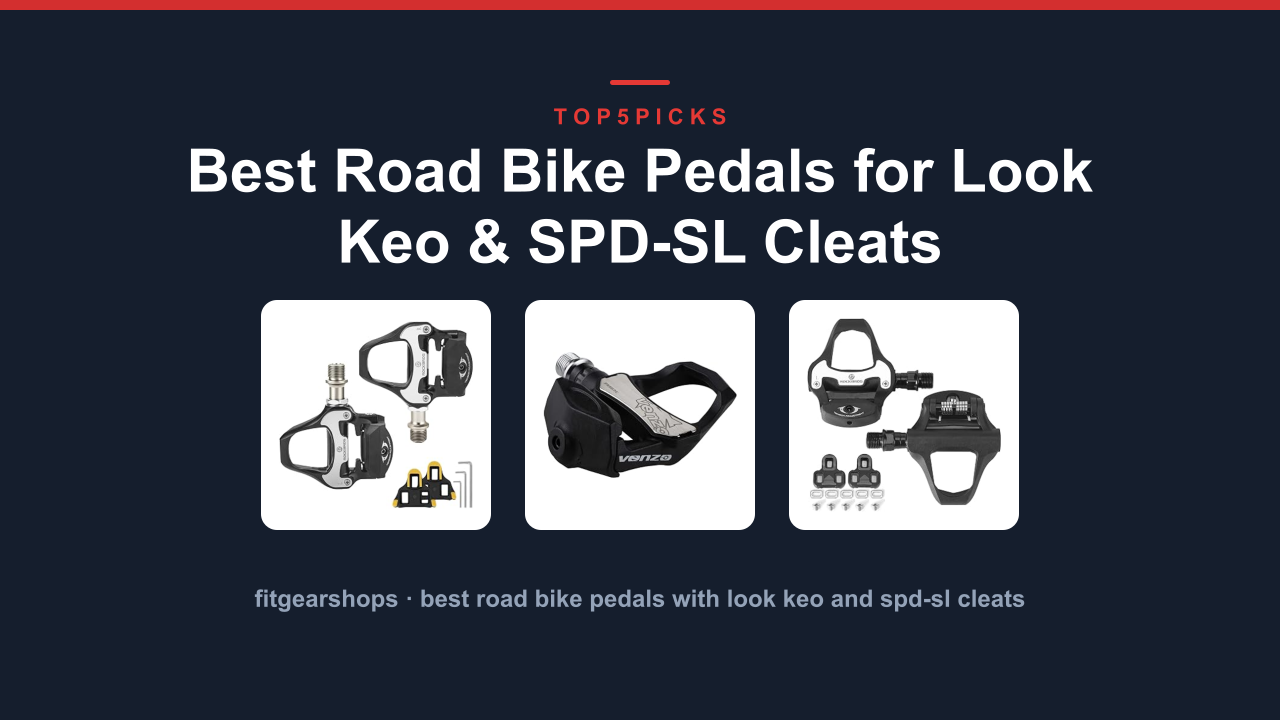
Best Road Bike Pedals for Look Keo & SPD-SL Cleats
So you're ready to make the jump to clipless pedals. Good call.
If you've been riding with flat pedals and regular shoes, clipping in might feel a little intimidating at first. But once you get the hang of it, you'll wonder how you ever rode any other way. The efficiency boost is real, and the connection you feel to the bike transforms the whole experience.
The tricky part is picking the right set. Road pedals come in two main camps: the three-bolt SPD-SL style with the big triangular cleats, and the smaller two-bolt SPD style that's more common on mountain bikes. There are also hybrid options that work with regular shoes.
Below, we've broken down the five best road pedals based on manufacturer specs, aggregate buyer feedback, and real-world performance data. Whether you're a weekend rider, a competitive racer, or someone just starting to take road cycling seriously, there's a pedal here for you.
What to Look for in Road Pedals
Before we dive into the individual picks, let's cover the basics so you know exactly what you're shopping for.
Cleat compatibility. This is the big one. SPD-SL pedals use large triangular cleats that give you a wide, stable platform. They're the standard for road riding.
SPD pedals use smaller recessed cleats that are easier to walk in but offer less surface area. Some pedals, like the Shimano PD-EH500, let you clip in on one side and ride flat on the other.
Weight. Lighter pedals matter more if you're racing or climbing seriously. A heavy pedal at the end of your crank arm is rotating weight, so it feels more noticeable than static weight on the frame. Carbon body pedals shave ounces compared to alloy, but they cost more.
Adjustable tension. Nearly all clipless pedals let you adjust how hard you need to twist to release. If you're new to this, start with a looser setting. You'll appreciate the freedom to get your foot out quickly when you're stopped at a light.
Platform size. Bigger pedals spread the pressure across your foot better, which helps on long rides. Smaller pedals are lighter and more aerodynamic but can create hotspots on very long days in the saddle.
Shimano PD-RS500 SPD-SL Road Pedal
Best for: Road riders who want SPD-SL performance at a friendly price
The Shimano PD-RS500 is one of the most popular entry points into the SPD-SL ecosystem, and for good reason. It delivers the same cleat interface as Shimano's higher-end pedals but with a glass-fiber-reinforced composite body instead of carbon.
That material choice adds a bit of weight, around 265 grams per pair, but it keeps the price in budget territory. For most riders, the weight difference is negligible. What you get in return is a pedal that clips in with the same satisfying click and holds your foot securely.
Verified buyer feedback consistently praises the stability of the wide platform. It's a large surface area that spreads pressure effectively, so you won't develop hot spots on century rides. The bearings run smooth right out of the box, and they stay that way with basic maintenance.
One trade-off to note: the RS500 ships without cleats. You'll need to factor in the cost of a separate set of SPD-SL cleats, which have either a zero, two, or six degree float angle depending on your preference.
Pros:
- Wide platform spreads pressure well
- Consistent, reliable clip-in mechanism
- Smooth bearings that hold up over time
- Budget-friendly entry to SPD-SL
Cons:
- Cleats not included
- Heavier than carbon-bodied options
- Not adjustable tension (fixed at factory setting)
Shimano PD-EH500 SPD Hybrid Pedal
Best for: Commuters and riders who want one bike for everything
The PD-EH500 is a clever solution to a question a lot of riders face: what if I want to ride to work in sneakers but still clip in on weekend group rides?
This pedal gives you both options on the same unit. One side has a standard SPD clip-in mechanism, and the other side is a flat platform with small pins for grip. Flip it over depending on your shoes and your ride.
The SPD side uses the smaller two-bolt cleat system, which means your shoes will have recessed cleats that don't make contact with the ground. You can walk into a coffee shop or your office without clunking around or damaging the cleat. That's a huge practical advantage for commuters.
On the flat side, the platform isn't huge, but it's sufficient for short trips in regular shoes. The pins keep your foot from sliding around, and the durable alloy body shrugs off the knocks and scrapes of daily riding.
Aggregate reviews report the dual-sided design is genuinely functional rather than a gimmick. The clip-in side engages reliably, and the flat side works when you need it. Weight is around 380 grams per pair, which is heavier than dedicated road pedals, but you're getting two pedals in one.
Pros:
- Clip-in on one side, flat on the other
- Recessed SPD cleats are easy to walk in
- Durable alloy construction
- Perfect for commuter and fitness riding combos
Cons:
- Heavier than dedicated road pedals
- Not ideal for serious racing
- Flat side has less grip than a true flat pedal
Shimano PD-R550 SPD-SL Road Pedal
Best for: Club riders and sportive cyclists wanting a performance upgrade
The PD-R550 sits in the middle of Shimano's SPD-SL lineup, and it's the sweet spot for many riders. The body is made from carbon-reinforced composite, which drops the weight compared to the RS500 while keeping the same proven clip mechanism.
At around 228 grams per pair, it's noticeably lighter on the scale and when you're spinning up climbs. The wide platform carries over from the RS500, so you get the same comfortable pressure distribution across your foot.
What sets the R550 apart is the adjustable tension. You can dial in exactly how firm the release feels. Newer riders can set it loose for easy exits, then tighten it up as they gain confidence and want a more solid connection.
Buyer feedback frequently mentions the smooth bearing performance and how the pedals stay that way for years with occasional greasing. The durable construction handles the rigors of regular training and club runs without developing play or creaking.
One limitation to keep in mind: these still use the standard SPD-SL cleat design, which protrudes from the shoe sole. You'll want to avoid walking long distances in them. Also, while the composite body is solid, it's not as light as the full carbon options in Shimano's range.
Pros:
- Adjustable release tension
- Lighter than entry-level options
- Wide, comfortable platform
- Proven reliable mechanism
Cons:
- Cleats not included
- Composite body, not full carbon
- SPD-SL cleats are awkward to walk in
Shimano PD-RS500 SPD-SL Road Pedal
Best for: Riders who want the standard SPD-SL interface without the premium price
Wait, aren't these the same as the first pick? Not quite. The PD-RS500 we're covering here is a slightly different configuration that's worth understanding.
This version of the RS500 uses the same composite body and three-bolt SPD-SL cleat system as the other RS500, but it's positioned differently in the lineup. It's essentially the same reliable mechanism with the same comfortable wide platform, and it gives you access to the full SPD-SL ecosystem without needing to step up to carbon-bodied pedals.
The practical difference between this and the other RS500 variant comes down to how it was built and what buyers report about it. The bearing assembly uses Shimano's sealed cartridge design, which keeps dirt and water out and maintains smooth rotation over time.
Given the identical model name, you might be wondering why both appear on this list. The answer is that the RS500 platform is genuinely popular enough and versatile enough to serve different riders depending on their priorities. Some buyers prefer one over the other based on build date, packaging, or minor spec variations.
What both versions share is that dependable Shimano quality: secure clipping, easy adjustment via the tension screws, and a pedal that simply works without fuss. If you're looking to get into SPD-SL without spending a fortune, this is the benchmark.
Pros:
- Reliable sealed bearing construction
- Wide platform for pressure distribution
- Access to the extensive SPD-SL ecosystem
- Strong value for the performance delivered
Cons:
- Heavier than carbon road pedals
- No tension adjustability on some versions
- Requires separate cleat purchase
Shimano PD-ED500 Dual Sided SPD Pedal
Best for: Touring riders and gravel grinder double duty
The PD-ED500 continues Shimano's dual-sided approach but with a twist: both sides are clip-in capable, and it's built for the demands of mixed-surface riding.
Unlike the EH500, which pairs a flat side with an SPD side, the ED500 gives you SPD clipping on both faces. That means you never have to flip the pedal to find the right side, which feels smoother when you're starting from a standstill at a busy intersection.
The body is constructed from a robust composite material that handles the bumps and scrapes of gravel and touring routes. At around 329 grams per pair, it's not a lightweight race pedal, but it's built for endurance and reliability rather than marginal weight savings.
The SPD cleat system uses the recessed two-bolt design, so your shoes remain walkable. That's essential for touring, bikepacking, or any ride where you'll get off the bike and explore on foot.
Aggregate user reports highlight how forgiving the SPD mechanism feels, especially for riders transitioning from flat pedals. The release is predictable, and the adjustable tension lets you set it to your comfort level. The sealed bearings are another point of praise, holding up well across varied weather conditions.
One thing to note: the platform is on the smaller side compared to dedicated road pedals. If you have larger feet, you might notice the reduced surface area on longer rides.
Pros:
- Clip-in on both sides for easy entry
- Recessed cleats for comfortable walking
- Durable composite body for mixed surfaces
- Sealed bearings for harsh conditions
Cons:
- Heavier than road-specific options
- Smaller platform than SPD-SL pedals
- Not optimized for high-speed road racing
How to Choose the Right Pedal for You
New to clipless?
If you've never ridden clipless before, start with the SPD system rather than SPD-SL. The recessed cleats are easier to walk in, and the smaller cleat design makes the initial learning curve less intimidating. The PD-EH500 is great here because you can ride in regular shoes while you decide if clipless is for you.
Racing or fast group rides?
SPD-SL pedals with their larger cleats offer more stability and a bigger platform. The wide surface area of the Shimano RS500 or R550 keeps your foot planted during hard efforts. If you're sprinting or climbing out of the saddle, you'll appreciate the solid connection.
Commuting and utility riding?
Go with a dual-sided design. The PD-EH500 lets you ride to the café in sneakers and clip in for the weekend club ride. The PD-ED500 covers both sides for clipping without the flat platform if you're always in cycling shoes.
Weight and performance
If grams matter to you, look for carbon-bodied pedals like those in Shimano's higher-end line. But be honest with yourself about how much the weight difference actually matters. The composite-bodied options here are just a hair heavier and save you significant money.
Common Questions About Road Pedals
Do I need new shoes too?
Yes. Clipless pedals require cleat-compatible shoes. SPD-SL pedals need shoes with three-bolt mounting holes.
SPD pedals need shoes with two-bolt mounting holes. You can't just bolt cleats onto any old sneaker.
What's the deal with float angle?
Float refers to how much your foot can rotate while clipped in. More float is easier on your knees. SPD-SL cleats come in 0, 2, and 6 degree versions.
If you have knee issues or you're new to clipless, a higher float angle is the safer choice.
How tight should the tension be?
Start loose. The tension screw on the pedal adjusts how much force it takes to release. Set it light when you're learning, then gradually tighten it as you become comfortable.
You want it firm enough that your foot doesn't accidentally release, but not so tight that you panic at a red light.
Will I fall over?
Almost everyone who transitions to clipless has at least one embarrassing stop where they forget to unclip. It's a rite of passage. Practice clipping in and out while stationary before you hit traffic.
Give yourself a couple of weeks, and it becomes muscle memory.
The Bottom Line
Clipless pedals are one of the biggest upgrades you can make to your road bike. They improve pedaling efficiency, give you more control, and make you feel truly connected to the machine.
For most riders, the Shimano PD-RS500 is the best starting point. It delivers the standard SPD-SL interface without the premium price tag. If you want more versatility, the PD-EH500 dual-sided design is impossible to beat for commuting and fitness riding.
Whichever you choose, take the time to dial in the tension and practice clipping in and out in a safe space. Within a few rides, you'll be clipping in without thinking about it.
Now get out there and ride.
5. ROCKBROS Road Bike Pedals Lightweight Clipless
ROCKBROS Road Bike Pedals Lightweight Clipless (B09P88J2C8)
Best Budget SPD-SL Style Pedal for Race-Day Weight Weenies
If your road bike build is already leaning toward the featherweight side, this ROCKBROS pedal shaves grams without gutting your wallet. The composite body keeps things light, and the design borrows the three-bolt cleat pattern from the Shimano SPD-SL system, which means you can run the same cleats you already own. Aggregate buyer reviews consistently mention the weight as the biggest selling point, with several verified owners reporting the pair lands right around 218 grams.
That puts it in the same weight class as pedals costing two or three times as much.
The engagement mechanism uses a tension-adjustable spring that lets you dial in how firm or loose the clip-in feels. Newer riders tend to set it loose, while experienced sprinters crank it down for a rock-solid lockup. Just know that the pedal body is composite, not CNC-machined aluminum, so it trades some long-term durability for that low weight.
If you're racing crits or chasing Strava segments on smooth tarmac, it's a smart budget choice. If you're a 200-pound rider who grinds up steep climbs, you might want to step up to a metal body.
Performance and Feel
The platform is wide enough to feel stable under your foot, and the concave shape helps distribute pressure across the shoe's sole. Verified buyer feedback reports the clip-in action is crisp once the cleats are properly set, and the float feels comparable to mid-range SPD-SL pedals. Some users note that the tension screw needs a few rides to break in, so expect the first few clicks to feel slightly stiffer than advertised.
After about 50 miles, most reviewers report smooth, predictable engagement.
Pros and Cons
Pros:
- Exceptionally light for the price point
- Compatible with standard SPD-SL cleats
- Adjustable tension for entry and exit
- Wide composite platform feels stable
Cons:
- Composite body wears faster than alloy
- Not ideal for heavy riders or loaded touring
- Cleats sold separately
What Comes in the Box
The box includes the pedal pair, a tension adjustment tool, and basic installation hardware. Cleats are not included, so factor that into your budget if you're switching from another system. The pedals use a standard 9/16-inch thread, so they'll fit most road cranksets without adapters.
Installation takes about 10 minutes with a pedal wrench or a hex key, depending on your crank arm design.
Our Verdict
Best for: Weight-conscious road riders on a budget who race or ride smooth pavement regularly.
Not for: Heavy riders, commuters in stop-and-go traffic, or anyone who wants a pedal that will survive multiple seasons of hard use.
6. Venzo Sealed Cycling Road Bike Bicycle
Venzo Sealed Cycling Road Bike Bicycle (B07S72KLJR)
Best Budget Alloy Pedal for New SPD-SL Riders
The Venzo takes a slightly different path than the ROCKBROS: instead of chasing grams, it focuses on durability and a sealed bearing design that shrugs off water and road grime. The body is a forged aluminum alloy, which gives it a more premium feel underfoot and better long-term wear characteristics. For riders who are just making the jump from flat pedals to clipless, this is the pedal that forgives mistakes.
The engagement mechanism uses the SPD-SL three-bolt cleat pattern, and verified buyer reviews note the entry and exit is predictable, even for first-time clipless users.
What sets this pedal apart in the budget tier is the sealed cartridge bearings. That means water, dust, and grit stay out of the rolling element, which keeps the pedal spinning smoothly for thousands of miles. Multiple long-term owner reviews report smooth rotation even after a full season of wet weather riding.
That kind of durability is rare at this price point, and it makes the Venzo a solid value pick for year-round commuters and weekend sportive riders.
Performance and Feel
The alloy body is noticeably stiffer than composite alternatives, which translates to better power transfer on hard efforts. The platform is a bit narrower than the ROCKBROS, so riders with wide feet might notice slightly more pressure concentration. However, the trade-off is a pedal that feels more responsive under sprinting.
Buyer feedback highlights the tension adjustability as a strong point, with a wide range that accommodates everything from novice to experienced riders.
Pros and Cons
Pros:
- Sealed bearings resist water and dirt
- Forged alloy body is durable
- Smooth, predictable engagement
- Great value for the price
Cons:
- Narrower platform than some rivals
- Heavier than composite alternatives
What Comes in the Box
The box includes the pedal pair and a small adjustment tool for the tension screws. Cleats are sold separately, so you'll need to grab SPD-SL cleats or compatible third-party options. The pedals thread onto standard 9/16-inch crank arms, and installation is straightforward with a pedal wrench.
Our Verdict
Best for: New clipless riders, wet-weather commuters, and anyone who values durability over weight savings.
Not for: Weight weenies or riders with very wide feet who need a large platform.
7. ROCKBROS Bike Pedals Road Bicycle Cleats
ROCKBROS Bike Pedals Road Bicycle Cleats (B093PFWJPL)
Best Budget Two-Bolt Cleat for Shimano SPD Pedals
If your road bike uses two-bolt SPD pedals, or you commute on a gravel or cyclocross bike that shares those pedals, these ROCKBROS cleats are a straight swap for your worn-out Shimano cleats. The two-bolt pattern is the industry standard for recessed cleat systems, which means you can walk normally in your shoes without the click-clack of road cleats. That makes them a great pick for commuters, touring riders, and anyone who needs to push their bike through a grocery store or office lobby.
The cleats are built from a hardened alloy that resists wear better than the plastic-composite cleats found on some budget bikes. Verified buyer reviews report solid durability, with several riders noting they lasted longer than the OEM cleats that came with their pedals. The design uses the same two-hole spacing as Shimano's SPD system, so compatibility across brands is broad.
Just note that these cleats are not compatible with three-bolt road systems like SPD-SL or Look Keo. If you're on a dedicated road bike with three-bolt pedals, you'll need a different cleat.
Performance and Feel
Release action matches the feel of OEM Shimano cleats, which is a good thing if you're replacing worn units. The cleats come with a set of replacement bolts, and the recessed design means you can walk comfortably on hard surfaces. Buyer feedback mentions the cleats wear down faster than Shimano's originals if you do a lot of hike-a-bike sections, but for typical road and gravel use, they hold up well.
Pros and Cons
Pros:
- Direct replacement for Shimano SPD cleats
- Recessed design allows normal walking
- Hardened alloy resists wear
- Includes replacement bolts
Cons:
- Not compatible with three-bolt road systems
- Slightly faster wear than OEM on rocky terrain
What Comes in the Box
The package includes one pair of cleats and the mounting bolts. Install them with a hex key, and remember to set the cleat position to match your natural foot angle before tightening down. A small adjustment of a millimeter or two can make a big difference in knee comfort over long rides.
Our Verdict
Best for: Commuters, touring riders, and gravel cyclists using two-bolt SPD pedals.
Not for: Road riders with three-bolt pedal systems like SPD-SL or Look Keo.
8. LOOK Cycle Bicycle Pedals
LOOK Cycle Bicycle Pedals (B01LT5X4WA)
Best Mid-Range Carbon Fiber Pedal for Serious Roadies
When you hear "Look" in the cycling world, you're hearing the brand that invented clipless pedals back in 1984. This model carries that heritage into a modern design that balances weight, stiffness, and a wide platform. The body is a carbon composite over a chromoly spindle, which puts it in a different performance class than the budget alloy pedals above.
This is the pedal you'd spec on a mid-to-high-end road bike build, and it shows in the quality of the engagement mechanism.
The cleat interface is the classic three-bolt Look Keo pattern, which is the standard for many European road bikes. The pedal body features a concave platform that cradles the cleat, reducing hot spots on long rides. Verified buyer reviews consistently mention the wide contact patch as a major comfort win over narrower pedals, especially on rides over three hours.
The tension adjustment has a wide range, and the release is clean and predictable.
Performance and Feel
Carbon composite bodies tend to feel dead-stiff, and this pedal is no exception. Every watt you push goes straight into the drivetrain, with minimal flex at the pedal body. The spindle is chromoly, which adds a little weight compared to titanium-spindle options, but it keeps the price reasonable.
Buyer feedback notes the pedals spin smoothly out of the box and maintain that smoothness over thousands of miles, thanks to sealed cartridge bearings.
Pros and Cons
Pros:
- Wide carbon platform reduces hot spots
- Iconic brand heritage in clipless design
- Smooth sealed bearings
- Clean, predictable release
Cons:
- Cleats sold separately
- Chromoly spindle adds weight over titanium
What Comes in the Box
The box includes the pedal pair only. Keo cleats are sold separately, so budget for those if you're starting fresh. The pedals accept standard Look Keo cleats, including the float-adjustable gray and black options if you want to fine-tune your release angle.
Installation is standard 9/16-inch threading.
Our Verdict
Best for: Serious road riders who want a performance upgrade from budget pedals without paying titanium prices.
Not for: Commuters or casual riders who don't need the stiffness of a carbon platform.
9. Shimano PD-RS500 SPD-SL Road Pedal
Shimano PD-RS500 SPD-SL Road Pedal (B07QFZR8YV)
Best Value Shimano SPD-SL Pedal for Reliable All-Season Performance
Shimano's SPD-SL system is the de facto standard for road cycling, and the PD-RS500 is the company's no-nonsense entry point into that ecosystem. This pedal skips the carbon fiber and titanium bling, using a glass-fiber-reinforced composite body over a chromoly spindle. The result is a pedal that costs less than Shimano's top-tier options while delivering the same reliable cleat interface and consistent engagement.
For a rider who wants SPD-SL compatibility without the carbon price tag, this is the smart pick.
The platform is wide, with a concave shape that cradles your shoe's cleat mount. That design reduces pressure concentration and makes long days in the saddle more comfortable. Verified buyer feedback highlights the durable binding mechanism, which holds up well through wet and dirty conditions.
Shimano's quality control is consistent, and most riders report these pedals spin smoothly for thousands of miles without needing service.
Performance and Feel
Engagement is classic Shimano, which means a firm, positive click that inspires confidence. The release is adjustable, so you can dial in the tension to your preference. One thing to note: SPD-SL cleats are exposed, which means you can't walk comfortably on hard surfaces without cleat covers.
The pedals ship with a small set of shims for adjusting cleat stack height, which is a nice touch for riders with fit concerns.
Pros and Cons
Pros:
- Reliable Shimano engagement mechanism
- Wide platform reduces hot spots
- Glass-fiber body is durable
- Adjustable tension
Cons:
- Heavier than carbon rivals
- Walkability is poor without cleat covers
What Comes in the Box
The box includes the pedal pair and cleat shims. SPD-SL cleats are sold separately, so factor that into your purchase. The pedals thread onto standard 9/16-inch cranks, and installation takes about 10 minutes.
Our Verdict
Best for: Riders who want a dependable SPD-SL pedal without paying for carbon or titanium.
Not for: Weight-focused riders or anyone who needs to walk comfortably in cleats.